



A southeast Wyoming pelican-killing operation will end after one heated season, though one man trying to protect stocked trout says he’ll fight for the right to keep shotgunning the hefty birds.
After WyoFile reported on a dispute that’s divided the 9-Mile Lake community outside of Laramie, U.S. Fish and Wildlife Service officials reached out to say that they don’t plan on authorizing another exemption to the Migratory Bird Treaty Act — the law that ordinarily protects pelicans from hunting. The permit will not be reissued because the Fish and Wildlife Service updated its regulations in April with new criteria for issuing lethal migratory bird depredation permits.
“Permits may not be issued … for abundant or non-native species, nor to protect resources for recreational purposes (i.e., stocking recreational fisheries),” the new regulations read.

The changed criteria specifically excludes what the Alco Rod and Gun Club was seeking to protect: the put-and-take rainbow, brown, brook and golden trout that drew opportunistic native pelicans into the small lake each summer.
The rod and gun club’s initial permit to kill 30 pelicans was issued in January, a few months before the regulation change. One of the two men who handled shotgunning pelicans for Alco Rod and Gun Club told WyoFile he isn’t happy about the change and will push to retain the right to continue killing the piscivorous birds.
“It boils down to this: If we can’t control the pelicans, we’re not going to have a fishing lake,” Pete Kontaxes said. “They will definitely come back in force if we’re not allowed to control them at all.”

Kontaxes described 9-Mile Lake as having a burgeoning population of pelicans that have completely ruined a once-popular fishery. The club, he said, spends a hefty sum annually stocking trout in the manmade lake — a water-filled former rock quarry on the Laramie Plains.
“I don’t want to spend $25,000 just to feed pelicans,” Kontaxes said. “That’s what this basically amounts to.”
But other current and former Alco Rod and Gun Club members who live in the area welcomed what’s likely the end of 9-Mile Lake’s pelican-killing era.
“That’s good,” local resident Andy Anderson said. “They should not be shot simply because they eat the fish.”
Kontaxes and Alco Rod and Gun Club President Mark Rozman’s pelican pursuit was a day-after-day affair that drove a wedge in the neighborhood and even had the effect of preventing people from picnicking and recreating, Anderson said.
“It’s not a fun lake anymore for anybody,” he said.

Longtime 9-Mile Lake resident Tom Bustinduy saw things similarly. The gun club losing its permit is “good,” he said.
“Why are we shooting the pelicans?” Bustinduy asked. “I don’t believe that they are impacting the quality of the fishing. That’s my opinion.”
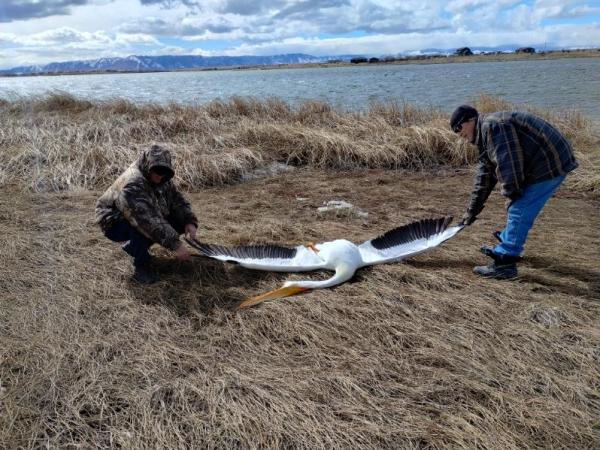
Pelicans numbers aren’t closely monitored in Wyoming, where they’re classified as a “species of greatest conservation need” because their breeding range in the state is relatively limited. Populations have been on the upswing for decades — but only after “precipitous” historic declines, Wyoming Game and Fish Nongame Bird Biologist Zach Wallace said.
“Similar to peregrine falcons and bald eagles, they were affected by DDT,” he said. “That whole situation with eggshell thinning.”
As populations have bounced back, pelicans have established new breeding colonies in Wyoming, according to the most recent account of the species.
While other states have more regularly encountered pelican-related damage to fisheries, Alco Rod and Gun Club’s depredation permit was one of only two that the Fish and Wildlife Service has issued in Wyoming, according to spokesman Joe Szuszwalak. The other, he said, is issued to the U.S. Department of Agriculture’s Wildlife Services, just giving that agency “general” permission to take out damage-causing pelicans.
Although Alco Rod and Gun Club’s pelican-killing days look like they’ve run out, Kontaxes plans to push the issue.
“We’re going to contact some people higher up,” he said. “We’ll certainly apply for another permit. We’ll see what happens.”
But the Fish and Wildlife Service has already signaled its likely response if the club applies for the same type of permit using the same justification.
“Given this new guidance, it wouldn’t be a renewal,” Szuszwalak said.

What about the lowly Sandhill Crane? Wyoming is only state I know of that allows SC take. Beautiful birds that don’t deserve to be hunted. Have you ever ate one? How was it. Some private gun club telling the state how to manage a problem they created. What a farce Wyoming is becoming.
Shooting Pelicans is wrong and not the answer for this problem. Just like the killing of other species, when you open a slot by killing an existing bird, others follow to fill the “gap”. This will just be a continual killing field with no end in sight. There are other ways to discourage the birds from this lake beyond lethal methods. Don’t renew their permit to take these majestic birds.
As a kid I used to be fascinated by the soaring and fishing white pelicans on Ennis Lake — before the houses –on the Madison. Incredible fishing, lots of pelicans. This outfit must not be managing their lake correctly if they rely on killing the birds.
At present, the National Eagle Repository in Denver is parting-out between 3,000 and 4,000 Bald and Golden Eagles per year! (The feathers and talons are given to groups of Native Americans and museums.)
https://www.fws.gov/program/national-eagle-repository
This tolerated “take” is largely the result of kills attributed to the operation of wind farms. So the management of artificial constructs, like fishing impoundments and wind farms, is just a matter of whose ox is being gored and the political interests behind those activities.
I can see them transitioning into ALCO PELICAN VIEWING CLUB. Charge $20 for 2 hours of pelican viewing. Give the elk feeding tour competition
If this Alco fishing club and it’s headmasters didn’t take such a hillbilly approach to the problem, the neighbors be damned plus apparently kill or wound many more birds vs. the 30 Pelican limit, they might still be able to utilize the Permit. I suggest that the fishing club transition from trout to bottom feeding catfish as they would be much harder for the Pelicans to grab n’ eat
Contrary to what Messrs. Kontaxes and Rozman think, there is no right to kill native migratory birds. That’s why a MBTA permitting system exists. Nor do they have a right to deprive residents the pleasure of living with white pelicans, many of whom travel more than 1,000 miles to get here each spring.
The duo appears to have violated the terms of the club’s 2024 permit by shooting more – considerably more – than the limit 30 pelicans, by leaving dead and dying birds on the lake, and by failing to deploy non-lethal hazing. Not to mention being inconsiderate neighbors by incessant shooting, and by indirectly depopulating three nearby National Wildlife Refuges.
Non-lethal hazing methods remain an option for next year. This requires a tad more thought and skill than picking up a shotgun.
Let’s hope the new USFWS policy ends the latest Wyoming episode of ecological vandalism. As ever, thanks to WyoFile for covering this and similar issues.
Agreed!
I’d like to know what non lethal deterrents were used prior to resorting to killing the birds.
There are several of these methods, used effectively by airports all over the USA.
How about we try those instead of whining about being prohibited from killing?
In the end, attempts to manipulate nature and the natural order will lead to negative knock-on effects and will ultimately fail. Hubris is a smelly cologne.
Good. The whole justification for this just sounds ridiculous. I get why they aren’t happy about the pelicans, but they created their own false habitat for fish for their recreational fishing experience. That to me doesn’t warrant killing pelicans because they are predating on your own private fishing preserve. It sounds utterly absurd that shooting pelicans for this purpose was allowed in the first place.