


Ahead of Wyoming’s primary election, Freedom Caucus member Rep. Jeremy Haroldson said he had a bad feeling.
The Wheatland lawmaker ran unopposed this year while most of his fellow caucus members and allies faced Republican opponents in the primary. Haroldson’s hunch, he told WyoFile this week, had to do with “the amount of mailers going out in all these races” that spun “a whole lot of misinformation, or skewed information.”
“Hence, in a way,” Haroldson said, “I had a sinking feeling it may go poorly” for his bloc.
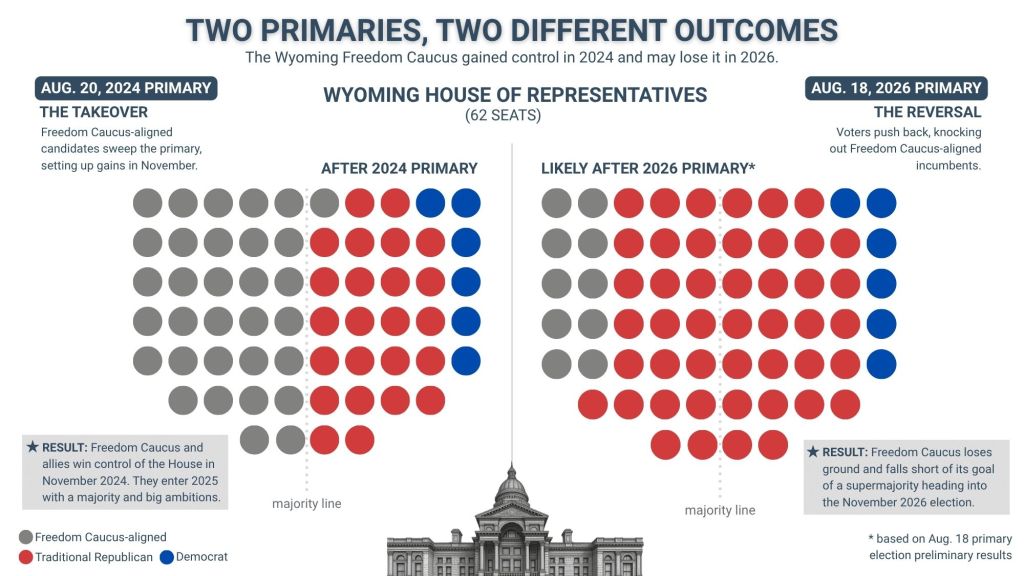
And it did. Voters across the state supported candidates who campaigned on traditional, middle-of-the-road conservative issues like business, education and healthcare. The result was a near complete ousting of the hardline group of Republicans who won control of the state House just two years ago.
Without an opponent, Haroldson is set to begin his fourth term in 2027. But his return to the House will be without most of his Freedom Caucus allies. Thirteen of the group’s aligned incumbents lost their reelection bids. Four more representatives lost their attempts to join the Senate. And over a dozen other candidates aligned with the caucus, including some political newcomers and some former lawmakers seeking rematches from 2024, were also defeated. As for legislators associated with the caucus who sought higher office in the executive branch, they, too, lost.
The results fell well short of the caucus’s goal to win control of the Senate and grow its House presence to a supermajority. Instead, the caucus will likely have 10 reliable votes in the House and five in the Senate come January.
The Freedom Caucus entered campaign season on the defensive in some ways. Most of its top priorities failed during the recent legislative session, including proposed budget cuts that faced significant public backlash. Plus, several caucus members and allies were embroiled in a controversy, known as Checkgate, involving the delivery of campaign donations on the House floor, which is currently under criminal investigation. After a legislative committee determined the checks did not constitute bribery, the House unanimously voted to approve a report that said: “the conduct that occurred on the House floor was undesirable and must never occur again.”
Few, however, believe that Checkgate, and a raft of narrow legislative defeats, solely account for the caucus’ dramatic reversal of electoral fate and loss of power. What explains the rest of the story depends on who you ask. Caucus opponents say the bloc’s priorities were simply, fundamentally unpopular with most of the state. Supporters say the media represented the Freedom Caucus’ agenda as more extreme than it actually was. Both sides agree, however, that opposition to the caucus was better organized, and funded, than it was two years ago when the hardline faction ousted several longtime Republican incumbents and won control of the House.
In the last year, several political action committees formed to directly oppose the caucus, including Common Sense Republicans for Wyoming, which reported spending more than $95,000. Other newly formed PACs championed specific issues, like public lands. The Protect Wyoming PAC was catalyzed by legislation from Sen. Bob Ide, a Freedom Caucus ally in the upper chamber, that called on Congress to turn over 30 million acres of federal public land to Wyoming.
Meanwhile, established groups, like Better Wyoming, worked strategically on voter education and community engagement. Americans for Prosperity, a veteran conservative group, reported spending nearly $286,000 opposing several Freedom Caucus candidates.
“Those that were trying to defend the Freedom Caucus were very few,” Haroldson said. “And those that were trying to defeat the Freedom Caucus were many.”
Sen. Cale Case, a Lander Republican, sees things in a different light.
“The good guys just got better organized,” Case told WyoFile.
Case triumphed over his primary challenger, Lisa Wilson, despite more than $17,000 in attack ads against him paid for by Make Liberty Win. The Virginia-based political action committee spent more than $549,000 largely backing Freedom Caucus candidates. Still, most of those candidates lost.
“People were very ready for the change,” Case said. “And it seems like they just got tired of those policies when they figured out the implication of them.”
Several Freedom Caucus leaders did not return WyoFile’s multiple requests for comment, including Rep. John Bear, R-Gillette, Rep. Rachel Rodriguez-Williams, R-Cody, and Jessie Rubino, the Wyoming state director for the State Freedom Caucus Network.
The media and negative campaigning
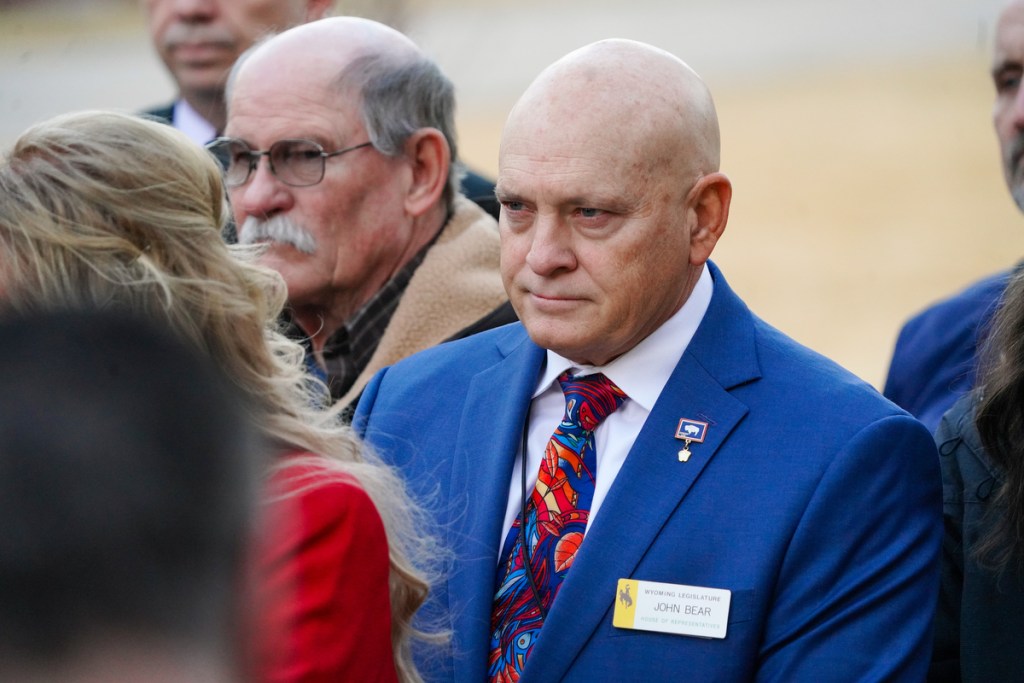
Bear previously chaired the caucus and has remained one of its most prominent leaders, including as chairman of the House Appropriations Committee. He lost his reelection bid in Gillette’s House District 31 to Douglas Moore, a longtime energy industry manager and political newcomer.
Several days after the election, he made an appearance on Cowboy State Daily’s Morning Show, where he said “I don’t think it’s too far-fetched to consider” the outcome of the election “to be an anti-Freedom Caucus vote.”
“The question is how did we get there?” Bear said, before pointing to several things, including anti-Freedom Caucus campaigning and the media’s coverage, which he said “leans left.”
During the session, when Rebecca Bextel, the woman at the center of Checkgate, handed over text messages to the House Investigative Committee, they included correspondence with Bear.
“I’m not planning on announcing until after the session,” Bear told Bextel sometime in January. “Too much media on my cuts to the budget.”
In his interview with WyoFile, Haroldson also pointed to what he sees as unfair media scrutiny.
“I’m going to be 100% honest with you. The media was against the Freedom Caucus. There was a lot of slanted media coverage through the session,” Haroldson said. “There was a lot that came out of that, and in all reality, things like Checkgate didn’t help anyone. Was that legal? 100%. Was that blown out of proportion? Absolutely.”
Haroldson also pointed to specific coverage.
“I think more than anything, what hurt the caucus is how the media portrayed the entire conversation around the budget when they say things like ‘University of Wyoming budget slashed.’”
The Freedom Caucus pushed to reduce the university’s block grant by 11%, or $40 million, which Haroldson said is “a long ways from being a slashed budget.”
Haroldson said the caucus’s work on the budget was about “asking questions and challenging the status quo.”
“Why would we not kick the tires on this?” he said.
Bear told the Morning Show that while negative campaigning gets a lot of complaints, it works, including against the caucus.
“The voters responded in a positive way to that negative campaigning, and they did in 2024 as well,” Bear said. “We held no punches back when we were illustrating the things that Republican legislators were doing that were antithetical to what the people of Wyoming desired.”
Two Republican lawmakers sued the caucus’s political action committee for defamation in 2024 after it sent text messages and mailers claiming they had voted to remove former President Donald Trump from the presidential ballot. No such vote occurred in the Wyoming Legislature, but the case was dismissed in May when a district court judge determined there was insufficient evidence to indicate the PAC had made statements with actual malice.
During this election cycle, Make Liberty Win spent more than $14,000 in digital ads, door hangers and text messages to voters supporting Bear, but it was “too little, too late,” he told the Morning Show.
“The negative stuff on me started right at the end of the session,” Bear said. “And by the time these campaigns were being started on our end — and this is an indictment of how conservatives campaigned — we were too little, too late in defeating those negative messages, and so we’ll have to learn from that.”
Different groups
Bear also named Rep. Liz Storer, a Jackson Democrat, and accused her of “funding candidates that were on the Republican side, as well as PACs that were attacking Freedom Caucus members.”
State campaign finance records show that Storer personally donated a total of $5,500 to candidates across Wyoming, including Bear’s opponent and Robert Short for secretary of state as well as the Democratic Caucus of the Wyoming Legislature.
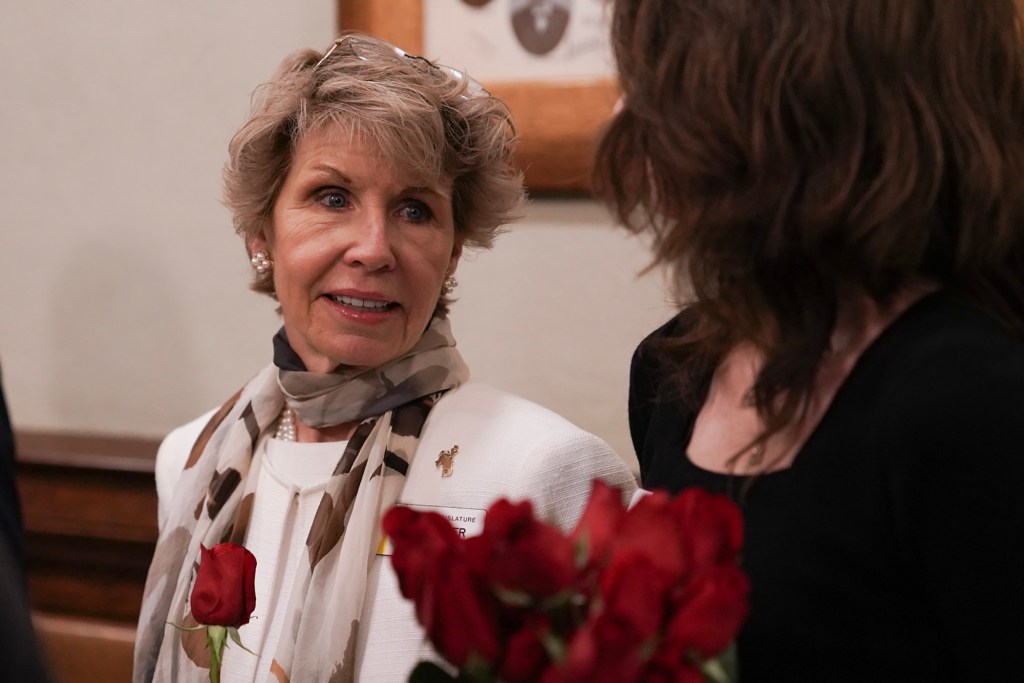
Storer is also president and CEO of the George B. Storer Foundation, which has funded an array of causes and organizations over the last 70 years.
(Editor’s note: The George B. Storer Foundation is a financial supporter of WyoFile. The foundation has no role in WyoFile’s editorial content.)
“I think there are a lot of groups that did a lot of things in the election,” to oppose the caucus, Storer said, “I probably don’t even know all of them.”
As for the Storer Foundation, she said, it “has worked for a long time to engage voters, with the idea that to get good policy done, sometimes you need to change who’s sitting in the seat,” Storer told WyoFile.
The foundation, for example, is a key funder of Better Wyoming, a progressive nonprofit that has focused much of its community organizing on voter turnout.
As to the Freedom Caucus loss this year, Storer pointed to voter turnout, which saw about 27,600 more residents cast ballots than they did in 2024, when the caucus was largely successful. “Primaries tend to get people that are out on the fringes, on both sides,” Storer said. “So if more people vote, it just means more people who aren’t quite so far out there are going to vote, and that will shift the outcome.”
Nate Martin, executive director of Better Wyoming, pointed to what he called the “Achilles’ heel” of the Freedom Caucus.
“They don’t support policies that are actually popular in Wyoming,” Martin said.
Martin, who’s married to Rep. Karlee Provenza, a Laramie Democrat, said the caucus proved its efficacy as the opposition party “by picking holes in the policy agenda of the people who were in charge.”
But it was given a different task in 2024 when it won control of the House, Martin said.
“When it actually came time to govern, and they said they were going to defund the University of Wyoming and abolish the business council and take local control away from public school districts and not give state employees raises, people in Wyoming were like, ‘What the hell are you talking about?’” he said.
As such, Martin said, it became important for Better Wyoming and its associated organization, Better Wyoming Action + Research, to “articulate the harm that the Freedom Caucus as a group does.”
Those efforts included mobilizing more than 200 volunteers across six of the state’s communities “to write handwritten postcards talking about the Freedom Caucus and how they vote,” Martin said.
The group also launched a website that used voting records, formal membership and endorsements to identify Freedom Caucus-aligned lawmakers and candidates.
“If you put up a big billboard that just says, ‘Vote out the Freedom Caucus,’ not everybody knows who the Freedom Caucus is,” Martin said. “The billboard isn’t necessarily targeting people who are going to vote, and the words Freedom Caucus don’t appear anywhere on a primary ballot.”
The page got nearly 20,000 unique viewers in recent months, according to an Aug. 20 press release from Better Wyoming A+R.
As for Haroldson, he rejected Martin’s characterization of the caucus as being out of step with Wyomingites.
“I haven’t met a single grandmother who’s upset that their little girl, their granddaughter, is not going to have to worry about a man walking into the locker room. I haven’t met a single one yet,” Haroldson said. “I haven’t met a single parent who’s like, ‘You know, what I really want is less parental rights when it comes to education. I haven’t met a single person yet that’s sitting there saying, ‘You know what, I think it’s okay to have men competing in women’s sports in the state of Wyoming.’”
After the election, the Freedom Caucus posted a statement on its Facebook page titled, “The WYFC Is Not Going Anywhere.”
“Last night’s results will not undo the policy wins we’ve delivered on behalf of the people,” the statement says, pointing to tax cuts, school choice, voting restrictions and anti-trans legislation that the caucus helped usher into law.
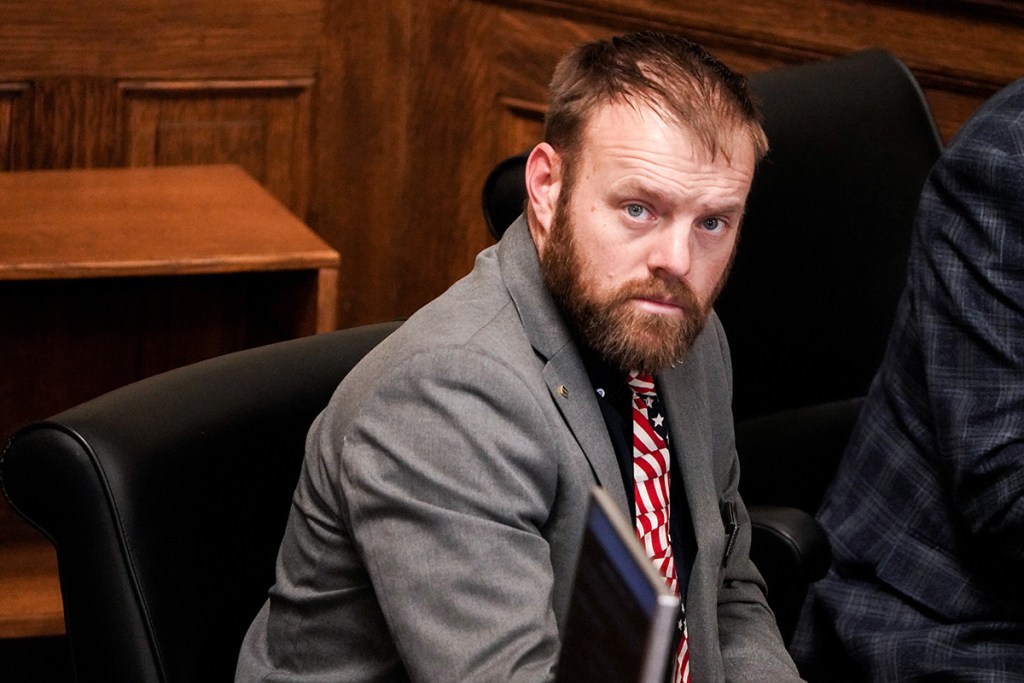
As the sole remaining caucus member with House leadership experience, Haroldson is effectively left to carry the torch in the Legislature. He currently serves as speaker pro tempore, the second-most powerful position in the House, which presides over the lower chamber in the absence of the speaker.
Asked about what’s next, he said, “right now there’s a lot of introspection” and asking questions.
“What are we supposed to do? What does it look like moving forward? What did we do well? What did we do poorly?” Haroldson said. “What do the people of Wyoming want?”


I sure will miss the cem trail discussions.
This article’s headline asks: what cost the Wyoming Freedom Caucus its power?
Answer: Rebecca Bextel.
“Why would we not kick the tires on this?”
If you watch the legislature on YouTube, you get used to hearing FC members parrot these meaningless cliches. Haroldsen has no substantive ideas
Pathetic that these people are still touting “keeping men out of women’s sports” as their main accomplishment. Newsflash, NO ONE CARES. We want serious legislators who can offer serious plans to address Wyoming’s many serious issues — medical deserts, youth brain drain, lack of affordable housing, an economy that is not diversified, underfunded public schools, etc. Not more talking points from their Virginia-based headquarters.
What’s wrong with the Freedumb Caucus can be summed up in two words. They’re nuts.
Short and sweet. I like it Ken!
Not a single LGBTQ member caused Wyoming health insurance rates to go up. Not a single undocumented person caused Wyoming gas, electric and natural gas prices to rise. Not a single “woke” person caused Wyoming food prices to increase. If you want to blame minorities for your ills, look up; look at the millionaires and billionaires who run this country. That is the most dangerous minority!
Specific minorities were Politicians and Bankers, Louis.
Debt spending to the tune of 40 Trillion, and Bankers at the Federal Reserve printing money to cover that spending.
She’s right
The freedom caucus always talked about doing “what the people of Wyoming wanted”. Obviously, they didn’t read the room because during this last primary election the people of Wyoming wanted them out. I believe one of the main drivers of this groups demise was pure arrogance on their part.
The Freedom Caucus tried to frame Wyoming as somehow flawed. Then they misled us as they tried to destroy long-standing laws and policies that protect our personal freedoms. It’s not the bad press that caused them to lose. It’s their dishonorable actions that go against our heritage and culture.
They lost because 7 million in data center, nuclear industry and Democrat money was spent against them lying about their voting records. Well done!
Freedom caucus was terrible for lobbyists. Now we can get back to business funding Gordon’s carbon sequestration slush fund and storing nuclear waste in Wyoming. No results, more taxes and heath detriment to Wyoming. Wyoming should be Colorado’s nuclear waste and data center dumping ground. After all, it’s military and government workers here anyway.
I hate to burst Jeremy Haroldson’s bubble but transgenders using women’s bathrooms is not what most Wyoming voters think about. It’s a fringe issue brought up when politicians don’t have anything else on their list to divide people and get them riled up. For the most part, I think, voters want a capable State government that delivers services and a reasonable cost. Plowed highways in the wintertime, community services, good schools and such. I would guess that voters in this latest election like things the way they are and don’t care to have bomb throwers in the legislature.
Rep. Haroldson missed the boat by thinking his crew understands Wyoming. If you think hunting on public land, supporting UW, fighting cheat grass and funding our kids school activities can be taken from voters without us being upset at you, you’re sadly mistaken. I think it’s clear, Freedom Caucus members don’t know Wyoming and that is the clear cause of their defeat. A majority of Wyoming Republicans in a low turnout primary is not a mandate for great change!
It’s members and it’s extreme conservative politics.
Checkgate may have been “legal” but it sure wasn’t right. I’m sure if someone who thinks like I do had tried to get on the floor after adjournment to talk to and try to influence any legislators, that wouldn’t have gone well for that person. Ethics doesn’t seem to have meant much to many ousted legislators.
I’m pretty sure that the very few elected Democrats in Wyo would take issue with the claim that the bias of the state’s media is left of center.
FC members have shown to be losers, worshippers of Chumpstein, sellouts to both our state and country, not too bright, ulterior motives, one of their biggest issues is chemtrails. Carpetbaggers that wanted to be a big fish in a small pond. We all have that crazy uncle lurking in the shadows but most of us don’t want that sick puppy running our government. Good riddance to these flea bitten mutts.
Introspection is a natural process. Here is an example from 1962. Correspondence from Jack Gage (D) and Governor of Wyoming to Steve McNichols and Governor of Colorado.
December 31, 1962
The Honorable Steve McNichols
Governor of Colorado
State Capitol
Denver, Colorado
Dear Steve:
As one of my last official acts, l wish to issue to you one of
the most sincere invitations l have ever extended to anyone. This is
an invitation to a dinner for just two at which the main dish will be
lame duck, stewed in its own juices. There are are very few people who
can make lame duck palatable end even a smaller number who like the
stuff even when properly prepared. I doubt if you or l do, or will, want
a second helping, but the conversation at such a dinner is what makes
it a gala and hilarious affair. For instance, you can ask me how in the
world it happened, and I can tell you that I do not know; then l can ask
you the same question and get the same answer. This alone could go on
for hours.
You will note that there is no date set for this dinner, the reason
being that l do not want to attend either.
Happy New Year!
Sincerely yours,
Jack R. Gage
Governor of Wyoming
Simply put, we can’t stand you and your attempt to control every aspect of our lives. Good riddance.
First time I ever listened to Jake and I had to listen to a lot of analysis to get to where I think people landed on these “conservative” issues. When out of one side of your mouth you claim you want less government and less intrusion on one’s life and then go about passing the most intrusive abortion measures on the planet, one might start to figure out that your ideas are false.
The Freedom Caucus claims the media is left bias and Bear seemed to even implicate CSD in that mix is just another example of their obtuse view of the media in this State. Even Jake and Clair’s eyes got bigger when they heard him when he uttered his nutty take. The Freedom Caucus opposes any view that is not their own and is bent on removing any voice of opposition to their ideas or methods. They emulate their leader Donald Trump in that regard as he set about to destroy any media that does not profess him and his ideas to be the “best.”
I think those wanting a christian nationalist government after DOBBs came down got out over their skis with those desires and as Wyomingites heard Trump say that he did not know what Project 2025 was and then implemented it when he got elected. The Freedom Caucus was already implementing this agenda and as the people of Wyoming started to see the outcome of those actions they said hey we have had enough of that, so out they went.
I wonder what committees Jeremy Haroldson will be on when the next session starts?
“The Freedom Caucus opposes any view that is not their own and is bent on removing any voice of opposition to their ideas or methods.”
Greg, you do realize that the same thing can be said about the Democrat Left, right?
No, not even close.
Wyoming dems are in the minority and, by definition, have to work with people they disagree with to pass bills. I’m skeptical of whether the Freedom Caucus has that ability
It can be said, but its not true.
Once the grifter Rush Limbaugh proved the right wing will bray at any dog whistle along came Fox News to ensure we are a divided country, so the US/International Oligarchs could rob the US blind. It is pretty evident right wingers have been duped so long, they cannot get out of the hole they dug for themselves and will continue to keep digging.
Talk about sour grapes. No introspection by any FC leadership. Blame the messenger and not the message.
Maybe they lost because almost every bill they passed was poorly written and they were thrown out when faced with legal challenges. A large volume of the FC members and candidates came from outside of WY (i.e., Bear from MO, Ward from IL, Andrew from WA, Williams from CA, etc.) so they looked like carpetbaggers. They took their marching orders (how they should vote on each bill was directed from outside) from some group that FC leadership would not acknowledge. And blaming the media when there’s the CSD that was spreading their message? Talk about a biased media source.
It’s easy to get elected when one doesn’t have a record that can be reviewed. Once the FC members got into office they created a record of bills, legislation, Checkgate, and speech(s) that showed where they stood, their standards, and where they wanted to make the state go. Many of us Wyoming citizens have a more libertarian perspective (if it’s not hurting me and I’m not hurting you — then butt out) and not the christian nationalist point of view that the FC members seemed to be hell bent on implementing.
Our elections are secure, public libraries are not spreading porn, we support UW, our state constitution says that public education dollars should not be used to support private schools, reproductive rights should only involve the mother, doctor and father if he wants to be involved – all others butt out, etc. So many of the FC members and the WY GOP have/had that smug attitude that they knew better and didn’t have to listen to their constituents. Grow up, take some responsibility, and maybe learn something. What a dumpster fire.