
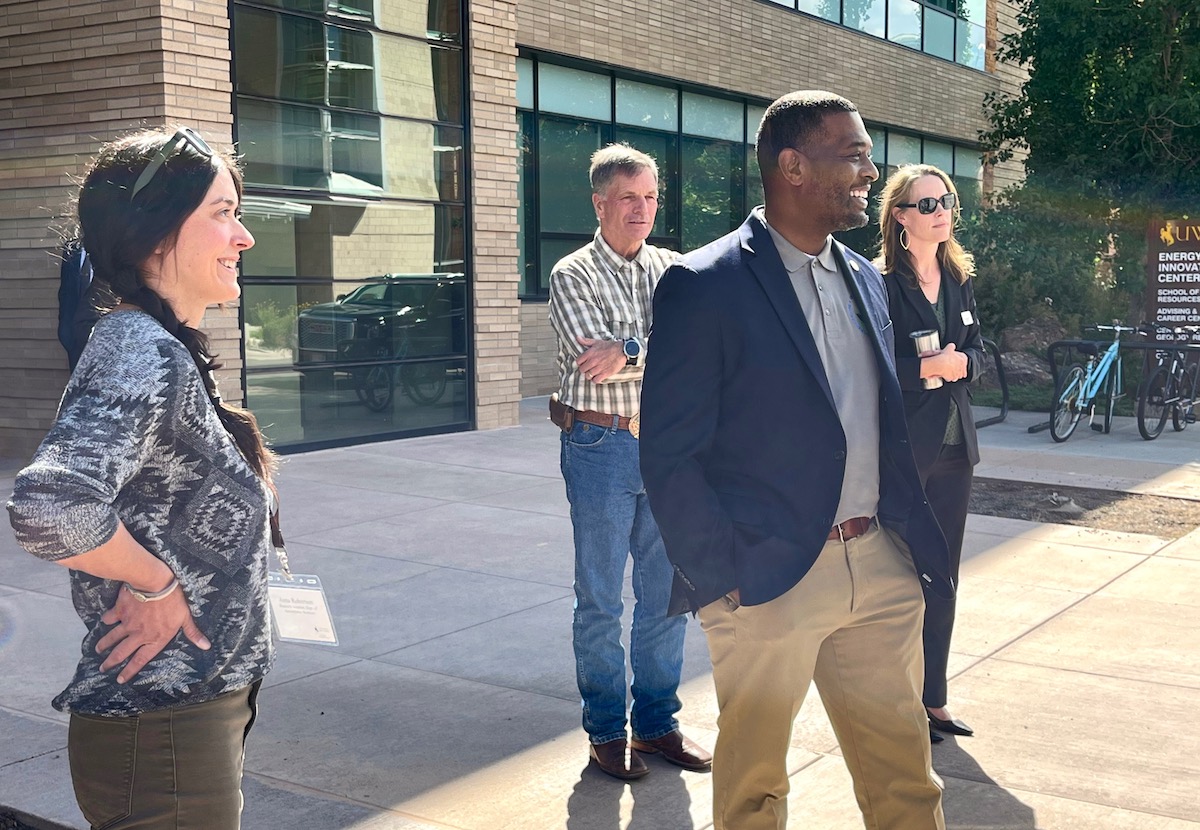
Anna Robertson, associate research scientist in atmospheric sciences in the University of Wyoming College of Engineering and Physical Sciences, Gov. Mark Gordon, former EPA Administrator Michael Regan and UW School of Energy Resources Executive Director Holly Krutka took part in energy research discussions in Laramie on Aug. 9, 2023. (Dustin Bleizeffer/WyoFile)

The University of Wyoming will receive up to $11.2 million in federal support to test deep geologic layers in the south-central portion of the state to determine if they are suitable for carbon dioxide storage.

The university’s School of Energy Resources will lead the 2-year study in collaboration with the U.S. Department of Energy and Williams Companies, which operates the Echo Springs natural gas processing plant south of Wamsutter as well as an extensive interstate pipeline network. 

The study will join three federal CarbonSAFE initiatives now underway at SER. State leaders hope the combined efforts will spawn a new carbon capture and storage industry that helps keep Wyoming fossil fuels in the nation’s energy mix while addressing climate change.

“The location for this project sits within a prolific gas field and, to date, there has been limited data of the deeper geologic formations to help us understand what the entire storage potential will be for the eastern side of the Greater Green River Basin,” said Fred McLaughlin, director of SER’s Center for Economic Geology Research. 

If the geology proves suitable, Williams could capture carbon dioxide from the Echo Springs gas plant, and potentially collect the greenhouse gas from other oil and natural gas sources to store up to 50 million metric tons of the planet-warming gas, according to SER.
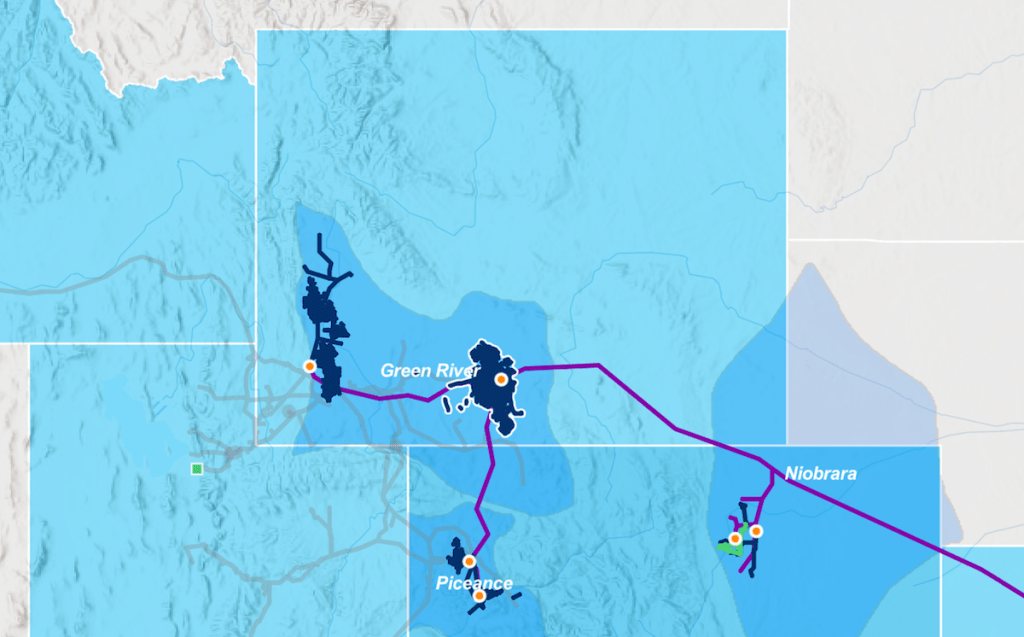
The University of Wyoming will lead a feasibility study of storing carbon dioxide in deep geologic formations near the Echo Springs natural gas plant in south-central Wyoming. (Williams Companies)

For scale, a typical passenger vehicle emits about 4.6 metric tons of carbon dioxide per year, according to the U.S. Environmental Protection Agency.

The SER’s other three CarbonSAFE projects include researching the feasibility of capturing and storing carbon dioxide from:

° The Dry Fork Station, a coal-fired power plant north of Gillette. 

° Calpine’s Hermiston Power Project, a Wyoming-sourced natural gas power plant in Hermiston, Oregon.

° Multiple trona processing facilities and a proposed “direct air capture” project near Green River for the Sweetwater Carbon Storage Hub project.

Researchers hope the four CarbonSAFE projects combined will identify a carbon dioxide storage capacity of 200 million metric tons. That compares to the state’s annual estimated carbon dioxide emissions of 54.6 million metric tons, according to the U.S. Energy Information Administration.

Wyoming is an attractive place to research and possibly deploy geologic carbon dioxide storage in part because the state has established a set of laws and regulations to accommodate the activity. Wyoming is one of only two states with primacy over the federal Class VI injection well permitting process, which is required to inject carbon dioxide underground. 

The Wyoming Department of Environmental Quality, for the first time, began reviewing permit applications this year for carbon dioxide injection wells. Applications have been filed by Texas-based Frontier Carbon Solutions, a partner in the Sweetwater Carbon Storage Hub project in southwest Wyoming, and Tallgrass Energy for its Eastern Wyoming Sequestration Hub in Laramie County.

Dustin Bleizeffer covers energy and climate at WyoFile. He has worked as a coal miner, an oilfield mechanic, and for more than 25 years as a statewide reporter and editor primarily covering the energy...

Join the Conversation

2 Comments

WyoFile's goal is to provide readers with information and ideas that foster constructive conversations about the issues and opportunities our communities face. One small piece of how we do that is by offering a space below each story for readers to share perspectives, experiences and insights. For this to work, we need your help.

What we're looking for: 

  • Your real name — first and last. 
  • Direct responses to the article. Tell us how your experience relates to the story.
  • The truth. Share factual information that adds context to the reporting.
  • Thoughtful answers to questions raised by the reporting or other commenters.
  • Tips that could advance our reporting on the topic.
  • No more than three comments per story, including replies. 

What we block from our comments section, when we see it:

  • Pseudonyms. WyoFile stands behind everything we publish, and we expect commenters to do the same by using their real name.
  • Comments that are not directly relevant to the article. 
  • Demonstrably false claims, what-about-isms, references to debunked lines of rhetoric, professional political talking points or links to sites trafficking in misinformation.
  • Personal attacks, profanity, discriminatory language or threats.
  • Arguments with other commenters.

Other important things to know: 

  • Appearing in WyoFile’s comments section is a privilege, not a right or entitlement. 
  • We’re a small team and our first priority is reporting. Depending on what’s going on, comments may be moderated 24 to 48 hours from when they’re submitted — or even later. If you comment in the evening or on the weekend, please be patient. We’ll get to it when we’re back in the office.
  • We’re not interested in managing squeaky wheels, and even if we wanted to, we don't have time to address every single commenter’s grievance. 
  • Try as we might, we will make mistakes. We’ll fail to catch aliases, mistakenly allow folks to exceed the comment limit and occasionally miss false statements. If that’s going to upset you, it’s probably best to just stick with our journalism and avoid the comments section.
  • We don’t mediate disputes between commenters. If you have concerns about another commenter, please don’t bring them to us.

The bottom line:

If you repeatedly push the boundaries, make unreasonable demands, get caught lying or generally cause trouble, we will stop approving your comments — maybe forever. Such moderation decisions are not negotiable or subject to explanation. If civil and constructive conversation is not your goal, then our comments section is not for you. 

Your email address will not be published. Required fields are marked *

  1. CO2 and its components are balanced continuously by nature. Keeping in mind the competency level of the government agency overseeing this moronic science, there will be a catastrophic release of co2 some future date that will result in wholesale death of all living creatures in the vicinity. Read about co2 release from lakes and ponds killing local life.
    At least it will flow downhill from Wyoming.