Guest column: Not for republication by other media outlets without permission of The Content Lab.
A team of videographers and journalists led by Geoff O’Gara is producing three documentaries on Wyoming subjects, partnering with Wyoming PBS and The Content Lab LLC. Each documentary is, in its own way, a search for the state’s character and heart: a biography of Dick Cheney, the historic Green River Drift cattle drive, and a portrait of the entire state using helicopter aerial cameras. O’Gara is keeping an occasional journal of the ups, downs, and sideways slips of these projects. WyoFile is pleased to post the entries here. Check back for more in the weeks to come.
The year-long process of documenting the Green River Drift – centered around a cattle drive from ranches down along the Green River up into the high country of the Wind River Mountains – is a mixture of high elevations, high anxiety … and, now and then, hijinks.
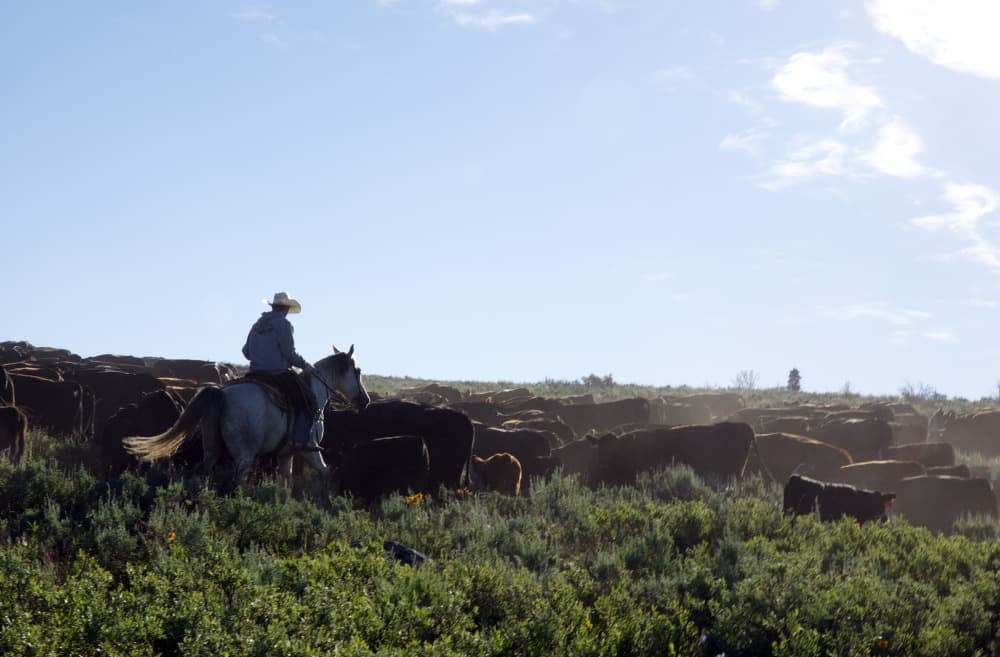
The dozen or so ranches that participate in the Drift pool their cattle and drive them on horseback as much as 100 miles, to the largest grazing allotment on U.S. Forest Service lands. During the summer, the cattle have to be moved on horseback from pasture to pasture to keep the range healthy and get to the best forage. They also have to be “doctored” (for foot rot and other maladies), and scouted daily by riders to see if – or, rather, how many – calves have been killed by grizzlies or wolves.
Recently, 20 or so riders herded the cattle from an area where the Green River bends south toward Squaretop Mountain up over Pinyon Ridge to the Fish Creek area, near the Continental Divide. Up there, Bobby Gilbank spends the summer in a cabin on the edge of a vast meadow, fixing fence, doctoring, riding the range, and reading by lantern at night. He’s one of six riders out there. It’s an old fashioned, solitary working life that few Americans these days will ever experience.

Well, maybe not that “solitary.” A local member of our production team, Clayton Selby, took us up for some time in Bobby’s cabin, and it seemed that night like the stories would go on forever, or at least as long as the Crown Royal held out.
On a Sunday, when riders swept the remainder of the cattle from the Bend up over Pinyon Ridge, we had Louise Johns, a young photographer and rider from Montana, imbedded in the drive shooting video, just as Seonaid Campbell did during an earlier shoot. Zach Turnbull, with the Wyoming Game & Fish Department, took her along as he checked a couple of calf carcasses. Grizzlies have been busy this summer around the Bend – over 20 calves have been lost. We’ll also document the way biologists investigate these kills and deal with problem bears.
Louise and myself and Director of Photography Peter Mallamo squeezed in a couple of visits to the Sublette County Fair as well. One of the issues we’re looking at in the documentary is: Will there be a next generation of ranchers riding the Drift? All kinds of pressures push against it: the tough economics of cattle, opposition to livestock on public lands, a growing population of predators, and the conversion of many Wyoming ranches to vacation and second home retreats. None of that is as important, though, as finding young people interested in continuing this life and the hard work that comes with it. So, we’re spending time with young riders like Jillian Walde, and the even younger ranch kids who show their animals at the fair.
Okay, you’re probably wondering: What about the beaver barf? That’s what you’ve tuned in for…

My route to the high country was in a crammed Ranger 4-wheeler with Clayton and Peter Mallamo. Whether on horse or wheels, ranchers always have a canine or few along – working dogs, herding, sniffing out bears, and eating on the fly. Clayton’s dog “Crow” got a little raw beaver the night before, and he was riding on the Ranger’s bed behind us. Unfortunately, he was balanced on my backpack at the moment when the beaver got the better of him. I’m calling it barf, but it came out both ends.
Perhaps that explains why late that night Bobby Gilbank, deep into the Crown Royal, still had the presence of mind not to offer a place for me and my bedroll in the cabin. The tent, and my backpack, would be a good distance off. Thanks, Crow.
Fine with me. You sleep like a baby that close to the stars – “nature’s soft nurse,” as Shakespeare put it – and the whiskey only makes it deeper. I didn’t even notice the smell off the backpack, though I might hope any curious bear would, and choose a less rancid meal somewhere else.
The wolves do a little singing in that high country, but the next thing I heard, at about 4 a.m., was Bobby howling outside the tent: “Coffee’s ready, boys!” Time to bring the horses in and get started on the day.


For earlier posts please visit The Content Lab.To learn more about The Content Lab, please visit this website.