


Lawmakers went too far when they added last-minute amendments to a bill stipulating conditions for “limited mining operations” on state trust lands, creating “constitutional consequences as to how state lands are managed to help fund schools,” Gov. Mark Gordon said this week.
Gordon vetoed Senate File 44 – Limited mining operations-amendments on Monday, noting the bill was modified late in the budget session in an attempt to satisfy an outpouring of opposition to a potential gravel pit at the base of Casper Mountain. Stipulations to increase the minimum “setback” between mining operations and occupied dwellings, as well as a requirement to obtain a “conditional use permit” from counties, would improperly shift management of trust lands from the state, the governor said.
“Statutory changes are not the proper place to address specific concerns for individual operations,” Gordon wrote in his veto letter. “While Wyoming seeks to manage her state lands cooperatively with counties and their land use plans, the state is not constrained by them. State lands and minerals are important to our state’s economic well-being and need to be treated the same as other lands in the state.”
Gordon recommended the Joint Minerals, Business and Economic Development Committee review the bill in the interim. Committee members say they’re eager to resume work on the original intent of SF 44 — to increase minimum bonding requirements and expand what type of operations qualify under the limited mining operations exemption — as well as address issues brought to the forefront by neighbors and others opposed to the potential of a gravel mining operation in the Coates Road area of Casper Mountain.
“I agree with the governor’s hesitation with changes made during the recent session,” Sen. Dan Dockstader (R-Afton) said. As co-chairman of the Joint Minerals Committee, Dockstader vowed to work “on a plan for continued work in the upcoming legislative session.”
Meantime, some 3,000 residents and others who recreate in the area are pressing both local and state officials to not only stop the potential gravel mine operation, but for more regulatory scrutiny and a higher level of public participation for such activities prior to leasing and permitting.
“We decided to retire and just enjoy the scenery up here,” area resident Walter Merschat told WyoFile. “Now we’re facing crushers and bulldozers, plus all the heavy duty trucks that go up the road to pick up the gravel.”
“It just boggles my mind that all this could disappear,” his wife Sharon Merschat added.
New attention to mining operations
Senate File 44 was originally crafted as part of a larger legislative effort to streamline and reduce regulations across a broad spectrum of businesses in Wyoming. Lawmakers sought to expand the state’s limited mining operations classification, which allows for a rubber stamp approval of gravel and other non-coal mines smaller than 15 acres.
The bill would have included gold, zinc, lithium, copper, or potentially, rare earth elements mining operations under the classification.
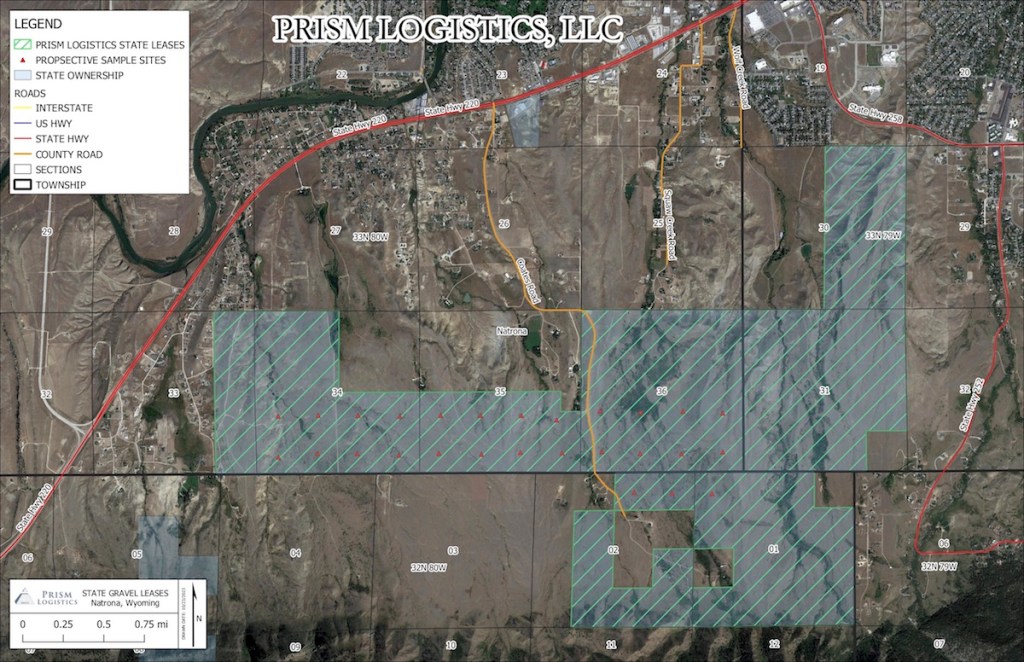
The regulatory tool, which is administered by the Wyoming Department of Environmental Quality, applies more broadly than to just state-owned lands, but state lands became a focus when Coates Road residents learned that several “school sections” in the area were leased to Prism Logistics to explore the potential for mining gravel.
What are state trust lands?
Upon granting statehood in 1890, the federal government bestowed some 4.2 million acres of “state trust lands” to Wyoming, and it currently manages about 3.4 million acres of trust land. The Wyoming Constitution prescribes that the primary use of those lands, which are scattered throughout the state in a checkerboard pattern, is to generate revenue to support public schools.
The Office of State Lands and Investments commonly leases those lands — often referred to as “school sections” — for grazing and industrial development such as mining and oil and gas drilling.
The leases were granted by the state early in 2023. But neither the Office of State Lands and Investments nor DEQ, under the limited mining operations rule, required a public notice. Residents didn’t learn about the proposal until they saw heavy equipment digging exploratory holes.
“I’m not sure that DEQ really has their thinking hat on,” Walter Merschat said, “because they seem to be somewhat nonchalant about this; if you sign a paper, give them a permit.”
When he heard from concerned constituents, Rep. Steve Harshman (R-Casper) offered amendments to SF 44 that would have required the Office of State Lands and Investments to conduct a review of state lease applications and notify the public. But those measures, as well as a requirement to obtain approval from counties, threaten to cede powers that should remain with the state, Gordon’s veto letter said.
“I think there needs to be a little more scrutiny before these things get put on [the Office of State Lands and Investments’] consent list,” Harshman said. “There’s got to be a way for more public notice and debate.”
No mining proposal, yet
So far, there is no formal proposal to move forward with mining gravel in the Coates Road area, Prism Logistics Manager Kyle True said. However, preliminary testing indicates a good “resource” of gravel, and he hopes to submit a mining plan to DEQ later this year.
That’s when the company will have more detailed information to share with the public and respond to concerns, True said. He’s also asking county officials to host a series of public meetings.

“I’m surprised at the speed with which this has escalated,” True told WyoFile on Monday, referring to neighbors who are collecting signatures to oppose mining in the area and who have flooded state and local offices with phone calls, letters and emails. “We’re going to need to do some education.”
True has also been responding to inquiries from concerned neighbors, and sometimes correcting misinformation, he said. Prism Logistics has obtained exploratory leases on eight separate state sections in the area. However, any gravel mining operation that might be put in place will not cover an entire state section, he said. It would be limited to fewer than 15 acres.
Meantime, residents worry about the prospect of multiple gravel pits and the potential for mining to disturb springs and a shallow aquifer in an area where households depend on water wells.
There are an estimated 244 water wells in the area for both domestic and livestock use, resident Jason Knopp said. “They’re all in that shallow depth of 10 to 15 feet deep, so this entire mountainside where they want to dig is our aquifer.”
CLARIFICATION: This story has been updated to reflect the current acreage of “state trust land” in Wyoming. – Ed


Mr. True says he needs to “educate” the residents near his planned mining operation. I think he perhaps needs to educate himself. Mr. True, hire an impartial hydrologist and find out how your planned project will really impact the area. Then lets talk about education.
I might add, I am a petroleum geologist and know how reservoirs (aquifers) work. I am not focused on noise and dust, my concern is preserving Wyoming’s valuable water resources.
I don’t agree to the gravel pit plan. There should not be no gravel pit, That’s going to make the land and Casper look ugly and make lots of dust everywhere. who wants to visit a town that has a gravel pit. Don’t destroy Casper’s beauty with a gravel pit.
State lands are to benefit the state and her people. They benefit us from mineral royalties that go to the foundation trust account and keep your personal tax burden some of the lowest in the nation. If the state lands are not put to work the loss of revenue will be recovered from you in other ways. Enjoy the benefits of low taxes from minerals, unless it’s next door. If you bought land next door you did or should have known that this could happen. I’m fairly certain it was state trust land long before any of the current owners were there. If everyone was in the not in my backyard camp, you’d be paying 8% sales tax and have so many mills on your property tax you would lose count. From the chorus of discourse over a gravel mine that will have daylight hours you would think it’s A propose 500,000 barrel refinery.This will be approved in the name of money and industry, despite your idyllic dreams fancying a windswept prairie as your slice of heaven.
Ezra’s right these almost always get approved. The exceptions are when the opposing parties can submit evidence that the gravel pit will be a safety hazard or cause harm to the aquifer which neighbors are getting their domestic and livestock water from. That is why I emphasized that public hearings must be held at which hydrologists – registered geologists licensed to practice in Wyoming – present their results of a hydrologic study of the ground water resources and their professional opinion on whether or not the gravel pit(s) will cause interference with prior existing ground water appropriation permits. DEQ Land Quality must have consultant hydrologist studies presented to them prior to the mining permit(s) being issued – and, they need the opinion of the State Engineer’s Office about the potential damage to ground water resources. Myself, I would attempt to locate the gravel pits as far away from residential housing as possible in order to avoid conflict – it could be several miles. One would think that would be a no brainer but I just drove by a county gravel pit operating within 300 feet of a residential dwelling. The neighbors to the proposed gravel pits absolutely need to commission a hydrologic study ASAP and demand open public hearings at which the matter can be discussed in an open public forum – the study might show there is no danger to the aquifer and/or the State Engineer’s Office might testify they don’t foresee a problem – but it must be heard.
Wyoming state residents, you are the state. You can change anything that you want to change, despite what the governor or anyone else says.
Thank you Steve Harshman, Curt Meier and Chuck Gray for taking an interest and responsibility in our fight to save this land from turning Casper into a dirty, rock blowing and ugly site at the base of our beautiful mountain. Why would a several generational family member, Kyle True, want to ruin his home town? Mind boggling.
Our water is already limited because of the shallow wells at the base of the mountain. 250+ Water Rights will be affected with lawsuits to come.
The drainage of silica poisoning into the Platte River will be devastating to tourism in Casper. Fishing and kayaking will halt, hotels and restaurants affected. Who would live in Casper after it’s turned into a dirt and rock bowl?
I would like to challenge our Governor and anyone else to visit us on the west side of Casper and ask yourselves… “How would I like a gravel pit in my back yard?” Governor Gordon, you are representing this state, so i am asking you to put a STOP to this catastrophic plan on 5 Sections of land at the base of our mountain.
THERE IS RECOURSE FOR CONCERNED RESIDENTS: When we were concerned about water discharges into Boysen from the Moneta divide oil field – we were successful in getting the EPA in Denver to ORDER THE WYOMING DEQ TO CONDUCT PUBLIC HEARINGS ON THE WATER DISCHARGE PERMIT. They were trying to renew the permit without addressing our concerns about discharge water quality.
DEQ can conduct open public hearings in Casper on the mining permit which will be required. The last thing Mr. True and DEQ want is the nightmare of open public meetings with the concerned residents in the room. The concerned residents should adamantly demand open public hearings, write letters to the paper, go on TV, bombard the Governor’s Office with demands for public hearings, communicate with Land Quality Division of DEQ directly about open public meetings and don’t back down until you get a commitment for the hearings. The Governor can order DEQ to conduct the hearings with a simple phone call. Doing so will refute the folly of SB 44 which attempted to deny the public’s right to participate and voice their concerns. And don’t forget your County Commissioners although Mr. True may have considerable influence over them and they don’t want to get involved. However, the Commissioners may take the opposite view and say they too were denied the right to review the gravel pit permit application under provisions in the Natrona County Land Use Plan – that would be a good scenario if the Commissioners would join the adjacent residents in demanding an open public hearing – lots of votes for elected officials backing the concerned neighbors.
We handled a contentious gravel pit project north of Thermopolis utilizing state land use statutes and County land use plans via a completely open public process, I mailed certified letters to the neighbors, we advertised in the paper the upcoming public meeting, we accepted public comments in all forms including written, phone calls and testimony at the public hearing. We conducted a cooperative public hearing with DEQ and the State Engineers Office representing their departments. It was a completely open public process with full participation and went very well.
What a contrast with these State school section leases. It almost appears like the public has been denied their right to participate in the decision making process. Why should projects on State lands be fundamentally exempt from land use changes and the ability of the Commissioners to add conditional use restrictions which address the concerns of the neighbors. It doesn’t make sense – one set of rules for private land and minimal public involvement for State lands.
And yes, shallow water aquifers are a major concern – one that needs to be fully addressed by the State Engineer’s Office. Mining activity can easily dry up shallow ground water wells – which are permitted. When the ground water rights of the neighbors are interfered with, the affected ground water permit holder can file a claim called ” interference with ground water claim” with the State Engineer’s Office which sets in motion a review by hydro geologists. The State Engineer can rule that the pre-existing ground water wells were interfered with – dried up. The only way to prevent this is to have open public hearings where water experts and the State Engineer’s Office submit comments addressing the probability of ground water right interference. But if you don’t have open public hearings the gravel pit can be approved without conditions attached to the mining permit intended to avoid drying up the wells. This is a common occurrence in Wyoming – each district of the State Engineers Office is usually investigating several “interference with ground water claims” all the time. This is a serious matter and cannot be overlooked and brushed aside. Issues like where is the recharge into the shallow aquifer originating from and will the underground flows be impeded must be considered by the experts. We have one shallow perched aquifer here in HSC that is very fragile and has been drained on several occasions by gravel mining operations mostly by WYDOT including one on a school section which created a spring that flows ground water out onto the surface. Someone else holds the ground water rights in that aquifer and at least one interference claim was filed – its called the Arapahoe Ranch aquifer. It does happen folks and it might be a big problem with the Casper Mountain gravel pits – only the water experts can determine if there is a significant potential for interference. This issue must be addressed prior to the mining permits being issued.