

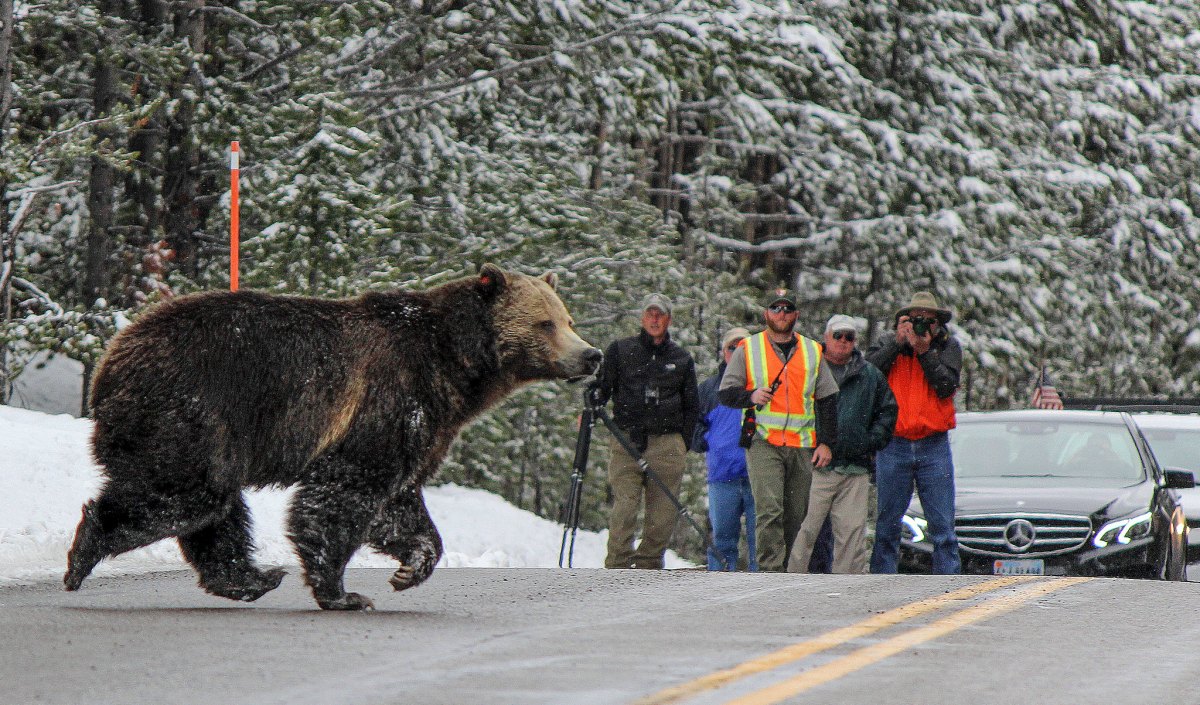
With weeks left to go before many grizzly bears den up, it’s already the bruins’ deadliest year in the Greater Yellowstone Ecosystem in modern times, surpassing records set in 2024 and 2025.
Historically, regional grizzly bear death counts have been higher. For example, biologist Frank Craighead tallied 120 of the large carnivores that perished in 1972, the year after Yellowstone National Park closed the last of its garbage dumps that scores of bruins depended on for food.
Over the decades that followed, wildlife managers and landowners went to great lengths to reduce conflicts. At the same time, grizzly mortality rates plummeted as the population recovered and bears spread out geographically — expanding their range until 2021 when it began to slowly recede.
Wildlife managers call the uptick in bear fatalities somewhat predictable and not a cause for alarm, but the numbers of grizzlies that have died the last three years have each set a modern record. As of Oct. 21, 81 known grizzly bears died in the calendar year, according to a database maintained by the Interagency Grizzly Bear Study Team. And there’s at least one additional mortality that hasn’t been logged yet, bringing the count to 82, according to Wyoming Game and Fish Department Large Carnivore Supervisor Dan Thompson.
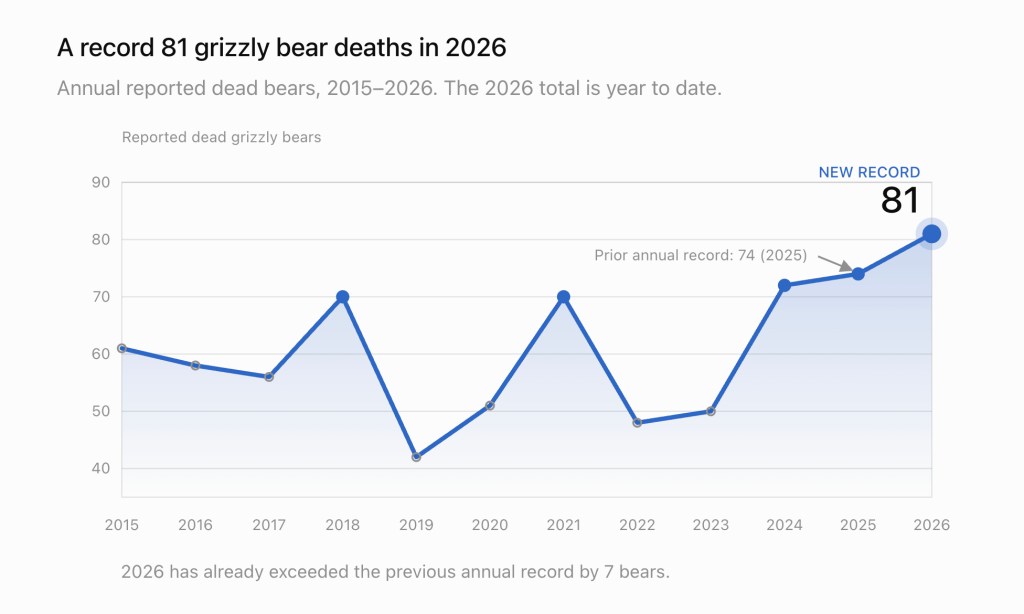
This year’s total mortality tops past highs set in 2025 (74), 2024 (72) and 2021 (70). Although this year was a record, the surge in conflicts and related deaths for grizzly bears paled in comparison to the “unprecedented” conflict-ridden year for black bears in Wyoming and neighboring Rocky Mountain states.
“I don’t have conflict numbers yet, but it was just a more prominent [year] with black bear conflicts, definitely, than grizzly bears,” Thompson said.
In 2026, grizzly bears in the Yellowstone region predictably died from the full spectrum of causes. The majority, about 65% of the 81 deaths logged so far were human-caused — a dynamic that is the norm.
Grizzly bear managers break causes of death into nine categories. Higher-than-average causes in 2026 are listed below:
- Cattle/livestock depredation: 27 grizzlies (1.6X higher than average)
- Accidental: 12 grizzlies (2X average)
- Natural: 11 grizzlies (3.6X average)
- Illegal poaching: 6 (3X average)
Remaining causes — those that are undetermined, from human-bear site conflicts and “human removal,” self-defense killings or mistaken ID incidents from black bear hunters — either occurred at below average rates this year or haven’t yet been calculated.
Interagency Grizzly Bear Study Team leader Matt Gould told WyoFile in an email that the variations in causes of death occur every year and are “natural and often substantial.”
“Drawing major conclusions from a single year is difficult,” Gould said. “That’s why the long-term monitoring conducted by [the study team] is essential for understanding drivers of population dynamics as they relate to sources of mortality.”
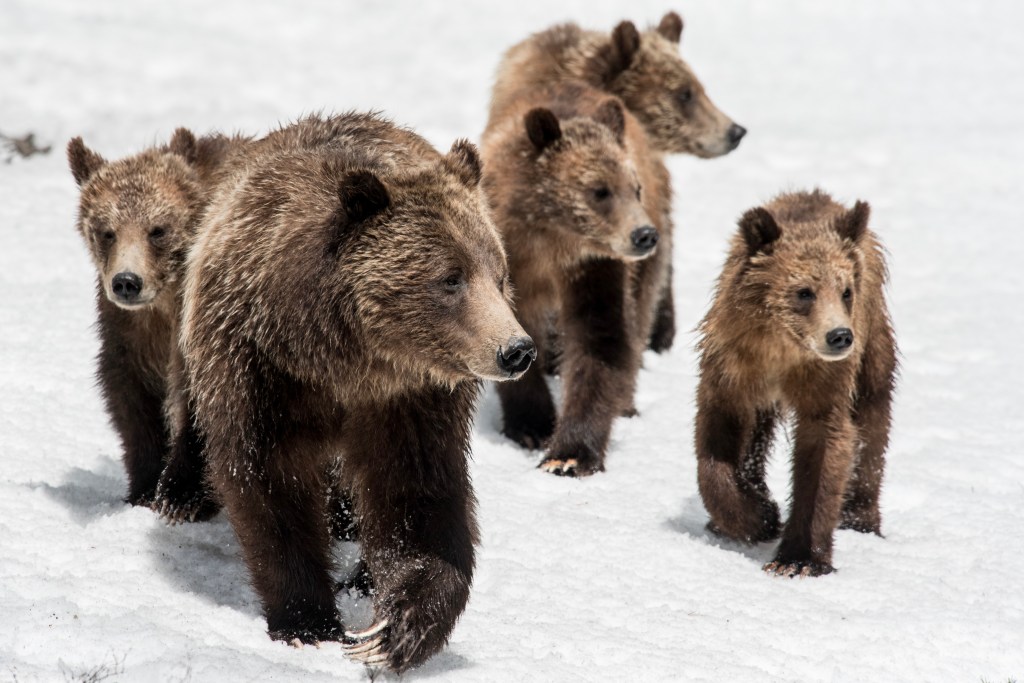
Wyoming Game and Fish’s Thompson noted some silver linings to the rough year for grizzly bears. For one, he said, adult female bears — the reproducers and important drivers of the population — fared relatively well, especially in the ecosystem interior zone known as the “demographic monitoring area.”
“Literally one female had been killed in an agency action in the DMA,” Thompson said. “I think that’s relevant because people think we’re just murdering bears left and right, but that’s not necessarily the case.”
Still, it was a rough year overall for grizzlies inside the 19,278-square-mile DMA, which is the area where wildlife managers estimate the population. The deadliest year for grizzlies inside that interior zone took place in 2025, when 54 known bruins perished. But this year isn’t far off, with 48 mortalities so far.
Another bright spot, according to Thompson: The grizzly bear population has so far absorbed the deaths without declining.
“There’s enough recruitment in the population going on that it compensates for this level of mortality,” he said. “We forget that there are over 300 bears born in the ecosystem every year.”
The now-record counts of grizzly deaths might end up becoming the norm as grizzly densities grow along the ecosystem periphery, Thompson said, though it’s too early to say.
“Maybe this is kind of where we’re at proportionally,” Thompson said. “I still am not worried about the population, whatsoever.”
Former Grizzly Bear Recovery Coordinator Chris Servheen agreed. The nearly 400% occurrence of natural bear-on-bear deaths in the Yellowstone region this year is “interesting,” he said.
“Grizzly bears are self-regulating,” Servheen said. “At higher densities, they tend to have lower subadult survival rates, because males are killing them. Over time, as the population increases in density, the growth of the population will slow because of those adult males and that higher mortality rate among subadults. That’s probably what we’re seeing.”

High mortality numbers alone don’t mean much in regards to the health of the population, he said.
“The key is the trajectory of the population,” Servheen said. “If we saw the trajectory change and start to decline, then I would be really worried about these numbers.”
So far, that’s not the case.
Grizzlies have recovered enough since hitting a low a half-century ago that the ecosystem’s tri-state managers in Wyoming, Montana and Idaho are anticipating a third attempt at “delisting” bears from their threatened status under the Endangered Species Act. In the meantime, the U.S. Fish and Wildlife Service is finalizing a rule that gives the states more management latitude.
Courts have reversed past attempts to delist grizzlies. In 2007, a ruling rejecting delisting hinged on how the decline of whitebark pine — its seeds are a major grizzly food source — would impact the species. In 2017, state jurisdiction was overturned days before the first hunting season in four-plus decades. The court cited concerns about genetic diversity and what happens when population numbers are “recalibrated” by scientists changing the way they count bears.
Recent high grizzly bear mortality figures likely won’t factor much into the delisting decision. Nevertheless, it “doesn’t benefit” states’ argument for more control, said Servheen, who’s been a leading voice against delisting. His chief concern is that anti-predator state politicians influence grizzly bear management, putting the species at risk.


I agree with you Julie, it is really appalling what we do to other animals, our lack of compassion, generosity, all characteristics of a radical human supremacy worldview, which is the root of all problems we cause. Bringing up the “carrying capacity” and bears having “outlived their suitable habitat” is exactly the problem because apparently that concept only applies to other animals. What about our own, “human carrying capacity”? We have by far exceeded it … why are we not talking about that?
It would seem the bear on bear deaths would be a major indicator that the Greater Yellowstone Ecosystem has surpassed it’s carrying capacity. The challenge now is to get people to listen to sensible facts and figures. Reducing human conflicts in sensitive areas has to be a reasonable start and that doesn’t necessarily mean restricting traditional human use.
It is so truly disgusting what humans are doing to the wildlife and the environment. It is pathetic pathetic pathetic who knows what we are going to be leaving our children and grandchildren plus we have to deal with this darn AI business that’s taking away jobs from everybody mind you I’m retired , and it doesn’t affect me, but it is what is happening to our world. ???? it seems this world is all about dollars$$$$$starting from the pharmaceuticals, Animal experimentations, etc. heartbreaking heartbreaking heartbreaking
The “record” will be continually broken until the griz numbers start being MANAGED.
How in the world do people not see that grizzlies have outgrown their suitable habitat??????
Hunts must start next year. And not just one or two per unit, multiple in every unit.
And this attitude is exactly why a hunting season now is wrong. Advocates for a hunt would wipe out decades of work by overharvesting both legally and illegally. The current mortality numbers are likely adequate to “control” numbers.
Starvation, human conflict, and bear on bear mortality over food competition is why like any other big game animals numbers are “managed”.
Are grizzlies starving to death or killing each other over food more humane to you than a REGULATED hunting season?