


OLD FAITHFUL — Engineers will account for climate change as they design replacement highways along the rivers in and to Yellowstone National Park, Secretary of the Interior Deb Haaland said Friday after touring the flood-damaged reserve.
Haaland, on her fourth visit to the first national park, made her remarks overlooking Old Faithful with Superintendent Cam Sholly. He said temporary roads serving two northern entrances to Yellowstone through Gardiner and Cooke City, Montana would be constructed and paved by the fall.
Their permanent replacement could take three to five years to complete, Sholly said, declining to estimate the cost of what some have said could be a billion-dollar undertaking.
“But you can imagine it’s going to be expensive,” he said.
“It’s pretty evident that the river just has a mind of its own.”
Deb Haaland
The Biden administration is committed to making reconstruction enduring and resilient, Haaland said. “We had a chance to actually see one of the roads that have completely caved in — firsthand,” she said. “It’s pretty evident that the river just has a mind of its own.
“The Department of the Interior is working very hard to address the climate crisis, because that isn’t going away,” Haaland said. “So, adaptation is definitely one of those … things that Cam and the team will take into consideration as you’re looking at ways to rebuild.”
Engineers are looking at realigning roads that the rivers ripped asunder, Sholly said, “so we don’t have another flood in two years that takes out some other sections.
“Any investment that we make, has to be looked at through the lens of what’s in the future, whether it’s sea level rise, whether it’s what we just experienced here, whether it’s devastating fires that we’re seeing,” he said.
Visitation down 30%-40%
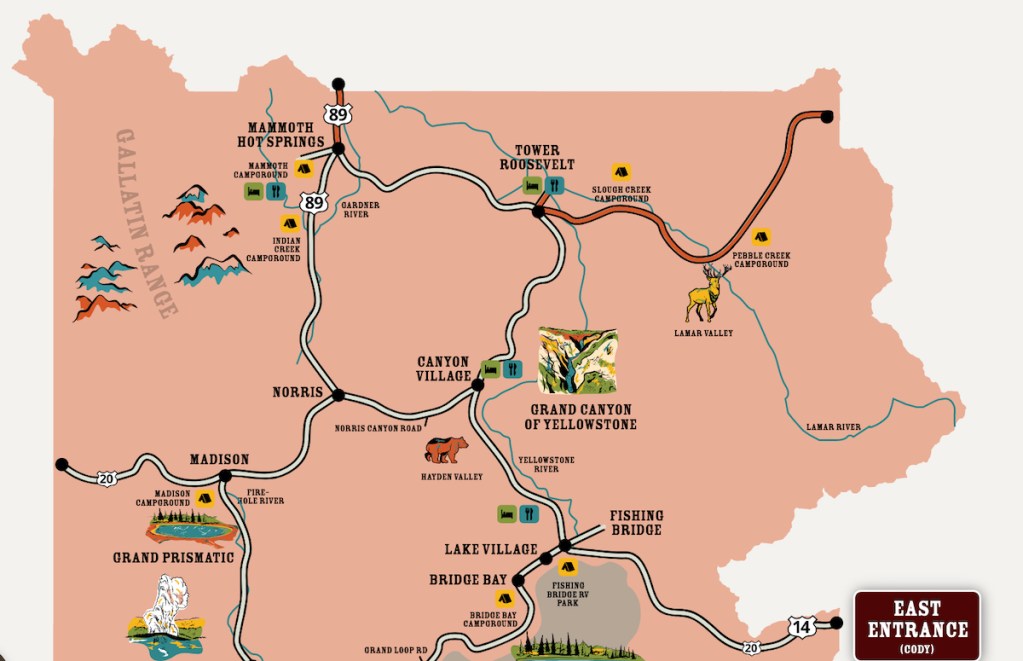
Yellowstone evacuated visitors June 13 after rain and snowmelt drove rivers out of their banks, damaging roads along the Gardner and Lamar Rivers and Slough Creek.
“Cam’s team’s preemptive road closures — even before the flooding began — I feel very strongly saved some lives,” Haaland said.
Highways are key to the general Yellowstone experience, with 97% of visitors never getting more than a half a mile from them, Sholly said.
Park officials opened the southern part of Yellowstone June 22 with visitor limits. They suspended those restrictions when they opened the park’s northern loop July 2. With two of five entrances — from Gardiner and Cooke City — mostly closed, visitation is down 30%-40% from pre-pandemic levels, Sholly said.
“They’re getting busier,” Sholly said of businesses inside and around the park. “I don’t know if it will get to normal.”
There’s usually a lag between when Yellowstone announces a reopening and visitors return in substantial numbers, he said, so tourism could improve.
A park entry reservation system won’t be ready for use this summer season, he said, but limits could be imposed.
Park roads are 93% open, and Yellowstone has $60 million in emergency funds to re-establish the temporary corridors between the two Montana communities and Mammoth this fall.
“We’re going to do just that before winter,” Sholly said, with two lanes to Gardiner “paved sometime around October, maybe sooner.”
The park was able to assess damages “only in the last few weeks,” he said.
“If you look at the total amount of actual pavement — it is less than a couple of miles,” that was wiped out, he said. But rivers inflicted the damage “in some of the most critical and hard-to-rebuild areas.”
Officials expect to award contracts this week to begin temporary fixes at four or five areas on the northeast corridor to Cooke City. Funding for the permanent restoration will go through the congressional appropriation process, Sholly said.
Yellowstone spans 2.2 million acres and roads cover 1,750 of them, Sholly said. Travelers are welcome to come to Yellowstone without their vehicles, he said.
“We’re allowing visitors to come into the park although they can’t drive, they can bike, hike, they can fish both from Gardiner and from Cooke City,” he said.
Haaland said she experienced the park’s lure the first time she saw Old Faithful erupt.
“I cried through the entire thing, because that’s what nature does sometimes,” she said. “It humbles us and makes us realize how important special places are.”


There are no free lunches. When you burn tens of millions of years worth of stored carbon there are consequences. Think of weather as mood and climate as personality. You may on any given day be a nice guy but overall still be a jerk.
I think Don Day said it best, not every weather event is a result of global climate change. What used to be normal Wyoming weather – wait an hour, it will change – is now according to the MSM and related followers, always because of global climate change. Not denying we have as the human race not had an impact on the environment, but at the same time every time it rains, snows, the wind blows, the river floods, the lake dries up…….is not specifically because of global climate change.
Global warming worn out except for leftists
Everything is caused by “global warming”….even record amounts of snow, and persistent freezing temps.
One might argue whether this weather event was caused by global warming or that one was. What matters is global warming is proven and it is changing our lives every day. The real question is what are we humans going to do about it?