

by Coco Liu, E&E Asia correspondent
Originally published Wednesday, March 18, 2015, and republished here with permission from E&E.
YULIN, China — The streets of this northwestern Chinese city were once packed with Ferraris, BMWs and other luxury cars. Now, they are all gone.
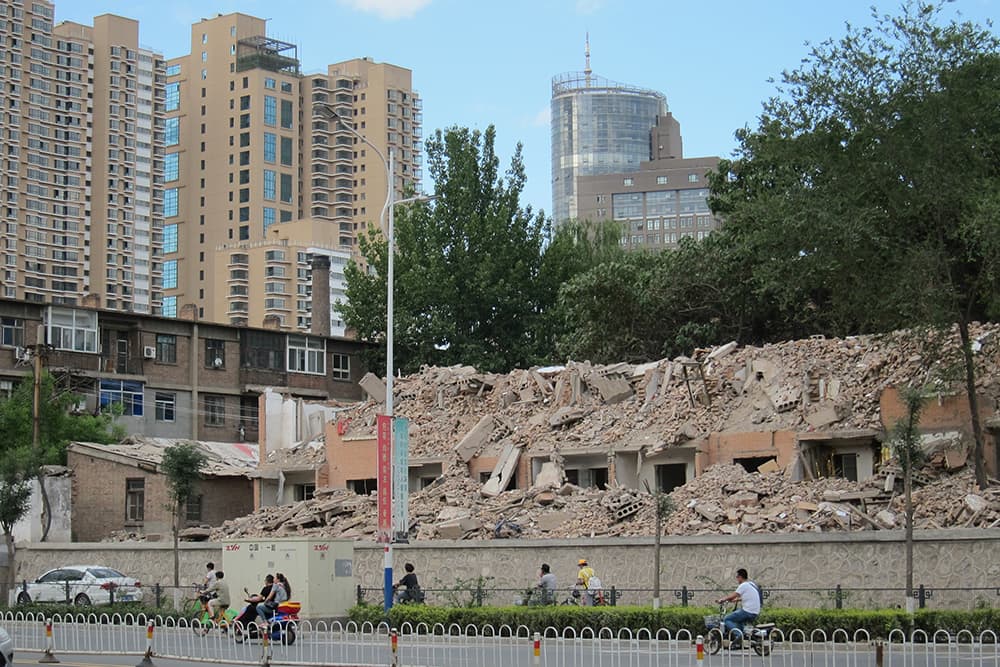
Average housing prices here have dropped by a quarter in two years. Driving across the city’s downtown, you see vacant buildings and empty restaurants.
“The business of coal companies here turned south since late 2012,” Yang Cheng, a local driver, explained while passing by a closed hotel.
“Yulin is a coal boomtown,” Yang went on. “Once coal businesses are not in good shape, the whole economy has been affected.”
Yang said that some companies in Yulin have already gone bankrupt and workers have been laid off. “People from nearby areas used to come here for jobs; now, many return home. It feels the city has fewer and fewer people,” Yang said.
The changes in Yulin are a clear indication of China’s changing attitude toward coal. The country has relied on this resource for years to fuel its economy, making coal-rich Yulin one of the fastest-growing Chinese cities. But as China has started restructuring its economy and favoring cleaner energy sources, coal companies here have begun to feel the pain of falling demand.
Statistics from the China Coal Industry Association show that in 2014, 7 out of 10 Chinese coal companies failed to make ends meet. And those that managed to stay profitable have seen a thinner profit margin.
Shenhua Group, the country’s largest coal producer and the second-largest in the world, for one, said in its latest financial report that the company’s profit dropped by 13.7 percent in the first three quarters of 2014 compared with a year ago.
Painful path to reducing emissions

China National Coal Group Corp. and Shaanxi Coal Industry Co. Ltd., two other Chinese coal mining majors, also reported a decrease of over 70 percent in profits during the same period.
The downturn is indicated not only in coal companies’ financial reports but also in investment in the Chinese coal industry. According to the National Bureau of Statistics, China last year invested about $74.8 billion in coal mining and dressing facilities, about $7.8 billion less than in 2013.
The government agency said that the country’s coal consumption also fell by 2.9 percent, or 118 million tons, in 2014 from the 2013 level, despite a growing overall energy demand. Official figures show that this is the first decline this century.
“The decline rate — close to 3 percent — is by no means small,” said Li Shuo, a researcher at Greenpeace China.
Alvin Lin, China climate and energy policy director at the New York-based Natural Resources Defense Council, said, “This is an important reversal in longtime trends.”
As Lin explained, although it is unclear whether China’s coal consumption will rebound in coming years, the decline rate suggests an increased likelihood that China can peak its coal use by 2020, if not earlier.
“In other words, we are unlikely to see the coal boom that China has experienced in the last decade,” Lin said.
Experts attribute the change to economic restructuring. Over the past few years, China has been shifting away from the steel, cement and glass industries, all of which are power-hungry.
Besides that, the country has been trying hard to feed its energy mix with more renewable energy sources. Already the world’s top wind power market, China hooked up an additional 19.8 gigawatts of wind turbines to the grid last year. It also added more solar panels than any other nation in 2014.
But for Chinese coal miners, that means fewer orders for their products. As the companies’ sales shrink, so does their ability to pay workers. Earlier this month, when representatives from all over China met in Beijing for the annual Congress conference, a delegate told reporters that about 23,000 workers at his company already had not been paid for two months.
And the impact of China’s decline in coal use may go beyond the border. In 2014, Chinese coal imports dropped by 10.9 percent year over year. Analysts called this bad news for global coal miners, who had hoped Chinese coal imports would save them from collapsing markets in the West.
Coal conversion — a risky business

As bad as it may sound now, the pain could get even worse. China plans to limit its annual coal consumption to 4.2 billion tons at the end of the decade, but its current production capacity has already surpassed 4 billion tons, with an additional 1 billion tons in the pipeline.
Chinese policymakers have been scrambling for ways to help close that gap. The government here has shut down nearly 6,000 coal mines in the past four years. It also has pulled in the approval of new mining projects in eastern China.
On top of that, China’s central planners have called for diversifying the use of coal. And companies here have responded by tapping into coal conversion technologies (ClimateWire, Feb. 23).
Across the nation, at least 16 coal-to-liquids projects have been built, are under construction or are in advanced planning stages. There are also plants that convert coal into chemicals or synthetic natural gas.
Such moves have raised worries inside and outside China. Environmentalists have blamed coal conversion projects for their huge water intake and for carbon pollution. And others have questioned coal conversion projects from an economic perspective.
“This will have big risks,” said Jiang Kejun, a researcher at the Beijing-based Energy Research Institute under the National Development and Reform Commission.
As Jiang explained, the efficiency of coal conversion technologies remains low, and coal-derived liquid fuels or coal-based synthetic gas have lost their price advantage due to falling prices for conventional energy sources.
Coal ‘will certainly be back’ — or will it?
China’s efforts to limit coal production can’t save the troubled coal industry, either, Jiang said. He added that “the decrease of coal use is decided by demand, rather than supply. Our projection is that coal will peak around 2016.”
But some researchers at the Chinese coal industry simply do not believe that the glory days are over.
“The share of coal in China’s energy mix will decrease, but its total volume won’t,” said Tian Yajun, a researcher at Shenhua Group’s National Institute of Clean and Low-carbon Energy.
“Economic restructuring does not happen in one or two years, but in one or two decades. China’s urbanization will also boost the demand for energy. Where can you find sufficient energy supplies if not using coal?” he said.
“Chinese coal companies have gone through much tougher times,” Tian continued. “Back to the early 1990s, when coal mines were up for sale, no one would buy. Now, you have no place to buy coal mines even if you want to.
“Every industry has its ups and downs. China’s coal industry will certainly be back,” Tian said.
For more on this topic, read these WyoFile stories:
Wyoming, China dream of a coal-chemical bridge to future energy, August 2014
Reasons differ, but Wyoming and China agree on cutting CO2 from coal, August 5
Wyo-Sino: Formalities precede Wyoming-China coal tech exchange, June 25
Wyoming lawmakers talk carbon cooperation in China summit, June 9