

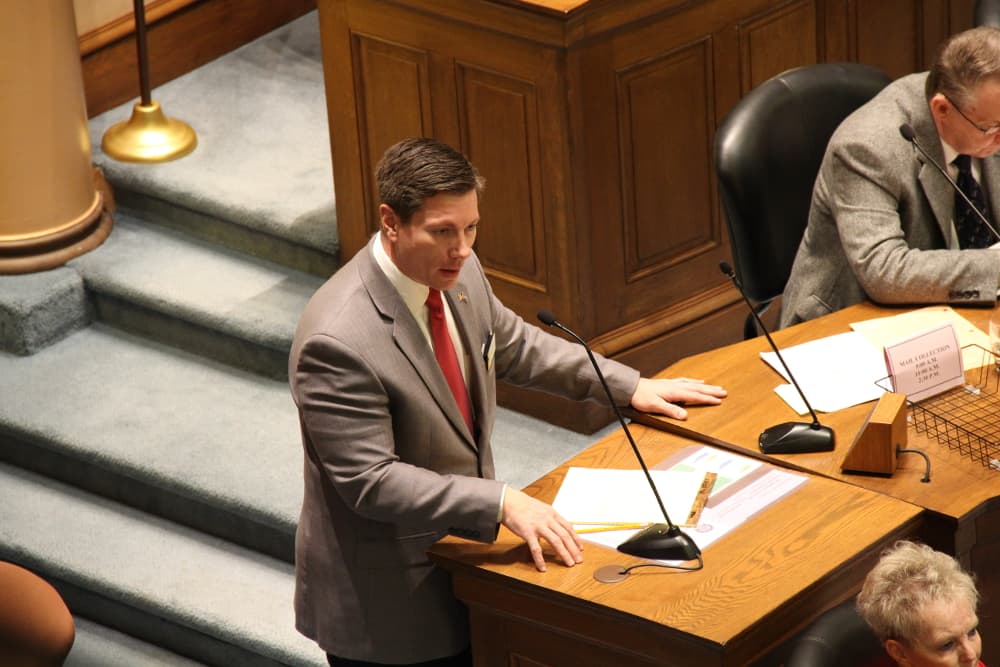
The Wyoming House gave initial approval to a bill lifting a ban on discussion of the Next Generation Science Standards.
House Bill 23 passed first reading in the House on a voice vote, with a clear majority voting yes. The measure faces two more rounds of debate in the House before going to the Senate. Chairman of the House Education Committee John Patton (R-Sheridan) sponsored the measure.
The vote responds to criticism of the 2014 Legislature’s use of a budget footnote to stop all discussion of the Next Generation Science Standards (NGSS) by the state Board of Education and the Wyoming Department of Education.
During 2014 floor debate former House Education chairman Matt Teeters (R-Lingle), proposed the footnote, which banned discussion of all science standards, NGSS or otherwise. His concern focused on how the Next Generation Science Standards taught climate change as fact, which he saw as an attack on Wyoming’s fossil fuel industries.

Many members of the public felt the use of a budget footnote to direct education policy was an abuse of the process. Others attacked the ban as an effort to censor discussion of climate change in schools.
“In the heat of the battle of the budget session, this amendment was not well thought out,” House Speaker Kermit Brown (R-Laramie) said.
Brown took a strong stance in favor of repealing the footnote during his opening address to the House last week, and continued his support in floor debate Thursday.
“We don’t burn books in this country. We don’t try to tell people how to think,” Brown said. “Our students need to hear things that are disagreeable. … Education is our friend. Ignorance is our enemy.”
Brown supported repealing the ban, but he didn’t necessarily support adopting the NGSS.
“Let’s take the state Board of Education and tell them, ‘You can talk about (NGSS), but if they aren’t worth anything, throw them out,’” he said.
Those speaking against the bill argued that the NGSS isn’t the most rigorous set of standards available.
“The NGSS represents a national norm that is far inferior to other standards that are out there,” said Rep. Nathan Winters (R-Thermopolis). “There is intense out-of-state pressure to adopt these.”
A legislator from the heart of Wyoming coal country spoke directly to how the NGSS could conflict with Wyoming’s fossil fuel-driven economy — and culture.
“Do we want our children to believe that their fathers and mothers, particularly in my county, are polluting and destroying the earth because of the energy industry that they have their jobs with?” said Campbell County Rep. Scott Clem (R-Gillette).
“Do we want our kids to think that CO2 is a pollutant and that coal fired power plants are a main cause of global warming?” Clem also opposed the NGSS because they teach evolution as a fact, not a theory.
Rep. Garry Piiparinen (R-Evanston), a teacher, voted in favor of the footnote last year, but said now he supports the repeal.
“(Speaker Brown said) he would seek to develop Wyoming science standards, our own Wyoming core standards,” Piiparinen said. “(That’s) why I support this bill.”
Ultimately, the bill’s intent is to put the process back under control of the Board of Education. Superintendent of Public Instruction Jillian Balow (R) said she plans to increase public participation in drafting new standards. The Legislature’s Joint Education Committee would weigh in at the end of the process as provided by W.S. 21-2-304.
Update: HB 23 passed second reading On Friday Jan. 23, after the House Rules Committee judged an amendment from Rep. Clem to be out of order. The amendment read in part: “In no event shall the state board of education adopt the Next Generation Science Standards in whole.” Bill sponsor and House Education chairman Rep. Patton called for the point of order, saying Clem’s amendment would have changed the bill.
To hear the debate, click here and navigate to 1:37:35.
For further reading:
Local proponents back new Climate Science Students Bill of Rights, July 10, 2014.
Lawmakers should have done homework before banning NGSS, July 1, 2014.


The coal legislators and the Governor have already made it clear that they don’t believe in man-made climate change. Not because of the science, but rather despite the science. So they will reject the science again. It is foolish to believe, that the Governor will not sacrifice students for the sake of King Mineral
Steen Goddik