

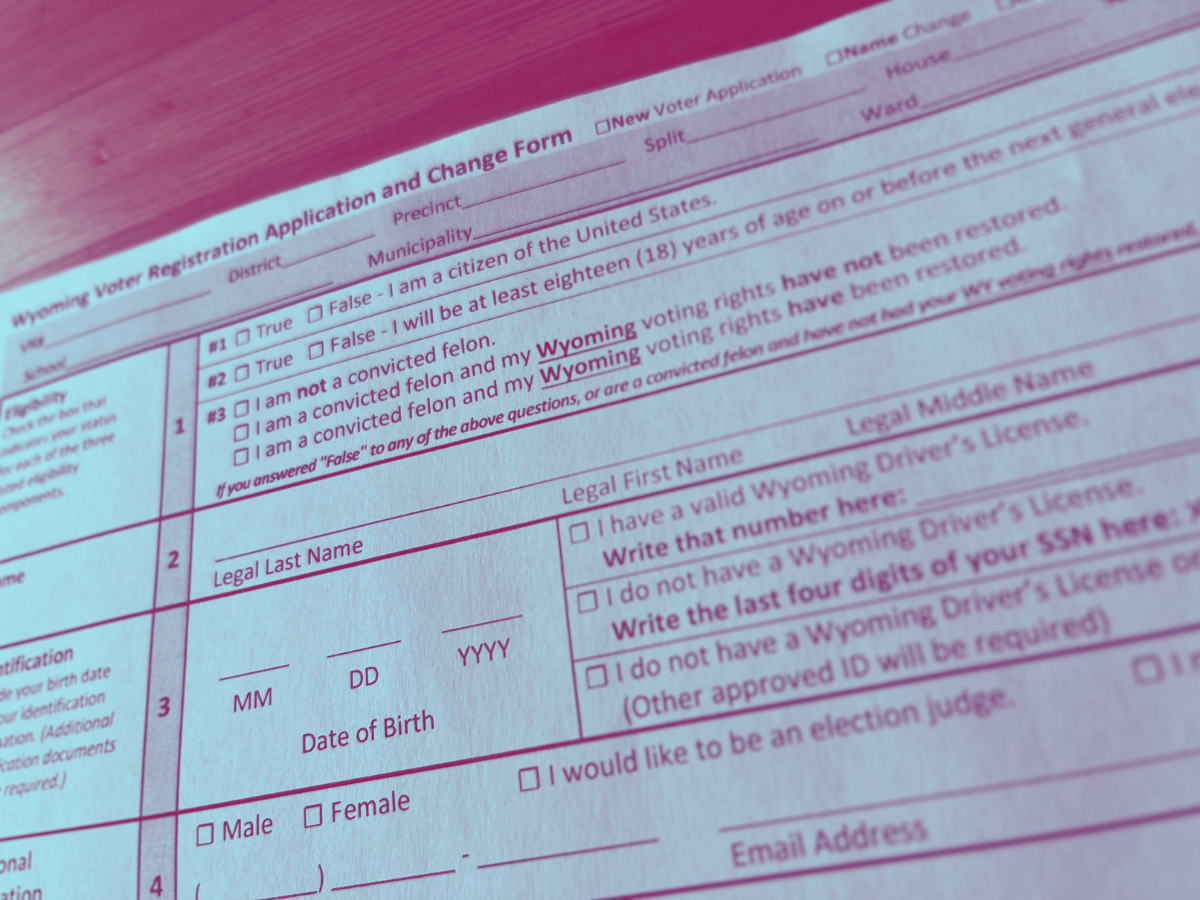
When I lost my voting rights, I didn’t think it really mattered.
Opinion
I admit that my judgment at that time was not the best. My voting rights were revoked, after all, because I was convicted of a nonviolent felony in Utah.
But as I got older, I started to realize why voting is so important. More and more, I became disappointed that I could not go to the polls alongside everyone else to decide who would be making decisions that affect my life and my community.
This is in large part because of my kids. I am a hardworking single mother of two wonderful children.
My son has autism, and he is on Medicaid’s Developmental Disability Waiver, a program that helps make him more independent. It also allows me to work, knowing he is being taken care of by good people.
The more I learned, the more I found out that this program is not something I can take for granted.
Like many things that are operated by the state, the fate of my son’s Medicaid program is basically in the hands of the Wyoming Legislature. They can make improvements, increase its funding and resources, or they can choose to get rid of the program altogether, leaving my family without help.
Whoever is in the Legislature makes those decisions, and voting determines who is in the Legislature. That was a huge eye-opener for me.
I also learned that state lawmakers decide whether people like me can vote.
In November 2016, I was hanging out with friends a few days before the election. The room was buzzing with election talk, but I tuned it out because there was no reason for me to care.
When someone asked me about the election, I blurted out, “I can’t vote, I have a nonviolent felony!”
That was my understanding, but a friend told me many states had recently restored voting rights for first-time, nonviolent felons.
I was doubtful. I just assumed that I would never vote again. But I did some research and found out that the Utah Legislature had passed a law that restored the right to vote for nonviolent felons. I could vote!
Thankfully, Wyoming has same-day voter registration. So, I looked up my voting center in Cheyenne, registered, and voted in 2016 on Election Day.
I haven’t missed an election since.
Sadly, the same can’t be said about many of my neighbors, who don’t exercise their right to vote.
According to the Wyoming Secretary of State, just 41 percent of Wyoming’s voting-age population cast a ballot in the 2022 primary election — and that was with the huge hoopla over Liz Cheney and Harriet Hageman for Wyoming’s U.S. House seat.
Most Wyoming primary elections see much worse turnout. In 2020 and 2018, only 31% of voting-age residents turned out.
In 2016, my first year back at the polls, it was only 25%.
In Wyoming, most of the races for the Legislature are basically determined by the outcome of the primary elections in August.
The general elections in November are important for school board races, city council, and a few contested races for the Legislature. But they are mostly a victory lap for whichever Republican already won the primary.
That means that only a tiny fraction of the people in our state — as low as 25% — are deciding who controls my son’s Medicaid program.
Even if you don’t have a child like mine, something important in your life depends on who is in the Legislature — the roads you drive on, the schools your children attend, whether you can afford health care, programs and decisions that can create jobs and help our economy or hurt it.
I didn’t appreciate my right to vote until it was gone. I hope that you don’t have to go through all that to understand why you should join your neighbors — however few of them — and cast a vote Aug. 20 in the 2024 primary elections.
Or, even better, cast a vote this month — early voting started Tuesday.

Good job, Angela.
I’ve known Angie for several years now and she never hesitates to explain why her voting right was taken and how grateful she is to have it restored. I’m so proud to call her friend.
as always,
El
Excellent commentary. Thanks for reminding all that voting IS a precious resource and should not be wasted.