


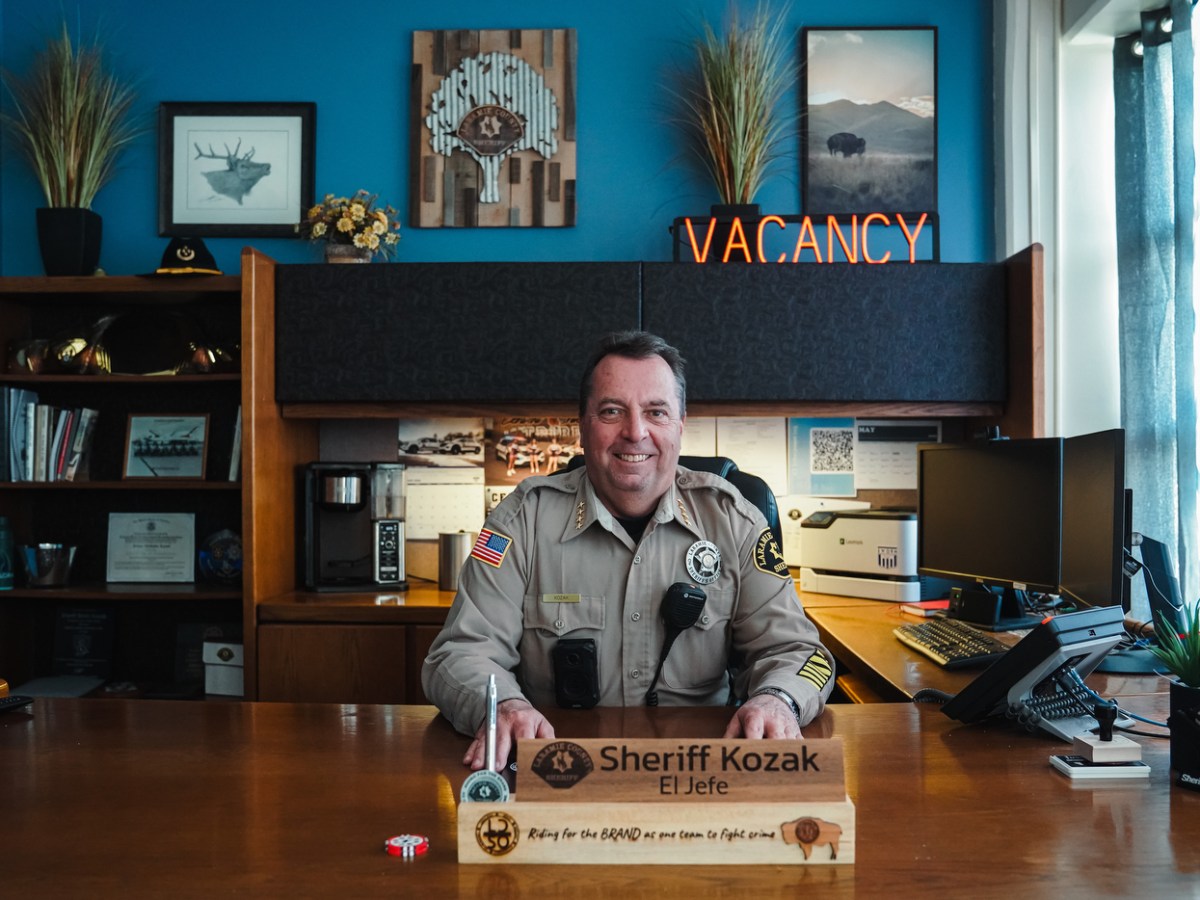
After a Colorado law firm sued the Laramie County Sheriff’s Office to obtain records critical to an ongoing deportation case, Sheriff Brian Kozak responded on social media, alleging the plaintiffs failed to prove they represented the man being arrested in the requested video footage.
But in a new court filing, plaintiffs assert that neither law enforcement nor the county attorney’s office ever asked for further proof they made the records request on their client’s behalf.
“Even after being sued, Defendant [Brian] Kozak continues to refuse to turn over the evidence critical to two judicial proceedings,” the plaintiffs state in the document. “As the delay continues it is creating more prejudice in those proceedings.”
Reached for comment after the lawsuit was initially filed, Kozak said that body camera footage is “not public record” under Wyoming state law. Current law doesn’t require law enforcement to make recordings public, but leaves it largely up to agencies’ discretion whether or not to release footage. Recently, for example, the Johnson County Sheriff’s Office released footage of a state lawmaker’s arrest. Two years ago, the Campbell County detention center provided video of a jail death to reporters.
Kozak didn’t immediately respond to WyoFile’s inquiry on Friday about the plaintiffs’ response.
Last month, Denver-based law firm Lichter Immigration and Laramie County resident Kevin Lewis, whom the firm retained as an investigator, filed a complaint accusing the sheriff’s office of blocking access to records after releasing a false report about the arrest of long-time Laramie County resident Mario Fabian Valenzuela Robles, a Mexican citizen with three children.
Lichter Immigration and Lewis eventually obtained a corrected version of the report, but continue to seek video footage of Valenzuela Robles’ arrest. These records, they stated, are crucial evidence for Valenzuela Robles’ ongoing immigration case.
The plaintiffs are represented by Cheyenne attorney Drake Hill, a former Wyoming GOP chairman and the spouse of former Wyoming Superintendent of Public Instruction Cindy Hill. Lewis was a staffer in Cindy Hill’s office when she was state superintendent.
Kozak responded to the allegations in a social media video, saying that the discrepancies in the reports resulted from a copy-and-paste error, and that the office hadn’t handed over footage because the county attorney never received a letter from the law firm stating that it represented Valenzuela Robles.
But neither the plaintiffs nor Hill received “any request” from the county attorney, a new court document states. Though the law firm itself didn’t directly send a letter to the sheriff’s office or the county attorney, Lewis shared a retainer letter with both offices. The records clerk at the sheriff’s office “accepted this as proof of representation and provided the initial report and later the ‘corrected’ report,” according to the filing. Lewis also gave the letter to the county attorney, who “likewise found that evidence of representation satisfactory.”
Laramie County Attorney Mark Voss declined to comment on the complaint because it involves pending litigation.
Arrest reports
The plaintiffs argue in the new filing that “a single cut and paste error” can’t explain the “multiple discrepancies” between the arrest reports for Valenzuela Robles, which are included in a new exhibits filing.
“A report so riddled with falsehoods, erodes trust in the legal system,” the document states.
“Either Defendant Kozak’s new explanation is knowingly false, or it shows a shocking level of incompetence one [sic] of the most important functions of law enforcement — drafting accurate, contemporaneous reports.”
Even after the report was corrected, both reports, the plaintiffs state, are “striking in what they leave out,” such as a date of creation that would help them determine if the documents were “after-the-fact creations rather than good faith contemporaneous reporting.”
According to the document, photographs of Valenzuela Robles’ arrest show two sheriff vehicles, three deputies and an ICE officer at the scene. (The corrected report identified two deputies by name and stated that an ICE officer was also present.)
“Simple math dictates that there should be dash cam video from two vehicles and body cam video from at least three law enforcement officers,” the court filing states. “At the very least, the report should specify what digital evidence is available (and if not available, why not).”
The immigration law firm also seeks more information about how deputies made a “probable cause” determination — an evidence-based reason to believe that a crime was committed — that allowed them to arrest Valenzuela Robles. Both reports state that a deputy initially stopped Valenzuela Robles for “failing to use directionals when moving lanes and tinted windows.” According to the reports, Valenzuela Robles provided a New Mexico driver’s license that wasn’t a REAL ID and therefore did not comply with federal standards.
An ICE-certified deputy then questioned Valenzuela Robles, “formulating Probable Cause” that he was in the country without authorization, the reports state. They don’t go into further detail about the questioning.
“How was the probable cause determination made?” the plaintiffs’ filing asks. “What was it based on? There was never a charge, so what was the probable cause for?”


this guy ain’t law enforcement, he’s a showboater
The Wyoming public backed an insurrectionist to be President who has, along with GOP support, created the largest unaccountable Federal police force in US history. In addition, Trump corrupted the DOJ so that they are now making up “evidence” to charge, harass or kill people, so why shouldn’t a Constitutional Sheriff like Kozak not be able to enact the same corruption of law in Laramie County?
The people of Laramie County and the truck driving coalition that backs Hageman LOVES that Kozak is treating human beings like used toilet paper, so why not leave this despot alone to do his christian mission?
Now that the Extreme Court has ruled that there shall be no coed sports, I am certain he will be checking the genitalia of all junior high and high school athletes making him a perfect candidate to be a member of the Freedom Caucus. GO WYO!