

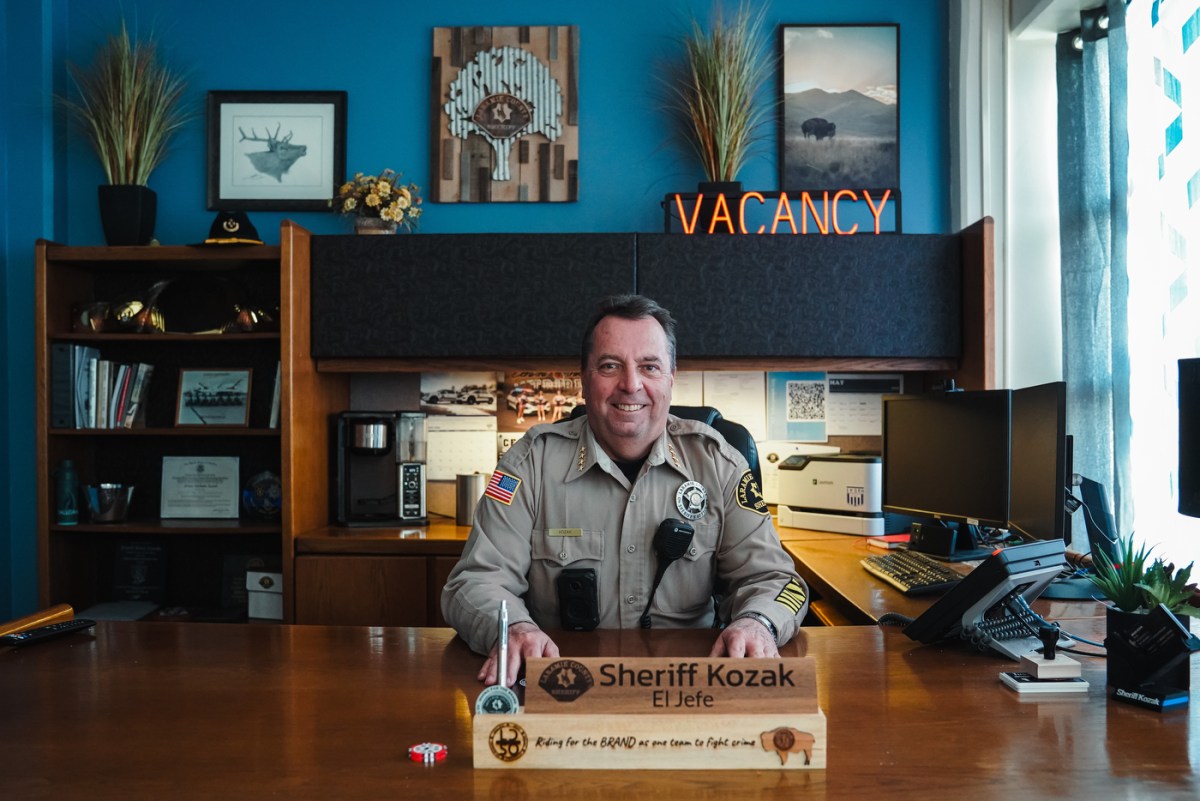
Laramie County Sheriff Brian Kozak and his office “engaged in the obstruction of justice by blocking access to critical evidence” in the ongoing immigration proceedings of a man detained in Laramie County, a lawsuit filed Tuesday alleges.
The complaint accuses the sheriff’s office of blocking access to records after it released a report about the arrest of long-time Laramie County resident Mario Fabian Valenzuela Robles, a Mexican citizen, that a representative of the Cheyenne Police Department called a “complete fabrication.” The sheriff’s initial report indicated a Cheyenne police officer was involved in the arrest, even though that officer was on leave at the time.
The complaint asks the court to order Kozak, who is up for reelection in August, and his office to immediately hand over “all evidence” related to Valenzuela Robles’ stop and detention. It requests that the court declare that they “obstructed access to evidence” relevant to Valenzuela Robles’ ongoing deportation proceedings and habeas corpus case in Colorado. The lawsuit also demands Kozak and his office pay a $750 penalty for allegedly violating the Wyoming Public Records Act.
The plaintiffs — an investigator and a Colorado law office — request an expedited review and emergency hearing of the matter. “This request is made as judicial proceedings are progressing and the Defendants’ refusal to provide the evidence has already jeopardized the defense of Mr. Valenzuela Robles in, to date, three court filings and one hearing,” the complaint states.
The plaintiffs include a Denver, Colorado-based immigration law office, Lichter & Associates, and an investigator working for the firm, Laramie County resident Kevin Lewis, who are acting on behalf of Valenzuela Robles in immigration proceedings that began with a traffic stop.
They are represented by Cheyenne attorney Drake Hill, a former Wyoming GOP chairman and the spouse of former Wyoming Superintendent of Public Instruction Cindy Hill. Lewis was a staffer in Cindy Hill’s office when she was state superintendent.
Drake Hill declined to comment on the lawsuit.
Kozak referred WyoFile to the Laramie County Attorney’s Office for further comment, noting that the county attorney’s office deals with records requests.
“We refer those to the county attorney’s office to deal with those public records requests,” Kozak said. “They’re the ones that deal with that, and they’re dealing with this as well.”
The county attorney did not immediately return WyoFile’s inquiry about the complaint.
Valenzuela Robles, who is free on bond while his habeas case is pending, was stopped in his truck by a law enforcement officer on April 23 because his taillights were “kind of dark” and his vehicle had “tinted windows,” a court filing in his habeas case explains.
Most of the documents in Valenzuela Robles’ habeas case aren’t public, but some are available to view.
ICE agents soon arrived on scene, according to the document. Valenzuela Robles stated that “he was given a choice between accepting $2,600 to voluntarily return to Mexico or to be transferred to ICE detention.” Valenzuela Robles, who has lived in the U.S. since 2006 with no previous criminal history, opted for detention.
Lewis, who has known Valenzuela Robles for a few years, described him in a phone call with WyoFile as a “soft-spoken guy” who “likes doing really quality work.” He knew Valenzuela Robles “through various renovation projects that he was doing around town,” including at the Hill household. He lives in Laramie County with his family, including three kids with U.S. citizenship, according to Laura Lichter, founder of Lichter & Associates.
Lewis was at home when the Hills called to tell him that Valenzuela Robles had been detained, he said. Lewis went to the Cheyenne ICE office to learn more about the arrest. An ICE officer informed him about the process for getting a lawyer to represent Valenzuela Robles in court. “They were very nice at ICE,” Lewis said. “They were very responsive.”
The following is an account of Lewis’ efforts to gather evidence from law enforcement agencies following Valenzuela Robles’ arrest, according to the 12-page complaint:
Lewis went to the Laramie County Sheriff’s Office on April 24, but it was closed. He then went to the Cheyenne Police Department to request records. An officer there searched for data concerning Valenzuela Robles but found none. The officer told Lewis that the computer system also showed sheriff’s office records, but that there was also nothing on Valenzuela Robles in the sheriff’s records.
On April 27, Lewis brought a written records request for all evidence related to Valenzuela Robles to the sheriff’s office. A staff member told him that there were no reports for Valenzuela Robles’ arrest or detention. The staff member told Lewis that he would need to prove he represented Valenzuela Robles to view records.
Lewis later provided a letter showing that Lichter & Associates had retained him in connection with the office’s representation of Valenzuela Robles. He also prepared a revised records request on Lichter letterhead. When he presented the request at the sheriff’s office, a staff member told him the office still didn’t have a report on Valenzuela Robles’ arrest or detention. The staff member told him to return “in a couple of days.”
“In the meantime, immigration proceedings that could lead to Mr. Valenzuela Robles’ removal were moving at a very fast pace and the records were vital to his defense,” the complaint states.
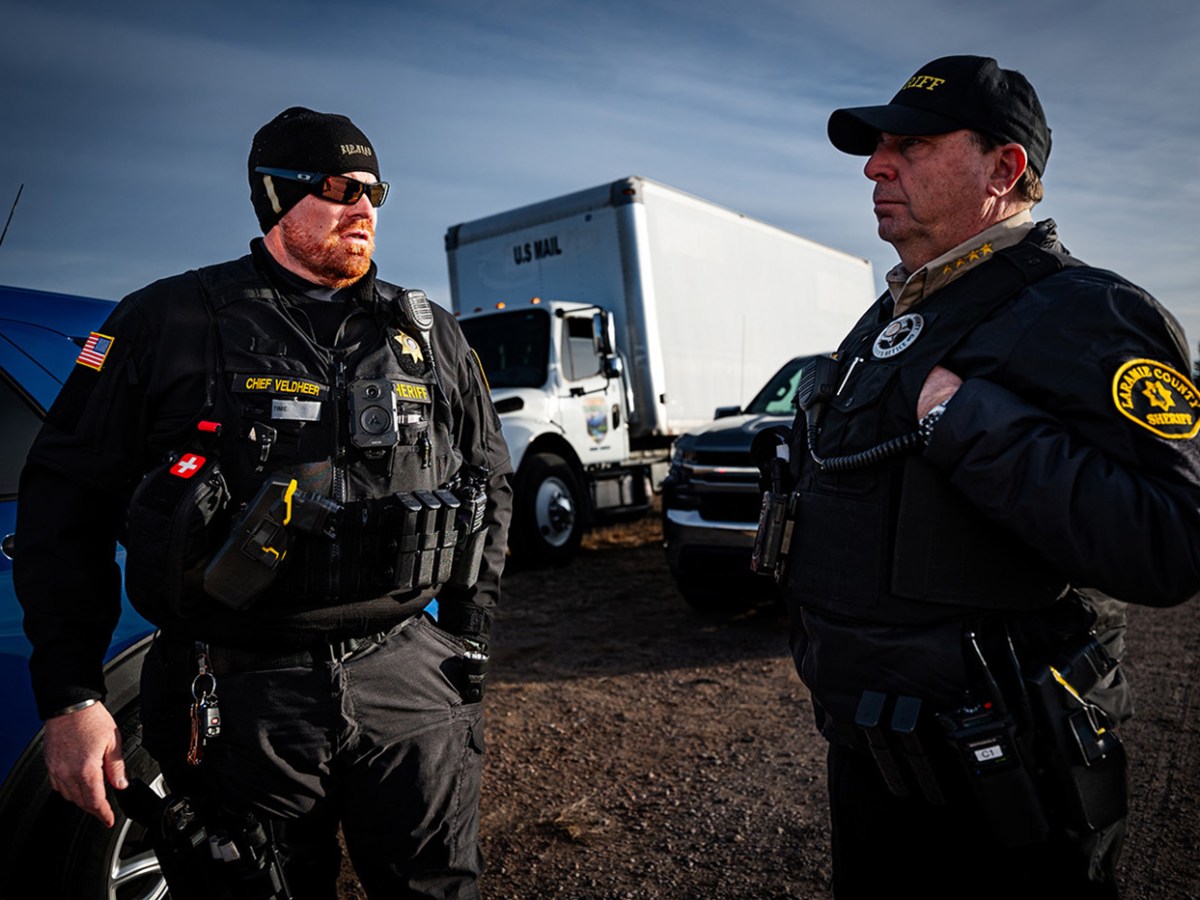
Lewis returned to the sheriff’s office on May 1 but found it closed. He went again on May 4. A staff member told Lewis again that the office didn’t have records for Valenzuela Robles’ arrest or detention and would need a date of birth to search. The staff member also informed Lewis that the alien registration number he had provided — a number that the U.S. Department of Homeland Security assigns to noncitizens — didn’t yield results for the search.
During this visit, the staff member told Lewis that if a person wasn’t physically booked into the local jail, the office wouldn’t have records of the event, even when local officers had helped ICE in the field, the complaint states. He was told that “such an event would be categorized as an ‘assist’ to an outside agency,” and that “ICE held custody in such cases.”
Lewis asked the staff member about digital media such as body and dash-camera footage connected with the encounter. The staff member told Lewis that the office wouldn’t release such footage.
Lewis visited the Cheyenne Police Department again on May 21 and was told that the department was not involved in Valenzuela Robles’ arrest or detention. Lewis proceeded to the sheriff’s office, where a representative gave him a report “purporting to document the encounter, arrest and detention” of Valenzuela Robles.
The report indicated that there was no body camera footage, that the Cheyenne Police Department collected all digital media related to the arrest and that a Cheyenne Police Department officer was involved in the encounter.
Lewis returned to the Cheyenne Police Department that same day to show the agency the report and get the digital media that the defendants stated was in the police department’s custody.
According to the complaint, a records department staff member reviewed the report and said “in an emphatic manner” that the report was a “complete fabrication.” The staff member pointed out that the Cheyenne police officer mentioned in the report was incorrectly identified as a male, and that the officer was “on leave that day and could not have been involved in the stop,” the complaint states.
The Cheyenne Police Department staff member informed Lewis that the sheriff’s office was rewriting the report. The same day, Lewis went to the Laramie County Attorney’s Office, where he was again told that the “revised report would be forthcoming.”
The sheriff’s office records department was closed when Lewis visited on May 22. He returned again on May 27 and obtained the revised report. “The new report provided a completely different narration of events,” the complaint states. That includes a statement that body camera footage was recorded and stored with the sheriff’s office.
“I can’t comment on it, but it’s not accurate,” Kozak said regarding the complaint’s narrative about the reports. “I can just say that.”
Initial versus revised
The initial and revised reports weren’t included in the complaint’s exhibits, but Lewis shared copies of them with WyoFile.
The initial report states that a deputy, whose “body camera was off in the patrol unit charger due to long hours being worked,” was conducting immigration enforcement in south Laramie County when he heard Chief Deputy Chance Walkama on the radio conducting a traffic stop and asking for help with a Spanish-speaking driver.
The deputy arrived at 3200 South Greeley Highway and contacted a Cheyenne police officer identified as P76 in the report and the complaint. The police officer, according to the report, had stopped a vehicle “for failing to use directionals when moving lanes and tinted windows.”
According to the initial report, the police officer told the deputy that Valenzuela Robles provided a New Mexico driver’s license that wasn’t a REAL ID. The deputy, who’s certified to conduct immigration enforcement, “proceeded to question” Valenzuela Robles, determining that he was “an illegal Alien.” A U.S. Immigration and Customs Enforcement officer who was present placed him under an ICE hold.
In contrast, the revised report states that the deputy’s body camera was recording during the encounter, and that the resulting video footage “has been uploaded to and is stored at the Laramie County Sheriff’s Office.” It says that Walkama, not a Cheyenne police officer, conducted the traffic stop.
The revised report includes a note at the top: “On April 23, 2026, at approximately 0818 hours an Immigration and Costume [sic] Enforcement hold (Arrest), was completed. A report was summited [sic] by mistake. The following report is the correct report.”
After receiving these reports, Lewis “continued to contact” sheriff’s office representatives to view the video footage until a lieutenant with the office made a June 1 appointment for him to view the footage in person. That was the same day of Valenzuela Robles’ bond hearing in Aurora, Colorado.
“The timing of the appointment ensured that no digital media would be available to assist in Mr. Valenzuela Roble’s [sic] defense and Mr. Valenzuela Robles’s position that the stop had been unlawfully conducted,” the complaint states.
Lewis arrived at the sheriff’s office on June 1 to view the video footage. But an office representative said that the lieutenant would email to inform him that he wouldn’t be allowed to view the footage and that he should contact the county attorney. According to the complaint, Lewis “reviewed his emails and found no such communication” from the lieutenant.
Since then, Lewis and counsel “have held several discussions with the Laramie County Attorney to obtain the records,” according to the complaint. But, except for the initial and revised arrest report, the sheriff’s office hasn’t produced any other evidence, the complaint states.
Lichter’s first reaction upon hearing about Lewis’ attempts to get records for the case was to wonder: “What are they trying to hide?”
“It just doesn’t make any sense,” she told WyoFile.
Lichter, who has practiced deportation defense and immigration law since 1994, said she had “never had a situation” concerning a Wyoming immigration case where she had requested records and not been able to get them. Lichter clarified that in the past, she has only requested records from ICE in relation to Wyoming immigration cases, and that she hasn’t specifically requested video footage.
Lewis hadn’t thought much about immigration before becoming involved in Valenzuela Robles’ case. His perspective is that people who have been in the country for a long time and who don’t have a criminal history should have a path to naturalization. “Because, quite frankly, America is a beacon of freedom,” he said.
After Valenzuela Robles returned to Laramie County on bond, he went with Lewis and Drake Hill to the Cheyenne ICE center for a court-ordered check-in, Lewis recounted. When they got out of the car in the empty parking lot, Valenzuela Robles looked at the facility and told Lewis that he had done a lot of the framing on the building.
“That just seemed like an amazing bit of irony when it comes to this whole situation, which has been full of irony in lots of ways,” Lewis said.
Lewis said he had never directly interacted with Kozak. The sheriff was also unfamiliar with the plaintiffs and their attorney.
The complaint comes on the heels of an American Civil Liberties Union lawsuit filed last month against Kozak and the Laramie County Sheriff’s Office over the agency’s immigration contracts with ICE. The lawsuit accuses Kozak and his office of violating legally required procedures and exceeding their legal authority when entering into three 287(g) agreements last year. Last week, the sheriff’s attorney asked the court to dismiss the complaint, arguing that the plaintiffs lack standing and didn’t follow notice requirements.
ICE has three types of contracts — Jail Enforcement, Warrant Service Officer and Task Force — that allow local and state law enforcement to conduct immigration enforcement, expanding the federal agency’s reach. The Trump administration revived the most controversial of these three agreements, the Task Force model, in 2025 after the Obama administration had phased it out in 2012.
Kozak’s office is one of two law enforcement agencies in Wyoming — the other being the Sweetwater County Sheriff’s Office — that have all three enforcement agreements with ICE. The Laramie County Sheriff’s Office has made over 400 immigration arrests since October, when deputies started enforcing immigration under 287(g).
Two candidates — Republican Eric Norris and Democrat Robin Cozad — are running against Kozak to be Laramie County’s sheriff.

So according to Lewis, both he and attorney Drake Hill knowingly hired an undocumented worker?
My interactions with Sheriff Kozak during my work on public access were favorable. I thought he wanted to do the right thing as chief. But after he was let go as the chief and ran for sheriff, he has gone wherever the politic winds were blowing. Disappointing.
I don’t think it’s too much to expect for law enforcement to follow laws and procedures when they are enforcing the law. N’est-ce-pas?
I suggest the re-election of your sheriff, who bares responsibility for this and other legal uses in the department regarding staff, but primarily himself, should not be in any position like this let alone supervise.
Don’t re-elect this person.
If they can do this to am immigrant, they might do the same to any of us.
This isn’t even an immigration issue. This is a matter of doing a job the way is it supposed to be done.
“Justice delayed is justice denied.” And it seems that all the agencies involved in this miscarriage of justice are experts at delay.
Opening the flood gates letting in 10+ million would be illegals in 4 years, will have consequences.
The immigration system has been broken for generations, and it has been allowed to stay broken for a few reasons.
There is a problem when a sheriff’s office in Wyoming can lift people, hand them to ICE to be held in Colorado, and not keep any formal record of the arrest/detention.
Imagine how this would have played if Valenzuela Robles was without a persistent advocate. Then multiply by several hundred thousand.
Quis custodiet ipsos custodes?