

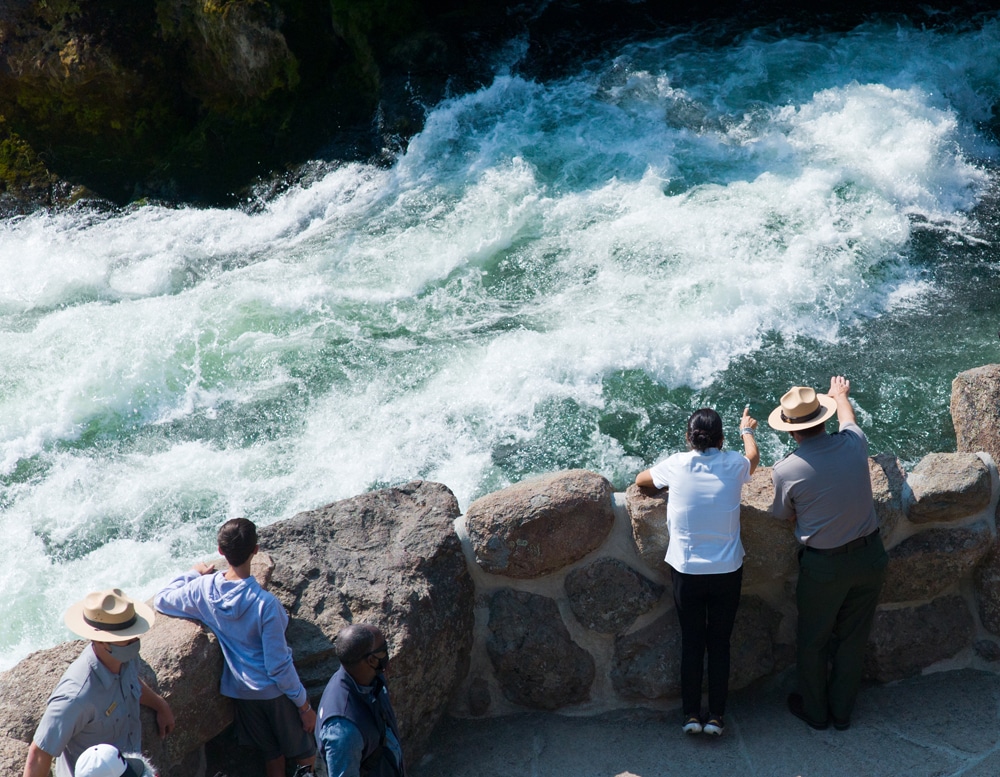
I spent a week recently in Yellowstone National Park. I was grateful to the people who had the courage and foresight to establish Yellowstone in 1872.
It was with gratitude that I watched grizzly bears playing among the meadows. Gratitude that I got to see wolves at their den sites. Gratitude that I observed moving waves of bison surge across the valleys. Gratitude that I could see bald eagles, coyotes, fox, bighorn sheep, elk, deer and pronghorn, among other wildlife, including the brilliant blue of mountain bluebirds returning to the park.
Opinion
Standing alongside the road with 100 other people watching, say, a bear rototilling up the ground in search of roots, voles or perhaps truffles, I noted that every person was enthralled and excited to see a grizzly in its natural habitat. Yet, all of the folks stood at a respective distance from the bear.
When a park ranger came to ask people to move a dozen feet farther from the bear, he didn’t order them. Instead, he asked politely, “could you please move a bit farther away from the bear?” Unfortunately, such civility is seemingly rare today.
People with spotting scopes willingly shared views with others without such equipment. Knowledgeable folks helped people locate the animals. There was a sense of common purpose and shared experience.
But the other thing I observed that was also very heartening in this day of social divisions and identity politics was the way people just put aside labels.
Among those on the road’s margin, I could see several women with hijabs. I saw another family with a woman wearing a sari. There was a Black couple from New York City who excitedly exclaimed to me this was the first bear they had ever seen. I talked to a family from Puerto Rico. And another couple from China, who, in broken English, told me that visiting Yellowstone was the high point of a trip to America. I heard excited observations spoken in other foreign languages.
There were, no doubt, Trump supporters and others who voted for Biden. There were hunters and anti-hunting folks standing side by side. There were wealthy elites with new sport utility vehicles, and others driving rusted, dented and barely operable old cars.
All of us were there to learn, appreciate and enjoy watching wildlife.
I have gratitude for the scenic beauty that parks preserve. I’m sure most of the people I saw were enthralled with the natural beauty of Yellowstone. We all need beauty in our lives.
There were no political, ethnic or religious divisions among us at that moment. Is this not one of the great things about national parks? That we can all come together and enjoy the natural world and appreciate the value of our national park system?
So it is with gratitude that I visit Yellowstone and appreciate how the national park system helps bring America together. Today, there are few things that bind us as a nation with a common purpose. I am willing to bet if you asked every person watching the grizzly bear there whether they are glad we have a Yellowstone National Park, there would be universal approval.
You can visit national parks, but you must prioritize wildlife and natural systems in your behavior and interactions with the parks. If national parks do nothing more than teach people the value of restraint and the idea of a greater good, including for wildlife and plants that don’t have a voice, they will have done enough.
We all need beauty in our lives.
George Wuerthner
And I hope that parks will continue to generate gratitude and a shared commitment to protecting nature for its own sake. For my part, I feel gratitude to those working to protect nature across the globe. Parks, though not perfect, still foster the best in people, which is why I work to promote gratitude in people for parks.
Our national parks include consideration for what I call the “others,” or the living systems that sustain us all.
I would put the creation of a national park system alongside other American achievements including the Emancipation Proclamation, public education, the Civil Rights Act and other progressive policies. Like other goals such as equal rights, parks can be improved, but we should appreciate what they represent in a world where human desires are often put ahead of all other considerations.
And so, I have gratitude for parks because they represent restraint. They represent consideration of more than just people’s desires. They are an institution we should celebrate, not denigrate. What we need is more national parks, not less.
And if parks help to promote gratitude in us, then all the better.

“Standing alongside the road with 100 other people”
No thanks.
Wilderness works for me. Many as wild as our national parks and just as beautiful. And no entrance fee.
But, yes, national parks, refuges, and national forests are a gem in an otherwise plundered world.
“The mass of men lead lives of quiet desperation.” Henry David Thoreau penned these words many years ago. As we immerse ourselves in wild places we see that it doesn’t matter how rich or poor we are, whether we’re Black or White or if we’re conservative or liberal. When we’re out there we are just one more species, many times not the apex predator. Wild places level the playing field. They are the real world. They put us in our place. Thoreau nailed it. Thanks, George.
Every National Park should be much larger in size- to protect not just the animals and plants but the air and water needed by all living things.
Yes, but the lay public should never lose sight of the fact that it is the right that wants to privatize public lands, and that would yield an irreversible tragedy.
Speaking of national treasures George, you are certainly one! Thanks for the decades of research and writing, bringing critical issues to the public.
Very well said George.
Thanks for this article George. It’s good to hear about the inspirational!