


WyoFile’s local news initiative partnered with Oil City News to produce this story.
CASPER—The right of landowners to “use and enjoy” their properties, due process and the government’s role in a long-simmering fight over leasing state lands for gravel mining at the base of Casper Mountain all surfaced Monday during back-to-back court hearings for a pair of separate but related cases.
“The ability to use and enjoy their property includes drinking the water and breathing the air,” attorney Marci Bramlet told District Court Judge Josh Eames.
Bramlet represents the Casper Mountain Preservation Alliance, a coalition of neighbors opposed to Prism Logistics’ gravel mining leases on nearby state land. The alliance is a plaintiff along with landowners Carolyn Griffith, Michael Fernald, Todd and Elizabeth Romsa, Walter Merschat, Jamie Bilek and Pat Sullivan.
Attorney Jim Peters for the Wyoming Board of Land Commissioners countered Monday that the neighbors’ concerns about the gravel mining operation’s detrimental impacts to their property interests are only speculative of potential future harms.
But the plaintiffs also allege that the leases were granted in violation of the Fourteenth Amendment of the U.S. Constitution and the Wyoming Constitution’s Declaration of Rights, which guarantee due process of law, and should be considered void.
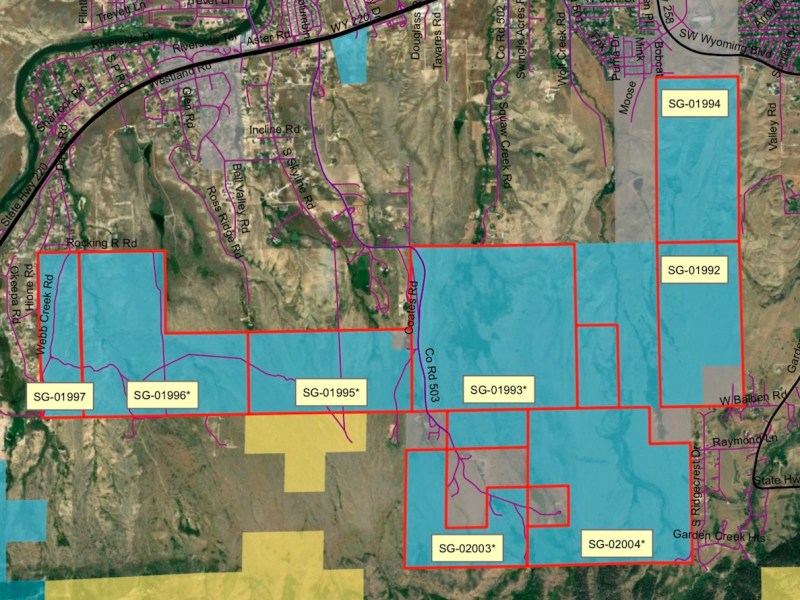
In this case, neighbors have said the state gave no notice, which they argue is part of due process. In February 2024, a nearby resident was surprised to see a backhoe digging on a section of state land in the Coates Road area, just west of Casper.
The state board unanimously approved the leases on a consent agenda without discussion, commissioners have admitted in public meetings.
Casper-based Prism Logistics sought eight gravel mine exploration leases for state-owned land in the area in 2023. The state board granted six in June of that year and the remaining two in October.

After learning the state land board had granted the leases on thousands of acres of state “school trust” lands that generate income for public education, many concerned Natrona County residents began packing public meetings to voice their opposition. From February through September of last year, opponents to the proposed gravel mine attended every Natrona County commission meeting and reiterated their opposition at each meeting.
Natrona County residents also raised complaints at the state level, and even gave Gov. Mark Gordon a tour of the area. A plaintiff in the case and founding member of the alliance, Griffith started a petition, which garnered more than 18,000 signatures in roughly seven months.

At the time, residents raised concerns about the impacts a mining operation would have on the area’s water and air quality. Opponents to the gravel mine also spoke to the detrimental impacts it could have on the area’s natural beauty and recreational value.
These concerns have become the basis for the alliance’s contention that leasing the area for gravel mining harms their ability to “use and enjoy” the land and infringes on their protected property rights.
However, despite the adverse effects the neighbors allege that Prism Logistics’ gravel mine could cause, Bramlet clarified that their legal issues do not lie with Prism but with the state land commissioners, Gov. Mark Gordon, Secretary of State Chuck Gray, Superintendent Megan Degenfelder, Treasurer Curt Meier and State Auditor Kristi Racines.
“It is the state we allege has wronged the plaintiffs,” she said.
Peters, on behalf of the state land commissioners, argued that the plaintiffs hadn’t shown the law that specifies how much notice must be given.
What’s the state’s role?
At the same time the state finds itself in one legal battle, it is also trying to extricate itself from another legal fight between Prism Logistics and the Natrona County Board of County Commissioners.
Prism contends that the county board overstepped its authority by amending its zoning rules in September 2024.
During a Sept. 17 meeting, county commissioners unanimously voted to amend the county’s zoning regulations to remove the ability to apply for or obtain a conditional-use permit for extractive industries in Mountain Residential-1 zoning districts. The land Prism Logistics had previously leased from the state was all zoned as MR-1.
The company alleges that the action was taken with the specific intent of preventing Prism from mining. By doing this, Prism argues, the county is preventing it from exercising its rights under the state leases.
Prism Logistics holds that the state, through the Board of Land Commissioners, has exclusive authority over state lands, and county zoning regulations should not override this authority or interfere with the state leases.

However, Natrona County asserts that local zoning and land use regulations do apply in this case.
“The Wyoming Supreme Court has long held, in a variety of contexts, that gravel, sand, rock, and similar materials are not ‘minerals,’ … and has thus determined that County zoning and land use regulations properly extend to the extraction of such resources,” attorney William P. Schwartz, representing the county, wrote in the counterclaim.
“The Wyoming legislature has delegated Natrona County the authority to exercise its police power, including promulgating zoning and land use regulations, on all lands within the unincorporated areas of Natrona County, without excluding state lands from that delegated authority,” the counterclaim goes on to state.
In asserting that the county commission overstepped the state’s authority, Prism listed the Board of Land Commissioners as an involuntary plaintiff — a role the state aims to see dismissed.
Judge Eames heard the second case immediately after the first suit between the citizens’ group and the state. In Monday’s court proceedings, Prism Logistics attorney Amanda Green argued that the state board should have an interest in the outcome of the case, as companies could be dissuaded from seeking leases in the future if they know county governments have the ability to hinder plans. In turn, she continued, this would impact the state board’s mandate to lease school trust properties that generate income for public education.

However, state attorney Kate Gamble contended that while the state has an interest in leasing state lands, it is then up to the lessee to get any further permitting it needs.
At the same time that Prism listed the state board as an involuntary plaintiff, the company also named the board as a defendant in the case. The state is arguing that it should be neither a plaintiff nor a defendant in this case.
According to court documents, Prism argues that the state board should be included as a defendant “[t]o ensure complete relief in this action and to avoid prejudice to the rights of the state of Wyoming.”
However, the state board posits that the complaint against it lacks any specific allegations, and only references the state board’s authority among other allegations made against the county commission.
“This court should dismiss Prism’s claim against the State Board because there is no justiciable controversy between Prism and the State Board,” the state claims in its motion for dismissal.
In both cases, Eames made no ruling, but took the cases under advisement and will issue written rulings at a later date.

Casper mountain has a long history of being mined. It is not a new thing to this area. However it has become a protested issue because people bought real-estate there and moved in. This has become a thing, buy property and kick the work out because you don’t like it.