This story is part of a collaborative legislative initiative by WyoFile, Wyoming Tribune Eagle, The Sheridan Press and Jackson Hole News&Guide to deliver comprehensive coverage of Wyoming’s 2026 budget session.
CHEYENNE—On Monday, Gov. Mark Gordon announced that he would let the Wyoming Legislature’s K-12 school funding recalibration bill become law without his signature.
Calling the legislation a “starting point,” Gordon explained in a letter to legislative leadership that he declined to sign the bill because of concerns it disadvantages smaller districts, usurps local authority and fails to address essential operational funding needs.
Gordon said he hoped his concerns would be addressed in the interim as the Select Committee on School Finance Recalibration continues its work on allocating school funding across Wyoming’s 48 districts. In a news release, his office noted that Gordon could not exercise line-item vetoes on Senate File 81, “K-12 public school finance-2,” because it does not include multiple appropriations. Gordon’s concerns echoed those of several representatives who did not vote for the bill, as he urged lawmakers to be more flexible in the allocation of categorical education funding.
“Ever since serving on the school board for the Johnson County School District, I have been mindful of the Legislature’s predilection that it knows best how to run things at the local level,” Gordon wrote in a letter addressed to Senate President Sen. Bo Biteman, R-Ranchester. “This attitude is not unlike what we have seen at the federal level when it comes to prescribing how states should conduct their affairs.”
A central component of the recalibration bill restricts funding for instructional purposes in an “instructional silo.” Gordon said he believes the approach is “well intentioned,” designed to maximize Wyoming’s resources in the classroom. And while classroom instruction is at the core of many school districts’ operations, it’s not their only task, Gordon wrote. Efficient and effective school district leadership “encompasses a wide range of operational endeavors, such as transportation, student activities, nutrition, school safety, and many others.”
During second- and third-reading debate last week on the House floor, Rep. JD Williams, R-Lusk, brought multiple amendments before his colleagues that would have allowed for more flexible spending.
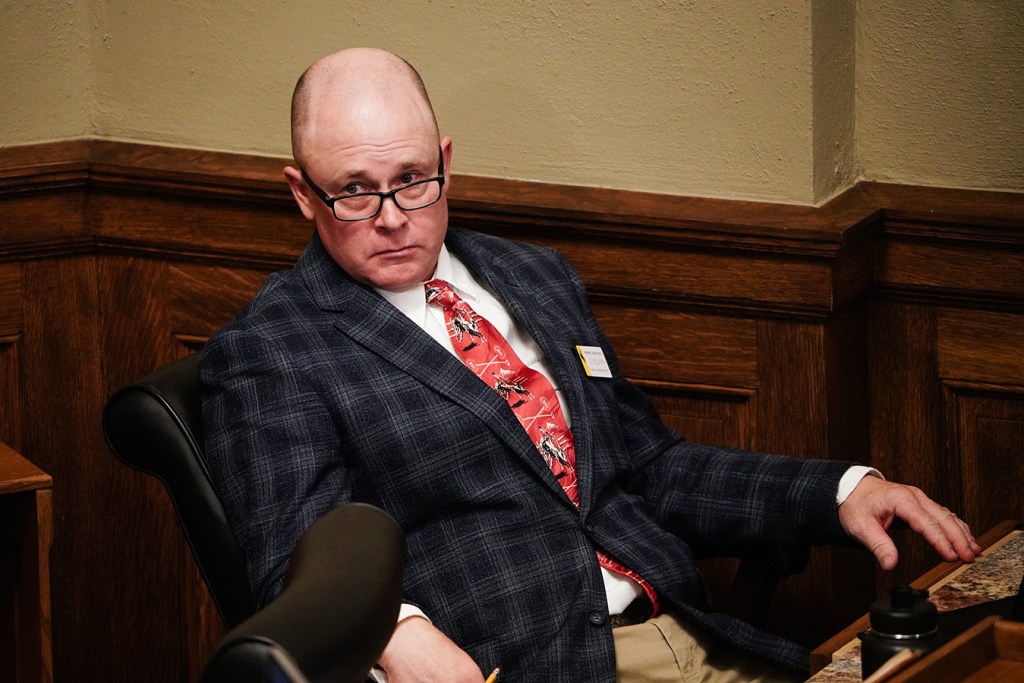
“I don’t believe the Legislature intends to tie my district’s hands, or my local school board’s hands,” Williams said. “But the smaller the district, the more they are bound by the categorical grant arrangement.
“I don’t think the goal is to cut the secretaries, the custodians, paraprofessionals or extracurricular programs, but these are the hard conversations that I am having with my districts that are a direct result of moving from the block grant model to siloed categorical funding,” he said.
Many representatives spoke against the idea, saying that focusing money into the instructional silo would mean better pay for teachers.
“One of the reasons I believe that this bill came about to begin with was because we had the task and the assignment of making sure that some of our teachers were given the proper raises,” Rep. Pepper Ottman, R-Riverton, said.
Rep. John Bear, R-Gillette, said that “what we are saying is the classroom is the priority.”
“The classroom is really where the money needs to be focused so we can improve the outcomes in education,” he said.
But Gordon wrote Monday that in offering funding restricted to certain categories, the Legislature “may be signaling that these capacities need to be pruned by shorting them in this act’s formulation.”
Operational and instructional aspects of running a school district are different from what goes on in the classroom, but they are not inseparable, the governor wrote.
“My concern is that the instructional silo as currently contemplated may so unreasonably restrict school districts that they will be forced into an untenable position of either running the operational aspect of the district at a deficit or severely diminishing the operations,” Gordon wrote.
Both could compromise the instructional benefit of better-compensated teachers, he said. These negative effects, he continued, will be especially magnified in small, rural school districts, which may be “unintentionally penalized for the efficiencies of operating in singular buildings.”
Gordon wrote that his second concern with the instructional silo is an “unreasonable encroachment on the prerogative of local school boards.”
“I firmly believe that the best government is the one closest to the people. When the state government becomes overly prescriptive to school districts, local control is sacrificed,” Gordon wrote.