

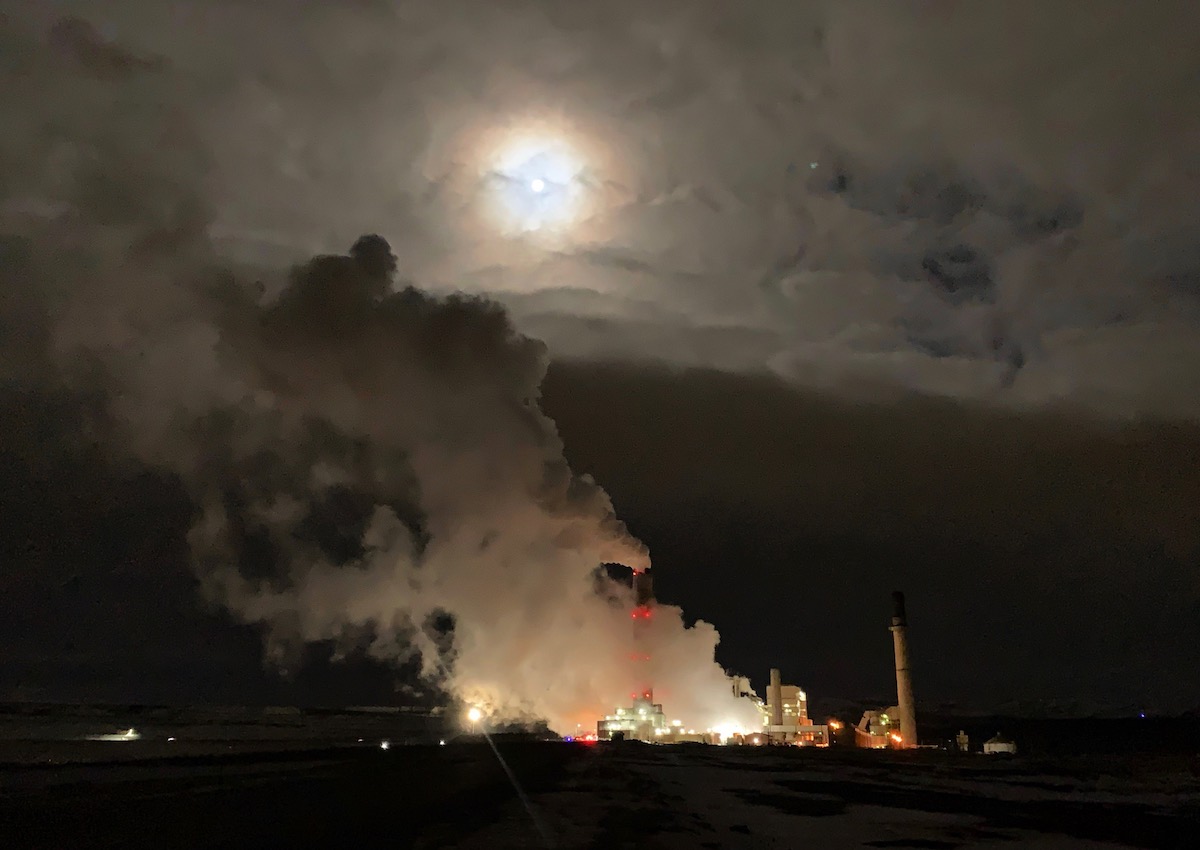
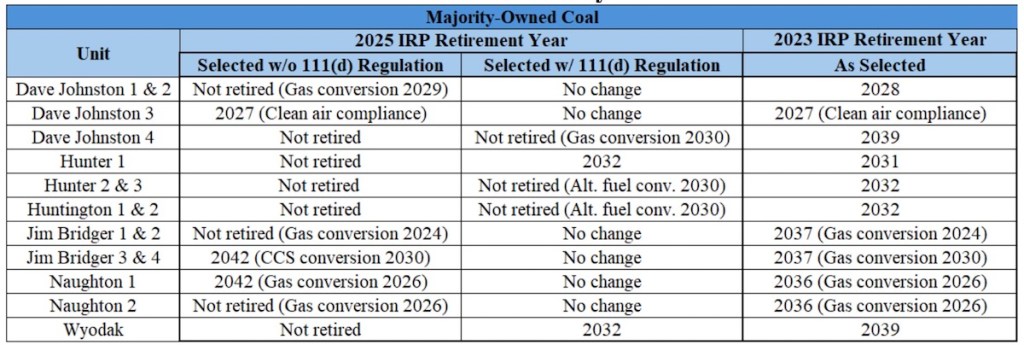
The last two coal-burning units at the Naughton power plant near Kemmerer are scheduled to go dark this month so crews can retool them to burn natural gas instead. A third coal-burning unit at the plant was switched to natural gas in 2020.
The power plant’s majority owner and operator, Rocky Mountain Power, determined that a $12.1 million expenditure to convert the two remaining coal units “was the least-cost, least-risk option for the company and its customers,” according to documents filed with the state.
“Coal operations are scheduled to cease on December 31, 2025 and natural gas operations are anticipated to commence in the spring of next year,” Rocky Mountain Power Senior Communications Specialist Jona Whitesides told WyoFile via email. The power plant employs 108 workers, according to Whitesides. “We don’t anticipate any layoffs as a result of the conversion to natural gas,” he said.
Naughton’s conversion is part of a larger trend. Rocky Mountain Power, a division of PacifiCorp, converted two of four coal-burning units at the Jim Bridger power plant outside Rock Springs to natural gas in 2024. The utility had planned on retiring two of four coal-burning units at the Dave Johnston plant outside Glenrock, but now intends to convert those units to natural gas in 2029, according to its most recent planning documents.
Naughton has been generating electricity since 1963, relying on the nearby Kemmerer coal mine, now operated by Kemmerer Operations LLC. Changes at Naughton, and what it might mean for the Kemmerer coal mine — frequently described by locals as an economic “lifeblood” — have been a source of anxiety for the Kemmerer and Diamondville communities.
The mine has shed about a third of its workforce in recent years, from 272 employees in 2019 to about 176 this year, according to federal data. Annual coal production has slipped from 3 million tons in 2019 to 2.4 million tons in 2024. The mine shipped about 1.1 million tons during the first three quarters of this year. Nearly half that volume went to Naughton.
Despite the loss of Naughton as a primary coal customer, Kemmerer Operations intends to continue business as usual and has no planned operational changes to report, according to the mine.
Declining coal and revenue
The Kemmerer mine has slogged through some hard times in recent years, including a 2018 bankruptcy filing by a previous owner, Westmoreland Coal Co., and a precipitous downsizing of workforce, including layoffs in March that cut 28 workers.
The mine serves other customers, according to local officials, including some soda ash operations near Green River. It’s unclear what other contracts the mine serves.
Despite what the future might hold for the mine, some local officials remain hopeful that Trump administration policies, as well as data center demand and new overseas market opportunities, may set the mine on the road to a comeback. Though Oregon and Washington have been cutting their use of coal, those states are “in a panic” due to recent grid reliability issues, asserted Kent Connelly, chair of the Lincoln County Board of Commissioners.
“Coal is still the cheapest and still the cleanest” fuel for utilities, Connelly told WyoFile. “Coal — it’s what pays the taxes in Wyoming.”
Though the coal industry’s outlook may improve, Naughton’s conversion away from the fuel is sure to sap local revenues, Connelly said. After the first Naughton unit was switched to natural gas in 2020, Lincoln County lost about $3 million in annual tax revenue, mostly due to decreased severance tax on lost coal production at the Kemmerer coal mine, he said.

“Going to natural gas will drop our revenue significantly,” Connolly said, adding that he holds out hope that Naughton may switch back to coal one day. “You’re seeing coal-fired power plants resurrected all over the United States right now.”
The legacy coal industry isn’t the only source of change in Kemmerer. Natural gas processing plants in the region have expanded and Lincoln County will soon be home to the $4 billion Natrium nuclear power plant now under construction.
The nuclear and natural gas expansions, as well as other potential industrial projects, provide some sense of security regarding jobs, local officials say. But whatever permanent tax revenue the Natrium plant might bring remains to be seen.
“The new power plant [Natrium] could offset [revenue losses from the mine] but it doesn’t start up until 2030 or 2031,” Connelly said.

I very much appreciate the factual reporting in this article. Thank you!
Some of the quotes from Commissioner Connelly, though, don’t seem very factual. It would have been nice to interview someone else to provide a more balanced perspective on the current state of the US coal industry.
Since they are shutting down in the middle of winter I assume their power isn’t really needed.
Continuing to place your bets on coal is a ”heads in the sand” approach to an economic problem that is not going to go away. Years ago Wyoming sold it’s soul to extraction industries and for a long time it paid off. It’s no longer the most viable option. The time has come now for us to demand a new approach to energy production in that doesn’t involve big holes in the ground and polluted air and waterways! And, quite frankly, I’m no real fan of endless acres of wind turbines either. What’s the answer? I don’t have a clue but I have faith that if we promote STEM education in our primary schools and fund higher education instead of finding ways to cut it every budget session we’ll find that someone does have the answer and I hope their from Wyoming!
Where are old fired coal power plants being resurrected? Name one. Coal is not the “Coal is still the cheapest and still the cleanest” fuel; it’s the opposite, today it’s consistently one of the the most expensive ways to generate electricity. That’s why the power plant operators have made plans to retire coal fired units and move to other sources of power generation. When the feds have to step in and force coal fueled powered plant operators from planned unit replacement this demonstrates that coal is not cheapest way to generate electricity. Feds forcing the coal fired power plant in Michigan to remain operational is costing over $600K per day, and that cost will be passed on the consumers.
Stop the pipe dream of local leaders (looking at you county commissioners, WY state freedom caucus reps, and the 3 reps in Washington, etc.) that thermal coal is going to come back. It’s on a downward trend, it’s been that way for years and it’s going to continue. That is a fact. The bust is not going to boom again. Denying reality doesn’t change it; it just prevents one from dealing with it effectively.
What does “When the feds have to step in and force coal fueled powered plant operators from planned unit replacement this demonstrates that coal is not cheapest way to generate electricity.” That’s even mean?
JH Campbell plant in Michigan. It was going to close and the feds have forced it to remain on-line. DOE keeps enforcing 90 extensions due to non existent energy emergency conditions. Same thing is expected for the Craig, CO station. And the Excel Pueblo CO station is going the keep the unit 2 online beyond the planned shutdown.
Apparently you don’t understand the grid.
I did not realize that the Craig units were also included in the “please stay on line, or else” movement. That impacts the availability of transmission capacity on the Craig-Ault path, which impacts the market for the Rail Tie wind project’s financials. The Rail Tie wind project was intended to use the Carg-Ault lines. Hmmmm…
To clarify. The J.H. Campbell plant was going to retired at the end of May 2025 and DOE has since then mandated 3 times that the operator has to continue the plant’s operation citing an electrical shortage emergency that is phoney. The operator had plans in place to replace the electrical generation when it was scheduled to shutdown and go offline but DOE at the last minute mandated that this plant had to remain online. DOE claims that the orders to extend the life of J.H. Campbell are necessary to help cover POSSIBLE energy shortfalls in the regional grid that is served by the Midcontinent Independent System Operator, Inc. (MISO). No such emergencies came to pass this past summer. In fact, MISO has stated that it “had 10 times the amount of unused resources available to it than the amount of energy Campbell was providing.” There are no shortfalls, this is a made up excuse.
The plant’s operator is being forced by the DOE to keep this plant online AND the operator stated that in the plans to close the plant that it would save their customers money due to using lower cost generation sources. They estimated a savings of $600 million by 2040.
In mid November Tri-State stated that it expects that DOE is going to mandate that the Craig Station Unit #1 will have to remain online past it’s planned closure date. Tri-State has replacement generation sources identified and in place that were to replace this unit as it went offline. Ultimately, Tri-State’s customers will be paying twice since they are already going to be paying for the replacement sources that were planned, and then they’ll have to pay for keeping the Craig Unit #1 operational under the DOE order if that is issued.
As far as I can determine, no coal-fired generating units that were fully retired have been restarted (“resurrected”) in the U.S.A. Planned coal-fired unit retirements have been either delayed, have been converted to other fuels, or have plans to switch fuel. Coal supply to the remaining existing units may indeed rise due to increase in electric power demand, which would increase unit capacity factors.
A generating units capacity has nothing to do with giving it more coal. A unit designed for 350 MWs cannot generate more because you added more coal. Not to mention that boilers have capacity limits as well, based on size and design. There are also regulatory considerations for increasing an existing units capacity.
I indicate a potential increase in capacity FACTOR, not capacity. There’s a difference. For instance, an existing coal-fired unit, that used to operate pedal-to-the-metal 24×7, now may operate at reduced or minimum load for significant periods, due to “market conditions”. This reduces the capacity factor. If the market improves (e.g. demand increases), that unit may spend less time at lower loads, which increases the capacity factor. More load=more coal burned=more coal used.
Examples:
A generating unit rated at 500MW nameplate capacity operates at max capacity 365x24x7. It’s capacity factor is 100%.
Another 500 MW generating unit that cycles output from max capacity for 12 hours, and lowers to half capacity for 12 hours, 7 days per week, year round, has a capacity factor of about 75%.
Which one burns more coal per year?