

by Dustin Bleizeffer
Lawmakers will consider draft legislation to allow large consumers of electricity — such as crypto-currency and blockchain miners, chip manufacturers and data centers — to contract for power outside the regulated utility market.
Proponents say it’s a means to attract new businesses that require significant amounts of electricity — more than Wyoming’s established utilities can quickly build — and that are currently setting up shop in deregulated markets like Texas. Others warn that any form of deregulation is a risky proposition that could result in higher costs and less reliability for the remaining customers who cannot opt out of the regulated utility market.
Lawmakers say they want to create a system that allows for deregulated power arrangements while protecting average ratepayers from those potentially risky deals. The Joint Minerals, Business and Economic Development Interim Committee will discuss two draft bills, Industrial power zones and Direct electric utility service agreements, when it meets Oct. 27-28 in Casper.
The industrial power zones measure would authorize regulatory exemptions for power consumed on state-owned lands that would be designated for deregulation. The direct electric utility service agreements would take a different approach. Rather than deregulated zones, this measure would allow any electric power producer to sell dedicated power generation outside the confines of regulated utility rules to industrial customers regardless of where they locate in the state.
In either case, the newly deregulated customers would presumably pay lower rates, according to proponents. That’s because rates would be calculated on only the power and infrastructure they use rather than based on the cost of larger utility systems — power plants, substations and electrical transmission lines — that serve thousands of customers over a large geographic area.
Whatever tack the minerals committee takes, some type of deregulated mechanism is necessary, according to Sen. Chris Rothfuss (D-Laramie), a proponent of limited deregulation. That’s because the state is constantly fielding calls from crypto-currency and blockchain miners eager to come to Wyoming for its raft of banking laws intended to spur the industry.
What turns them away, though, is that their business model requires the cheapest electricity possible — not Wyoming’s “fairly cheap” commercial rates, Rothfuss said. Regulated utilities in the state simply are not motivated to take on new customers outside the regulated monopoly system that gives them a guaranteed rate of return.
“We have this weird system that actually excludes any large projects that use large amounts of electricity from happening in the state of Wyoming,” said Rothfuss, who co-chairs the Select Committee on Blockchain, Financial Technology and Digital Innovation Technology. “So what you would want, ideally, is an isolated microgrid where you have a company that owns a power supply.”
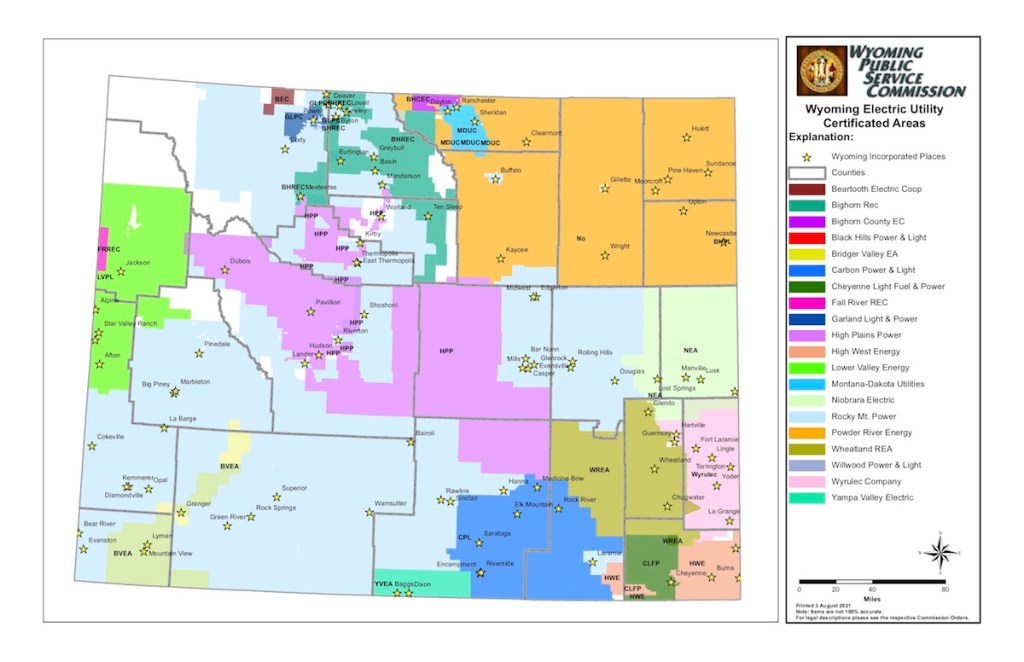
Wyoming Rural Electric Association, which represents 14 co-ops in the state, opposes the legislation, according to the group’s executive director Shawn Taylor. The state’s largest regulated utilities, Black Hills Energy and PacifiCorp, are lukewarm on the idea. Last session, a similar measure, Senate File 71 – Deregulated industrial power zones, failed.
Weighing deregulation
Wyoming’s average retail price for electricity is 8.7 cents per kilowatt hour compared to the national average of 10.59 cents, according to the U.S. Energy Information Administration.
One of the reasons Wyoming ratepayers enjoy a moderate electricity rate is because large commercial customers — strip mines or oil and gas processing plants, for example — pay higher rates and help keep the shared cost of the broader utility grid low. Some worry that if the state begins to carve large industrial customers out of that shared-cost system, rates will go up for other customers.

“We can’t just dip our toes into energy deregulation,” Powder River Basin Resource Council attorney Shannon Anderson said. “It really is a different way of managing the power grid.”
Creating deregulated zones, or isolated industrial microgrids, doesn’t benefit the larger electric utility system that serves the state, according to Anderson. Some also consider crypto-currency and blockchain mining risky endeavors. If a utility builds a new power generation source to serve a data-mining center and that customer goes belly up, the utility and the rest of its customers could end up paying for the investment.
“If the utility takes on bad debt, it’s coming back to ratepayers one way or the other,” Anderson said.
Crypto-currency and blockchain mining, as well as data centers and microchip manufacturing facilities, all require large amounts of electricity. Globally, the crypto-currency industry consumes more power than Argentina or Australia, according to a White House fact sheet. Rothfuss estimates dozens of companies have expressed interest in coming to Wyoming, each requiring on the order of 50 to 200 megawatts of electricity. One megawatt is enough to power 400 to 900 homes.
Wyoming has a net generation capacity of 9,599 megawatts, according to the EIA.
“We have this weird system that actually excludes any large projects that use large amounts of electricity from happening in the state of Wyoming.”
Sen. Chris Rothfuss (D-Laramie)
The state is well-suited to accommodate the new power demand, Rothfuss said, via natural gas power turbines, wind energy and even existing coal-fired power plants that might otherwise be retired. Wyoming also has a vested interest in selling more of the power it generates to customers inside the state. Currently, Wyoming exports more than half the power it generates.
“We get sales tax on every kilowatt consumed in the state of Wyoming,” Rothfuss said. “We get zero sales tax on every kilowatt consumed out of the state of Wyoming. So every kilowatt that is sold elsewhere, we’re losing money.”
Black Hills Energy recently contracted with a crypto-currency mining company, Bison Blockchain, under the state’s new Blockchain Interruptible Service Tariff, authorized by House Bill 113 – Special electric utility agreements in 2019. The tariff allows Black Hills to purchase market power to provide 45 megawatts of power to Bison Blockchain, which plans to set up shop at the North Range Business Park outside Cheyenne.
The new tariff allows Wyoming utilities to strike deals with crypto miners, Rothfuss said, but it doesn’t necessarily entice utilities to build new power generation in the state.
“Still, what we’re hearing is it’s largely insufficient, partly because the utilities really don’t have the power available,” Rothfuss said.

Thanks for the informative article Dustin. We should be actively discouraging crypto miners from settling in Wyoming. Let them go to Texas. They are parasites on the power grid, produce nothing of value, and every job they bring costs far more in public services than they pay in taxes.
The whole point of regulations is and always has been to bring common sense, fairness, and predictability to the marketplace. In my opinion, deregulation, whenever and wherever it has happened, has brought avarice, unfairness and wild unpredictability to the industry that has been deregulated. Furthermore, whenever large players, from the airlines to online marketing companies–you know who I mean–offer to come to states that give them special favorable treatment, it is the locals who always get hurt in terms of lower tax revenues. A pox on the lot of them!
Lawmakers when asked to encourage the movie and TV industry to do business in our state: “never”
Lawmakers when asked to encourage a online scam industry run by grifters: “Do whatever you want!”
Exactly the case. Apparently, Republicans like scam artists and conmen. Bringing in unregulated power will work like it does in Texas, with its power outages in the winter or periods of high heat, just when the voters need it the most.