Wyoming’s legislature shifted around education money in its second reading of the budget, putting more toward K-12 salaries and retention pay for University of Wyoming professors.
After a hard-fought debate on Tuesday, members of the House voted 37-22 to restore a pay raise for K-12 teachers. The Joint Education Committee and Gov. Matt Mead (R) had recommended increasing teacher salaries by 2.675 percent, which the Joint Appropriations Committee reduced to 1.7 percent in the draft budget bill.
Today’s action directs $6.6 million to school districts, some of which believe inflation is eroding the purchasing power of teachers’ salaries. The increase comes on top of a 2014 pay raise, which was reduced from Gov. Mead’s initial recommendation.
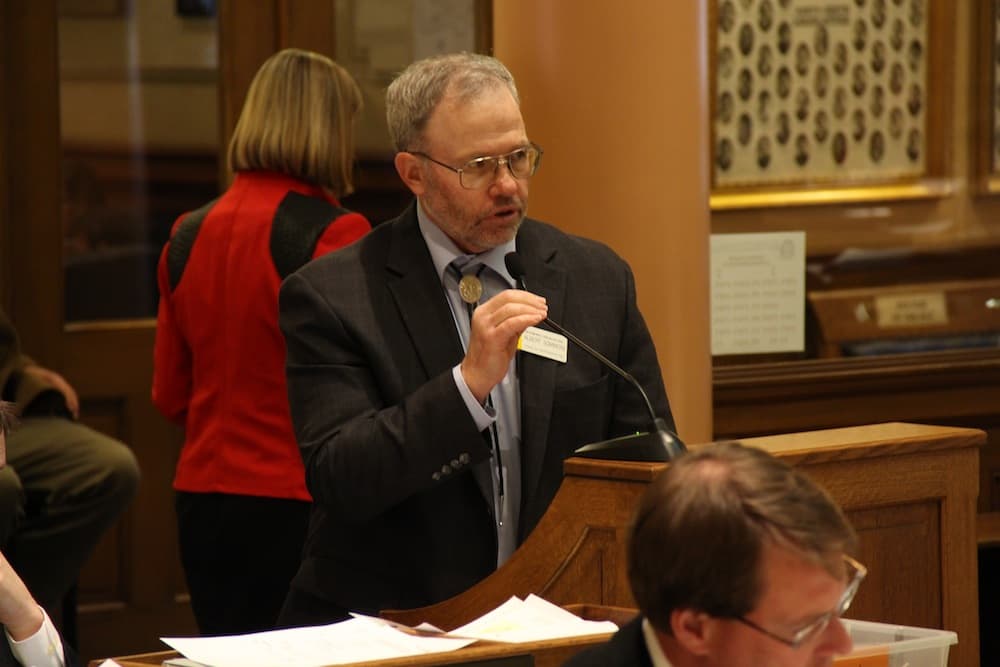
Amendment sponsor Rep. Albert Sommers (R-Pinedale) said the salary increase is needed so that the legislature complies with the State Supreme Court’s recommendation to consider a pay adjustment for teachers every two years. That recommendation comes from paragraphs 89 and 90 of the 2001 decision State of Wyoming v. Campbell County School District.
Rep. Marti Halverson (R-Etna) said the teacher pay raise would help with the rising cost of living where she lives in Star Valley. “Inflation is the hallmark of this recovery from this recession, and we have to make our rural schools whole,” Halverson said.
Senate education amendments
The Senate adopted an amendment from Sen. John Hastert (D-Green River) to allow the University of Wyoming to include $1 million for retaining professors in its standard budget request for 2017-2018. The university has not kept pace with other higher education institutions that are spending more to retain top-performing professors.
The Senate also approved $15 million for the university to use as matching funds for unconventional oil and gas research — reduced from the $20 million proposed in the original budget bill. The money would come from investment returns in 2015.
Sen. Eli Bebout (R-Riverton) sponsored the amendment, which redirected $5 million in 2015 investment returns to community colleges to use as matching grant funds for disciplines directly related to Wyoming’s economy.
The amendment further replaces the 2015 money taken from unconventional oil and gas research using 2016 investment returns, with a corresponding reduction in community college matching funds from $20 million to $15 million. The House adopted a similar measure sponsored by Rep. Tom Walters (R-Casper).
Highway funding
Original language in the budget bill would appropriate $10 million to construct new passing lanes on Highway 59 and Highway 20/26, and $2 million for planning the projects. Another $5 million would go to the roads in 2016 if anticipated investment returns materialize.
Lawmakers rejected calls to increase spending on Highway 59 improvements, killing two amendments from Campbell County lawmakers.
Sen. Michael Von Flatern (R-Gillette) attempted to add $12.8 million to build passing lanes on the busy two-lane road through the coal and oil-rich Powder River Basin. Rep. Eric Barlow (R-Gillette) introduced a separate amendment to direct funds only to Highway 59, and not to Highway 20/26 between Casper and Shoshoni. Both measures failed.
Efforts to redirect automatic transfers fail
The House rejected several amendments that would have stopped automatic transfers of funds to the Legislative Stabilization Reserve Account, the Permanent Mineral Trust Fund, and a savings account for K-12 schools.

Under current statute, investment income that arrives at the end of the fiscal year in June automatically tips into several savings accounts.
The amendments, from Reps. Cathy Connolly (D-Laramie), Mary Throne (D-Cheyenne), and Mike Madden (R-Buffalo), would have left the money in liquid accounts until the following session. Doing so would reduce the use of temporary savings accounts, which some lawmakers say creates the artificial appearance of budget shortfalls. The sponsors argued their amendments would present a more transparent picture of the state’s available funds.
Rep. Steve Harshman (R-Casper) opposed the amendment to stop the automatic transfer to the LSRA, arguing that the process is already transparent.
Water for the university golf course

In the House, lawmakers tried but failed to kill a $4.8 million budget line item for the University of Wyoming’s Jacoby Golf Course.
The university pays $100,000 annually for municipal water to keep the course green. House Speaker Kermit Brown (R-Laramie) championed the appropriation to drill a well and build a new irrigation system, and helped fend off attempts to kill the funding.
However, the Senate passed an amendment that will require the university to apply for a grant to rebuild the irrigation system at the golf course. That grant would come from Water Development Account II, which pays for irrigation infrastructure projects across the state.
The final score on second reading
In total, the Senate adopted 22 of the 45 budget amendments introduced on second reading. Senators killed 19 other amendments, and withdrew four.
The House adopted 19 amendments to the budget. It killed 28 amendments, and withdrew eight.
Amendments for the third and final reading of the Wyoming budget will be posted Wednesday evening. Those could reverse many of the actions taken Tuesday. The Wyoming Legislature will debate the amendments Thursday.
Note: This story has been updated to reflect the 2016 fund flows in the Bebout amendment on unconventional oil and gas research.