


The push to take taxpayer money from public K-12 schools and divert it to private, religious and home schools is advancing in Wyoming, even while privatization advocates admit this violates the state’s constitution.
Opinion
Diverting public money to private, religious and home schools would further undercut local Wyoming K-12 public education, which has struggled to retain teachers in recent years because of low pay, even as student achievement has remained high.
The idea for “Education Savings Accounts,” commonly known as “vouchers,” failed in the Legislature last year after Speaker of the House Albert Sommers blocked it. Then, on the first day of the 2024 budget session, a bill sponsored by the Joint Education Interim Committee failed to obtain the two-thirds vote needed for introduction.
However, an alternative version, House Bill 166 – Education savings accounts-1 has passed the House and seems likely to become law.
Public schools are managed by elected boards from their local communities. I serve on the Albany County School District #1 board as a trustee, and every four years my neighbors have the opportunity to replace me with someone else if they think I’m doing a bad job.
“Education savings accounts,” which are funded with public money meant to pay for private school, have zero accountability for how the funds would be spent or who oversees the schools they pay for.
To be clear, this is my opinion on school vouchers and not an official stance of my school board.
Apparently, lawmakers believe that Wyoming taxpayers want to pony up tuition for children to attend Krusty’s Cringey Kindergarten — private schools are not required to screen staff for sex offenders — the Cheyenne Satanic Academy, or schools where students learn in science class that Wyoming’s abundant wildlife exists today because animals’ ancestors survived a worldwide flood aboard a boat.
Even a supporter of school privatization like Rep. Ocean Andrew (R-Laramie) has admitted the effort is on sketchy legal ground because of the Wyoming Constitution’s prohibition on using public funds for private or religious schools or giving money away to individuals.
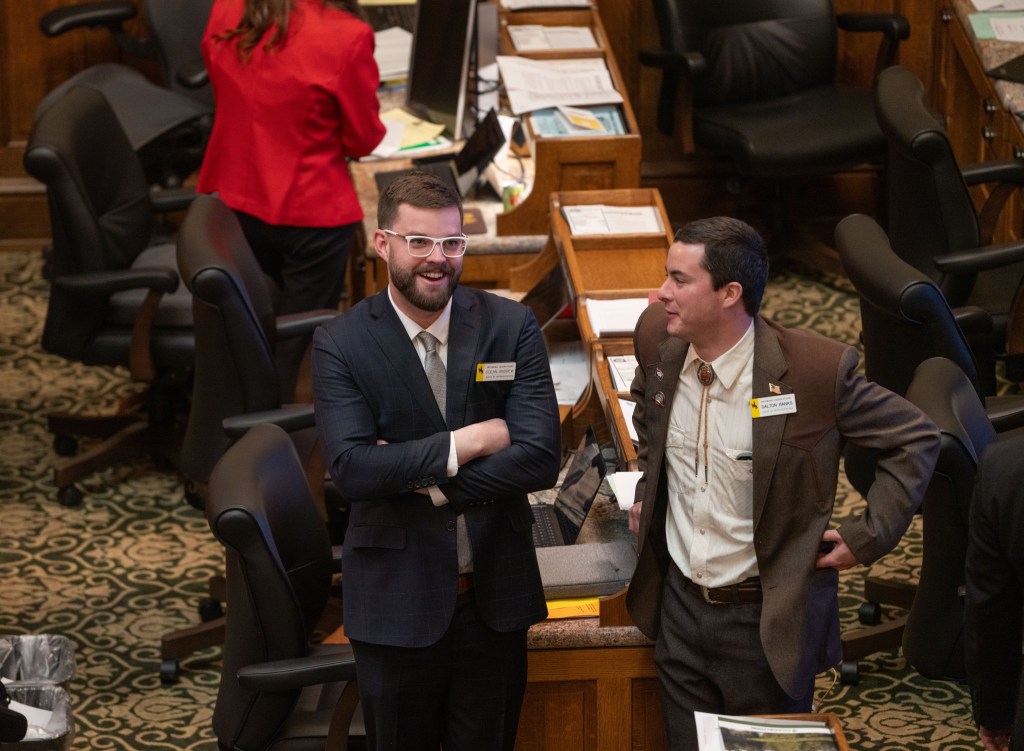
“Is it public money or is it private money?” he asked at a Joint Education Committee meeting in November. “Because if we were to change this bill on the basis that this is public money, then this whole bill actually is probably unconstitutional. The point of this and the way we make it constitutional is that this becomes private money when it’s in an [ESA] and the parents can appropriate it.”
But most supporters of shifting public money toward private schools know that even this is dicey.
Some members of the Freedom Caucus even discussed publicly before the session the idea of amending the Wyoming Constitution so that the Legislature could appropriate money to individuals and private and religious schools. This would essentially create a free government money dispenser for anyone lawmakers deem worthy.
No formal proposal along these lines appeared in 2024, but this will surely be waiting in the wings as the Freedom Caucus seeks to grow its ranks in the Legislature.
Arizona tried for two decades to build an education system in which “the money follows the student” wherever their parents want to send them.
Lawmakers finally succeeded, and as a result, the state’s education spending has ballooned — its budget is now $900 million in the red.
Meanwhile, student test scores in the Grand Canyon state are among the very worst in the nation.
Public schools are the bedrock of many Wyoming communities, especially in rural areas. They function as social centers, provide opportunities for entertainment and athletics, and generally play a huge role in many residents’ lives.
One of the biggest problems with taking money from public schools and giving it to private schools is that the latter tend to operate in more populated areas, where they can turn a better profit. This means education savings accounts divert resources from rural areas to urban ones, which will hurt small-town Wyoming.
For parents who have children requiring special education, public schools are a lifeline that gives their kids a chance for a better future.
But private and religious schools are not required to admit students who need special education. As a result, education savings accounts take funding away from public schools that are obligated to educate special ed students — often at high expense — and given to schools that may refuse to admit special ed kids, leaving even fewer resources for children who require more care.
Wyoming families tend to support their local schools — even if they know they’re not perfect — and at least they know that’s where their tax money is going. They also know that their local school districts are overseen by elected members of their communities whom they can hold accountable.
Wyoming parents are completely free right now to send their kids to private or religious schools, just not with taxpayer money.
That’s how it should be.

Concur. I oppose tax money going into vouchers to pay for private/religious school education. What would those students be taught in science class, for example? Would they be required to learn that Evolution is a hoax, that God created the universe in 4,004 BC based on the Bible, and that climate change is a false, liberal plot to destroy the Wyoming way of life? Personally, I would not trust such schools to provide a sound education to our kids.
Very good to see this opposition to bad public policy.
Thanks to Mr Martin for this important article, raising awareness of a VERY real threat to Public Education.
Let us ask our Legislators to vote NO on HB166-1 and keep Public dollars helping Public Schools and Education!
This bill will just result in a money grab with fly by night scams that overpromise and underdeliver as there will be no requirements and no oversight or expectations. The private schools won’t be held to the same standards as public schools so can operate at a lower cost – but will say it costs the same and pocket big profits. All the time siphoning money away from all students in the public education system. And lets not start on the separation of church and state by using public funds for religious schools.
I agree. Separation of Church and State is a must. I do not want my tax dollars paying for private/church schooling. It amazes me that this is even an issue, given the history of this sort of thing.
Hopefully someone will bring suit against the Wyoming theocracy. The state has turned into a big pile of mythological you know what.
This proposal is terrible. Clearly unconstitutional and likely to be challenged in court, if the bill passes.