
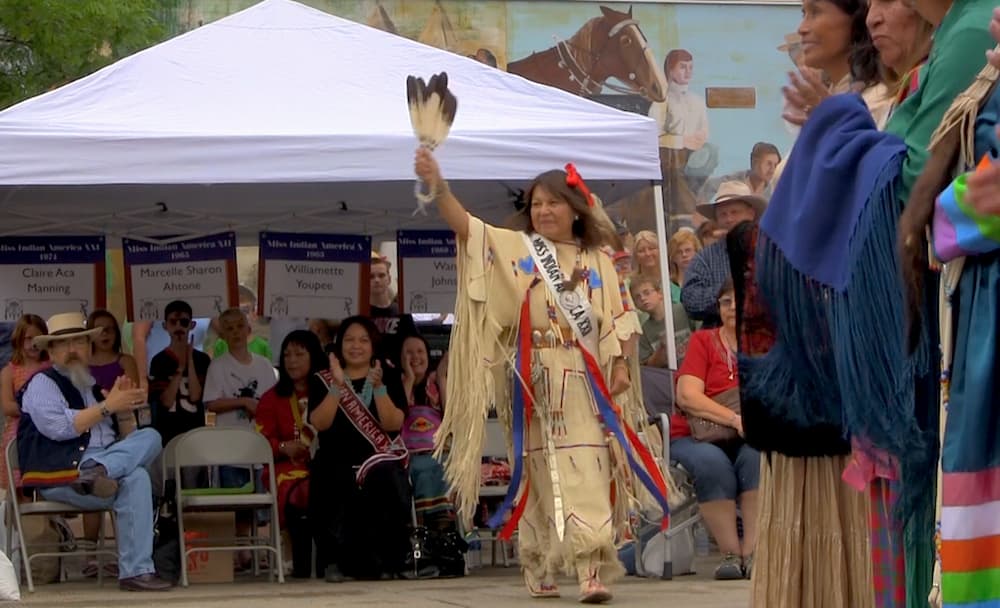
Miss Indian America 1976 Deana Harragarra Waters (Otoe-Kiowa) greets the crowd at the 2013 First People's Powwow at the Sheridan WYO Rodeo. The event was part of the 2013 Miss Indian America Reunion, the subject of a film that will appear on the Wyoming Chronicles series on Wyoming PBS at 7:30 p.m. Oct. 16. (Leon Schatz/Wayward Films)

In the years after World War II, Sheridan, Wyoming went from being “an Indian-hating town” in the words of Crow elder Joseph Medicine Crow, to being “the Indian capital of the world.” At least for a while.

That story is the subject of a short documentary film produced by WyoFile reporter Gregory Nickerson that debuted on OCt. 16 on Wyoming PBS as part of a Wyoming Chronicles episode on the Sheridan WYO Rodeo.

The film is titled No Indians or Dogs Allowed: Sheridan, Wyoming and the Miss Indian America Pageant, and documents the rise of an effort to end public prejudice against American Indians in Sheridan in the 1950s.

At that time, as Medicine Crow describes in the film, some businesses on Main Street had no qualms about denying service to American Indians from the neighboring Crow and Cheyenne reservations. They used signs to deny public accommodations to Indians, both men and women, young and old. Even American Indian war heroes like Medicine Crow were excluded.

But the election of a Crow woman named Lucy Yellowmule as rodeo queen — the first American Indian to hold that title at a Sheridan rodeo — sparked a public relations effort to take down the signs.

It also led to an annual celebration of Indian cultures called All American Indian Days, and its keynote event, the Miss Indian America pageant, which ran in Sheridan from 1953-1984. At its peak, the event hosted thousands of Indians from dozens of tribes, with more than 100 contestants for Miss Indian America.

The event moved to Bismarck, North Dakota in 1985 and ended in 1991. Yet it’s legacy lives on in pageants like Miss Indian World, Miss Indian Nations, and others, according to Susan Arkeketa (Otoe-Missouria/Creek), Miss Indian America 1978-1979. It also returned to Sheridan in 2013 and 2015 with reunions of former Miss Indian America titleholders.

Nickerson produced the film as an independent project with an all-Wyoming film crew, funded in part by the Wyoming Humanities Council, with in-kind support from the Sheridan County YMCA and Wyoming PBS producer Craig Blumenshine. Footage came from a reunion of Miss Indian America winners in 2013 and 2015, along with archival collections from the Sheridan County Fulmer Public Library and the Sheridan County Museum.

“This is an important story about building bridges, and how American Indians and Wyoming people tried to live up to our nation’s values of freedom and equality,” Nickerson said. “The pageant touched a lot of lives. As Miss Indian America 1976 Deana Harragarra Waters says in the film, it has a message that is still relevant today.”

The film aired on Wyoming PBS at 7:30 p.m. Friday Oct. 16, with additional showings at 6:30 p.m. Oct. 17 and noon on Oct. 18. It is also available to stream online on the Wyoming PBS website (and on WyoFile, see below) and will screen at the annual meeting of the Western History Association in Portland, Ore. on Oct. 23.
Join the Conversation

1 Comment

WyoFile's goal is to provide readers with information and ideas that foster constructive conversations about the issues and opportunities our communities face. One small piece of how we do that is by offering a space below each story for readers to share perspectives, experiences and insights. For this to work, we need your help.

What we're looking for: 

  • Your real name — first and last. 
  • Direct responses to the article. Tell us how your experience relates to the story.
  • The truth. Share factual information that adds context to the reporting.
  • Thoughtful answers to questions raised by the reporting or other commenters.
  • Tips that could advance our reporting on the topic.
  • No more than three comments per story, including replies. 

What we block from our comments section, when we see it:

  • Pseudonyms. WyoFile stands behind everything we publish, and we expect commenters to do the same by using their real name.
  • Comments that are not directly relevant to the article. 
  • Demonstrably false claims, what-about-isms, references to debunked lines of rhetoric, professional political talking points or links to sites trafficking in misinformation.
  • Personal attacks, profanity, discriminatory language or threats.
  • Arguments with other commenters.

Other important things to know: 

  • Appearing in WyoFile’s comments section is a privilege, not a right or entitlement. 
  • We’re a small team and our first priority is reporting. Depending on what’s going on, comments may be moderated 24 to 48 hours from when they’re submitted — or even later. If you comment in the evening or on the weekend, please be patient. We’ll get to it when we’re back in the office.
  • We’re not interested in managing squeaky wheels, and even if we wanted to, we don't have time to address every single commenter’s grievance. 
  • Try as we might, we will make mistakes. We’ll fail to catch aliases, mistakenly allow folks to exceed the comment limit and occasionally miss false statements. If that’s going to upset you, it’s probably best to just stick with our journalism and avoid the comments section.
  • We don’t mediate disputes between commenters. If you have concerns about another commenter, please don’t bring them to us.

The bottom line:

If you repeatedly push the boundaries, make unreasonable demands, get caught lying or generally cause trouble, we will stop approving your comments — maybe forever. Such moderation decisions are not negotiable or subject to explanation. If civil and constructive conversation is not your goal, then our comments section is not for you. 

Your email address will not be published. Required fields are marked *