


Within hours of announcing the new Childcare Provider Start-up Grant, several inquiries landed in the inbox of Wyoming Community Foundation’s Micah Richardson. That was despite the announcement coming in the thick of the holiday season.
“So it just makes you realize, OK, this is needed if that’s the kind of response we get within like two hours of this press release going out,” Richardson said. “So hopefully we can help tackle some of the issues and see if this does anything to help shore up these holes that we have across Wyoming.”
The program will give awards of up to $10,000 to child care providers for startup or expansion costs, prioritizing those serving communities with limited or no child care options and home-based providers. The community foundation is both part of the Interagency Childcare Working Group that launched the grant program and the entity that will administer it.
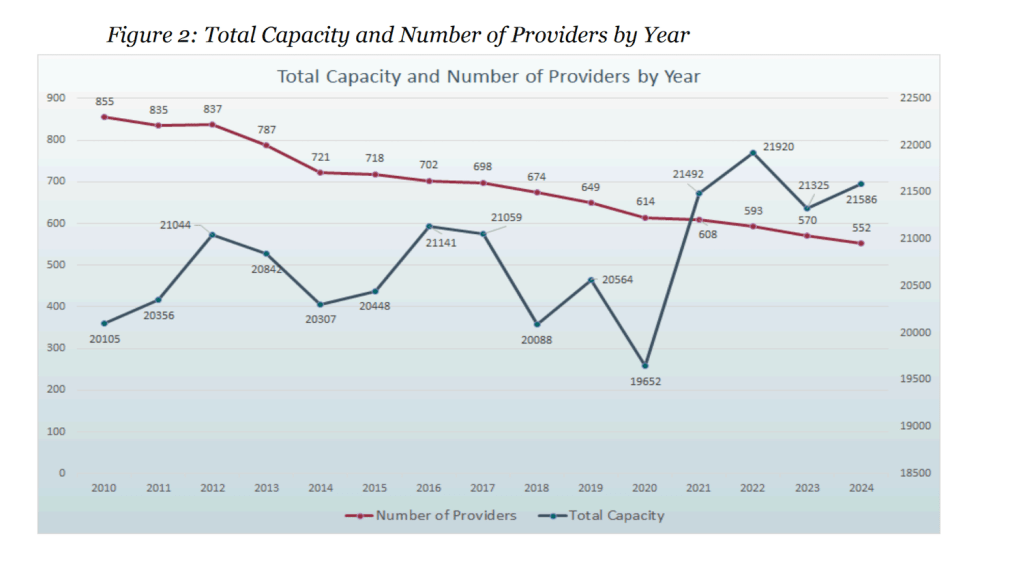
Considering the statistics, the definition of a community with limited options could apply to most of the state. The state’s provider tally dropped from 721 in 2014 to 527 in December 2024, according to the working group. Wyoming has a child care gap of nearly 30%, according to estimates from a 2022 assessment, which reflects the difference between the potential need for care for children under 6 and the supply.
And because child care is intrinsically linked to workforce health, the working group aims to accomplish more than rebalancing supply and demand. It hopes to help solve one of the state’s steepest workforce challenges.
“We’ve got probably around 10,000 people that are out of the workforce because of lack of access to child care,” said Kristin Fong with the Wyoming Business Council, another working group member. “What if those 10,000 people could rejoin the workforce?”
Lawmaker interest in addressing the issue legislatively, meanwhile, appears tepid. The No. 1 interim priority for the Legislature’s Joint Education Committee was studying early childhood education and child care. Chris Rothfuss, a Democratic senator from Laramie, proposed exploring a new state endowment to permanently fund early childhood education, but it was voted down.
Supply shortfall
It’s a common story around the country: Child care operators struggle to make ends meet with strict licensing regulations and workforce challenges. Parents struggle to find a spot for their kids. When they can’t, some are forced to balance work and child care, which makes full-time work tough. Others drop out of the workforce entirely to care for their children.
But Wyoming’s rural nature and unique characteristics have exacerbated the child care shortage issue here, with members of the working group arguing that a more reasonable way to view it is as “a significant business problem.”
Both the working group and the grant program are offshoots of a partnership between the Wyoming Business Council, state workforce and family service agencies and the Harvard Growth Lab. The partnership’s “Pathways to Prosperity” project, which started in 2022, set out to develop stronger pathways to sustainable prosperity across Wyoming, where the economy is lagging compared to neighboring states in the Mountain West.
“Much of rural Wyoming is functionally a childcare desert,” the group found.
Estimates point to more than 10,000 individuals who may be out of the workforce completely here due to a lack of child care, according to the group. At the same time, they say, Wyoming is facing a historically tight labor market — and the lack of child care further deflects potential new residents.
“Childcare is something in which states ultimately compete to attract businesses,” their report reads. “Childcare access for their workers affects their bottom-line and childcare access and cost are a problem nationwide. Wyoming is failing to compete and losing out on growth and opportunity as a result.”
The Growth Lab team zeroed in on the supply shortage when developing its child care policy recommendations released in July.
It urged the state to expend resources that could help both large child care centers and home-based operations startup and grow. These initiatives could resemble small business supports, removing unnecessary zoning regulations and offering small grants.
Real dollars
After the recommendations came out, working group members split up to focus on three initiatives: getting startup grants off the ground, exploring subsidies for child care workers and examining why child care businesses sometimes don’t access the full range of resources available to them.
A $50,000 grant from the John P. Ellbogen Foundation plus $30,000 from the Wyoming Community Foundation’s early childhood grant and contributions from others seeded the grant funding pool, and the Community Foundation stepped up to administer the program.
(The John P. Ellbogen Foundation and Wyoming Community Foundation are both financial supporters of WyoFile. Neither played any role in the repertorial or editorial decision making for this story.)
The new grants aim to boost supply by enabling new facilities to open or existing centers to grow.

Applicants must be licensed, working toward licensure or must accept child care subsidies. They can be nonprofit or for-profit entities. Grant funding can support a wide array of needs, including safety equipment, furniture, renovations, egress windows, kitchen equipment and fencing.
“We’re just trying to think of ways that there is some startup funding or some support funding to allow some sustainability,” Richardson said. “where these things that they’re applying for can help in the long run as well.”
Any applicant who submits will automatically be connected with free support services from The Wyoming Early Childhood Professional Learning Collaborative, the Wyoming Small Business Development Center and the Wyoming Women’s Business Center.
“Hopefully this will also provide another layer of support,” Richardson said.

The working group also hopes to glean insight from grantees about the realities and challenges of providing care.
“We’re going to keep that line of communication open with all the awardees so that we can learn from them about their experience starting a child care business in the state,” Fong said, “and offer supports that maybe we’re missing right now.”

Growing up in a rural agriculture area, my siblings and I often accompanied my parents in their daily chores. We never saw day care, and there was no kindergarten. I see nothing wrong with that. As a parent, from birth thru early adulthood, your responsibility is to nurture and promote a healthy family environment for your children. If that means that one or both parents make sacrifices in order to raise happy, well adjusted children, well then so be it.
“We’ve got probably around 10,000 people that are out of the workforce because of lack of access to child care,” I’m not so sure that this is a bad thing. Do we promote a full workforce over the full time job of raising a child?
I know that these two words are like tossing fuel on a fire but “planned parenthood” means more than just being pro-choice or birth control. To me what it means is being proactive in your approach to parenthood. Examine your finances, talk about sacrifices you’re willing to make, realize that taking an active role as a parent is time consuming and can be quite frustrating, but also rewarding.
Do I think that industry should have a role in providing child care for their workforce? Of course. A stable workforce directly benefits any business’ bottom line. Do I believe that throwing free grant money out to attract growth among providers is the answer? Nope, there is no such thing as free money, and problems are not resolved in the long term by throwing money at them. It just prolongs the inevitable.
I would like to see an emphasis on big business solutions as well. The employers need to take on part of the answer of daycare. For instance, a shift based daycare attached to the Sinclair Refinery so a parent could work the type of shifts available. These and other jobs in the extractive fields are high paying for single mothers, yet out of the realm of possibility without flexible daycare. This same idea could also be applied to hospitals, distribution centers and manufacturers. Imagine being able to attract a workforce when daycare is available….and the loyalty of an employee whose employer understood their child care needs.
Childcare should be state funded, we sock away billions of dollars in investments to “save for the future” when spending a fraction of that money on childcare actually does secure our future.