
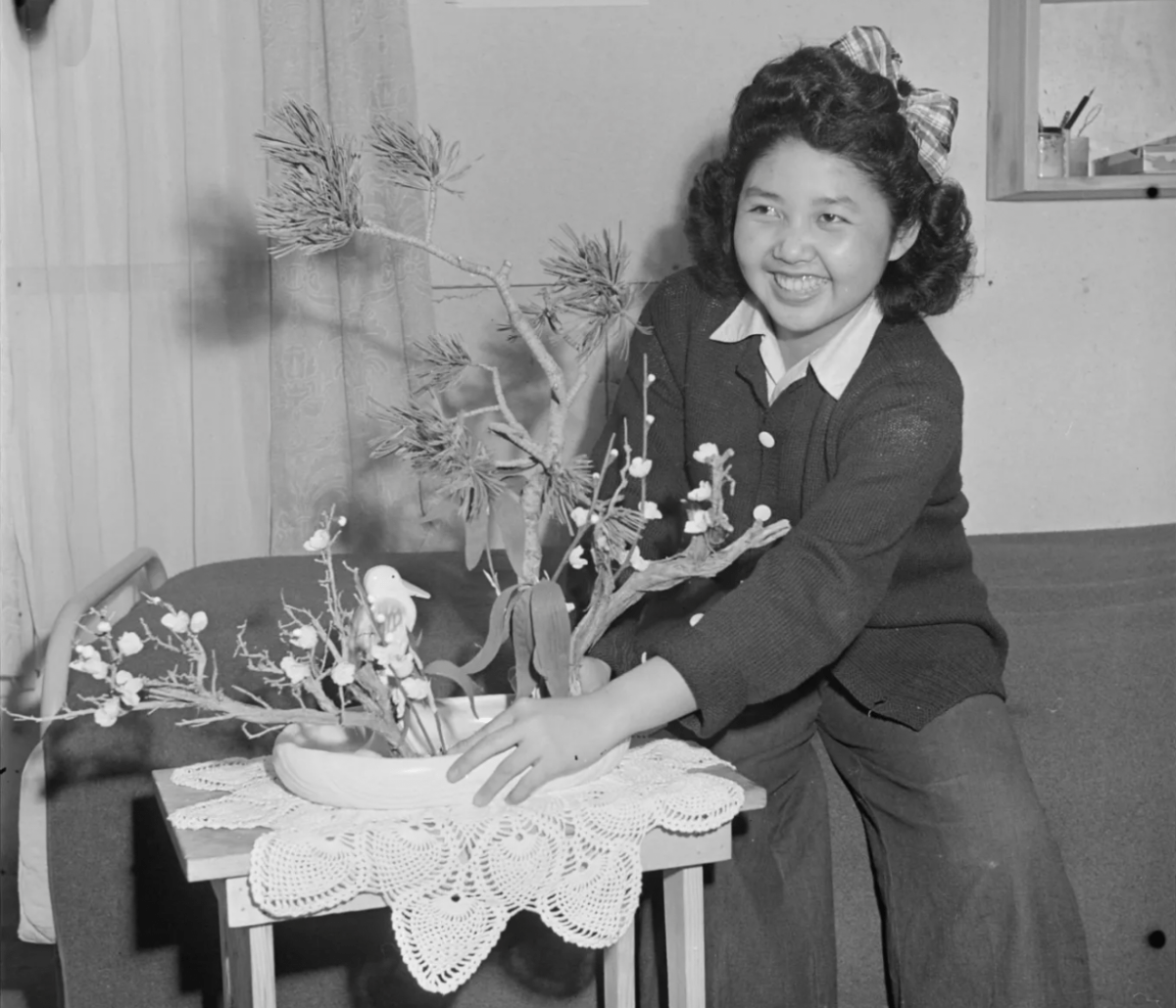
New Year’s celebrations and traditions are important in Japan, and were likewise important to many of the Americans of Japanese ancestry forced to live in Wyoming’s Heart Mountain WWII Japanese American Confinement Site between 1942 and 1945.

Ruby Hifumi, 16, was photographed with a special arrangement she made to celebrate the new year of 1943 while detained at Heart Mountain. These types of holiday arrangements are called kadomatsu, and tend to be created with pine boughs, bamboo and flowering plum branches. 

Hifumi here used paper bamboo, paper flowers on a sage branch and real pine.

“The flower arrangement of the three materials symbolizes in order, hardness, courage and strength,” the photograph’s original caption reads. 

As of Jan. 1, 1943, the camp confined 10,767 prisoners, according to the Heart Mountain Wyoming Foundation. Using 1940 census data, it would’ve been Wyoming’s third-largest community at the time.
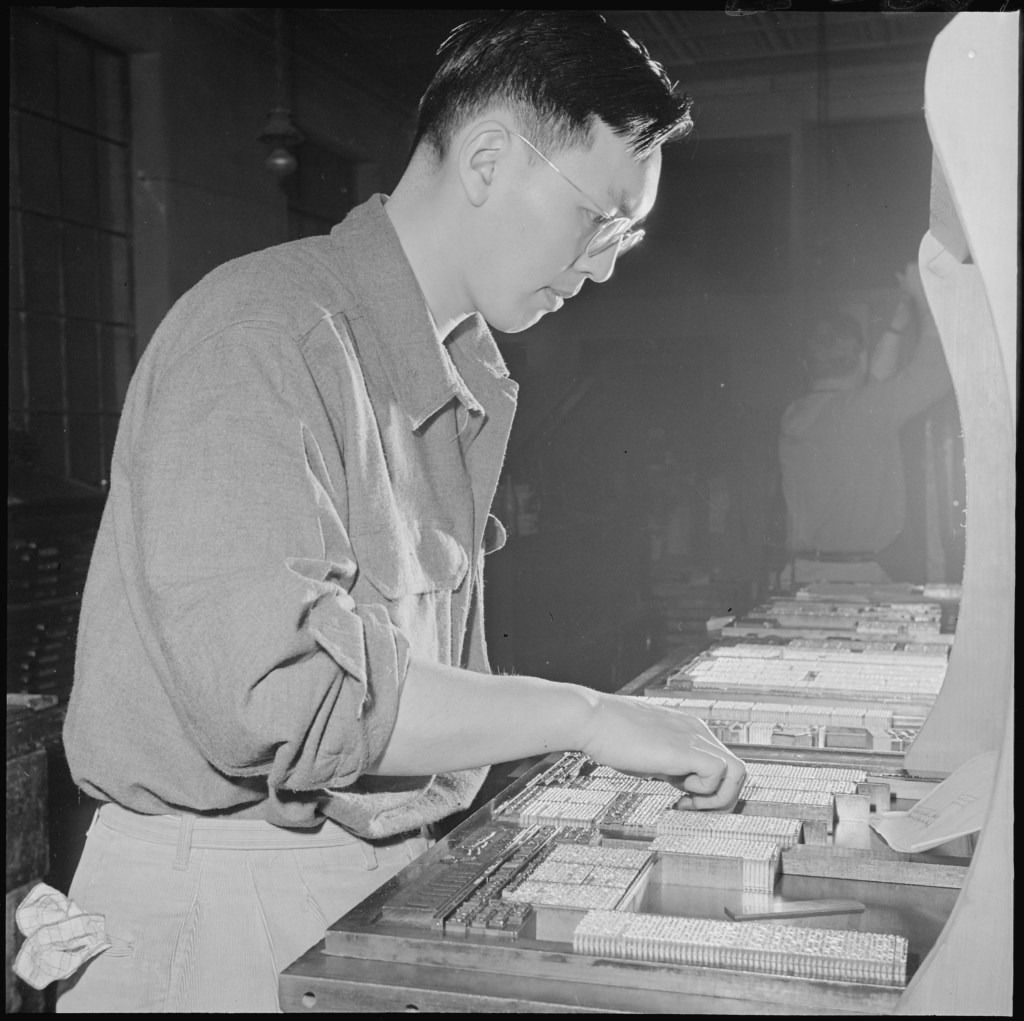
A young man with glasses moves around printing press materials
“In the press room of the Cody Enterprise, Bill Hosokawa, Editor of the Sentinel, Heart Mountain Relocation Center newspaper, prepares the final makeup for the weekly edition. Leave regulations will allow only one member of the staff to leave the center, so Bill performs all the necessary jobs, type setting, makeup, form locking, and all necessary press work in order to get out the edition.” – Jan. 8, 1943. (Tom Parker/War Relocation Authority/National Archives Catalog)

Behind the lens

Colorado native Thomas Parker — who took this picture — visited a handful of Japanese internment camps around the country. His images, including this one of Hifumi, are in the National Archives. 

Among those images are also people at Heart Mountain learning to ice skate, working on a newspaper printed out of the Cody Enterprise office, playing games, taking classes and sitting in stylish living rooms created from almost nothing but scrap wood and ingenuity.

A man and a woman hold onto eachother's hands while trying to ice skate
“Centerites at Heart Mountain were quick to grab the recreational opportunities of cold Wyoming winters. Shallow ponds were prepared and flooded for ice skating. Here a former California boy and girl try out what to them is a brand new sport.” – Jan. 10, 1943. (Tom Parker/War Relocation Authority/National Archives Catalog)

While thousands of Japanese Americans living near the West Coast were forced to relocate to under-prepared camps like Heart Mountain, those already living in Wyoming remained free. The Heart Mountain Interpretive Center is a Wyoming museum dedicated to teaching future generations about this dark moment in U.S. history.  

All three branches of government have recognized Japanese internment camps as racist overreaches of governmental power. Still, hundreds of those within the camps joined the military and fought for a country that stripped them of civil liberties.

As we head into yet another new year, this is a reminder of the Equality State’s past — both the painful and joyous parts of it — and a reminder of the diverse cultures and celebrations Wyoming remains home to.

Madelyn Beck reports from Laramie on health and public safety. Before working with WyoFile, she was a public radio journalist reporting for NPR stations across the Mountain West, covering regional issues...

Leave a comment

WyoFile's goal is to provide readers with information and ideas that foster constructive conversations about the issues and opportunities our communities face. One small piece of how we do that is by offering a space below each story for readers to share perspectives, experiences and insights. For this to work, we need your help.

What we're looking for: 

  • Your real name — first and last. 
  • Direct responses to the article. Tell us how your experience relates to the story.
  • The truth. Share factual information that adds context to the reporting.
  • Thoughtful answers to questions raised by the reporting or other commenters.
  • Tips that could advance our reporting on the topic.
  • No more than three comments per story, including replies. 

What we block from our comments section, when we see it:

  • Pseudonyms. WyoFile stands behind everything we publish, and we expect commenters to do the same by using their real name.
  • Comments that are not directly relevant to the article. 
  • Demonstrably false claims, what-about-isms, references to debunked lines of rhetoric, professional political talking points or links to sites trafficking in misinformation.
  • Personal attacks, profanity, discriminatory language or threats.
  • Arguments with other commenters.

Other important things to know: 

  • Appearing in WyoFile’s comments section is a privilege, not a right or entitlement. 
  • We’re a small team and our first priority is reporting. Depending on what’s going on, comments may be moderated 24 to 48 hours from when they’re submitted — or even later. If you comment in the evening or on the weekend, please be patient. We’ll get to it when we’re back in the office.
  • We’re not interested in managing squeaky wheels, and even if we wanted to, we don't have time to address every single commenter’s grievance. 
  • Try as we might, we will make mistakes. We’ll fail to catch aliases, mistakenly allow folks to exceed the comment limit and occasionally miss false statements. If that’s going to upset you, it’s probably best to just stick with our journalism and avoid the comments section.
  • We don’t mediate disputes between commenters. If you have concerns about another commenter, please don’t bring them to us.

The bottom line:

If you repeatedly push the boundaries, make unreasonable demands, get caught lying or generally cause trouble, we will stop approving your comments — maybe forever. Such moderation decisions are not negotiable or subject to explanation. If civil and constructive conversation is not your goal, then our comments section is not for you. 

Your email address will not be published. Required fields are marked *