


“Making visual art,” Ginnie Madsen said, “gives one a chance to think without words.”
I first became acquainted with Jon and Ginnie Madsen’s work through Touchstone Laramie, the biennial community-artist exhibition.
We spoke about their creative process and their work as artists at their home in Laramie. Both having taught art classes at the University of Wyoming, our conversation naturally became that of student and teacher, one where I learned how they communicate through visual language.
Jon’s paintings are often inspired by a metaphorical or philosophical question while Ginnie’s typically draw on a memory or specific landscape, but they both lead the viewer into their worlds.
Ginnie paints with oils and watercolors and makes prints. Though her paintings are composed of delicate details and an array of colors, it is her printmaking that fascinates me and for which she is best known.
“Printmaking makes me simplify things,” she said, because she can’t get picky with the details. Unlike a watercolor or an oil painting, her prints may have up to four layers of colors. What I perceived as shadows in her piece “Light Stream,” she explained, was enhanced by the omission of paint.
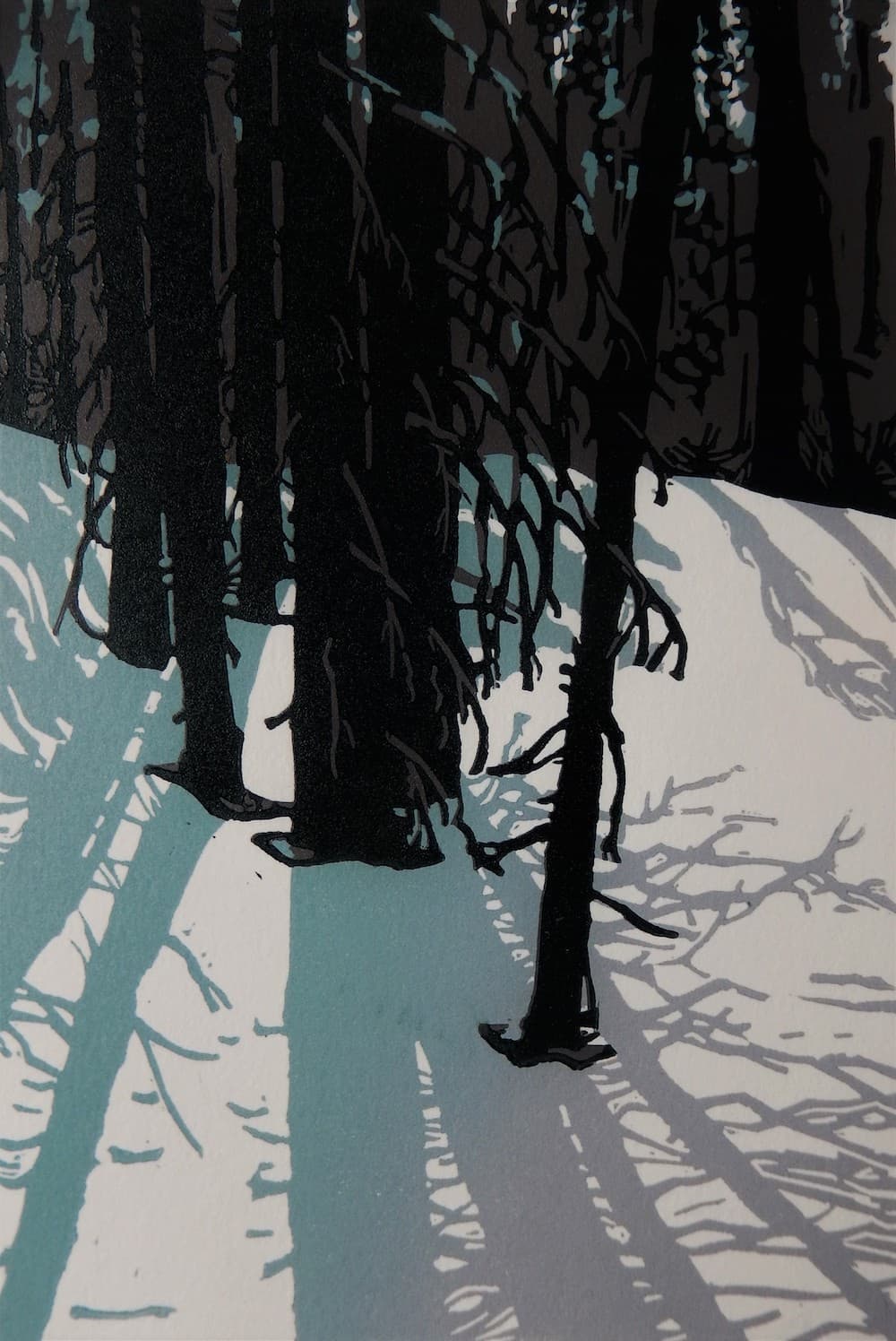
The printmaking process is at once simple and complex. The artist carves the first layer of image that she would like to make — either drawn from a photo or watercolor — into a linoleum block. Then she inks the block using a roller and presses it to the paper. The block can then be carved further, re-inked and printed again. This process is subtractive and one that artists have practiced for a long time. There is no room for error but there may be space for magic, she explained.
“I’m open to what happens during the process,” she said. Though she starts with a specific result in mind, if changes come, she works with the unexpected and uses it to her advantage.
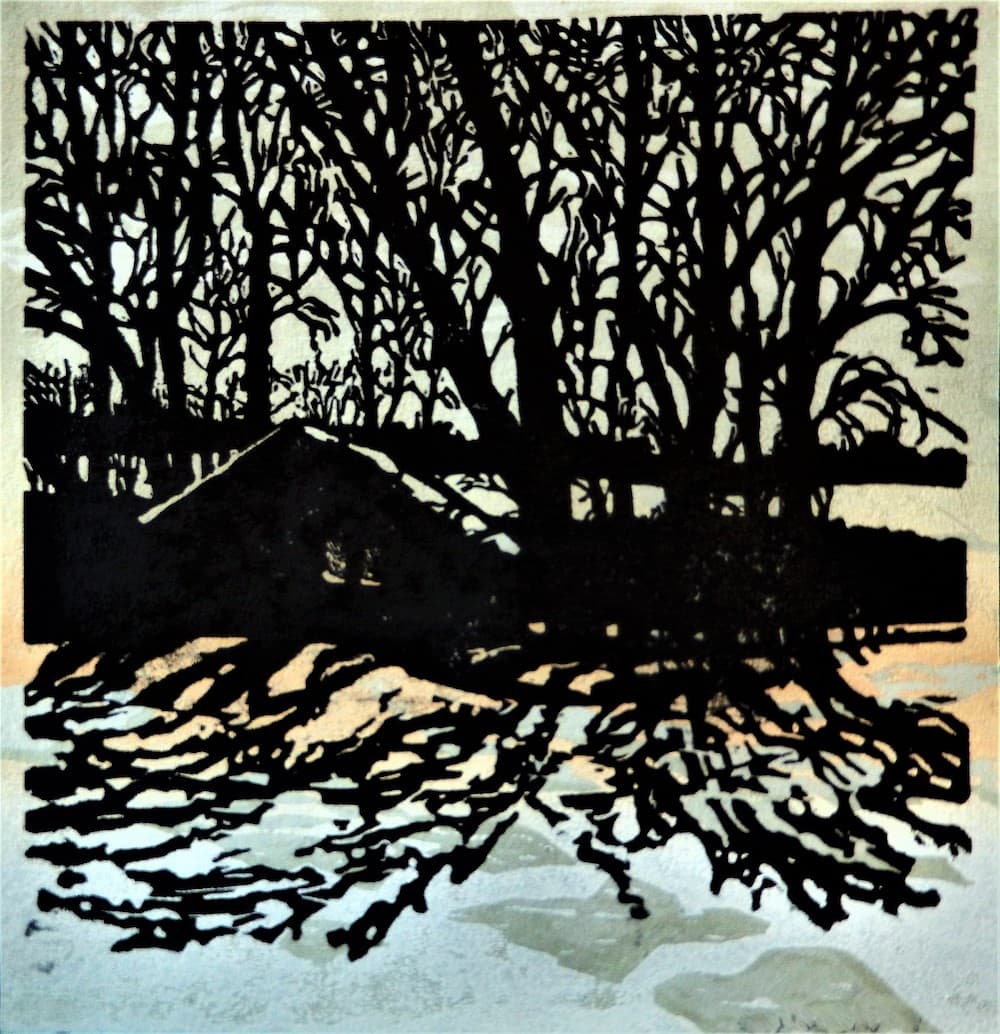
Time halts in Ginnie’s pieces. She captures the serenity of morning or evening light, a Christmas snow, a moment in nature. Looking at her prints, I have the sense that I may have been there before. I recognize in her subtle blending of colors something I have experienced, and I want to stay in the familiar.
Ginnie also paints contemporary oils. Though different from her prints, “They are two modes of thinking and each feeds the other,” she said.
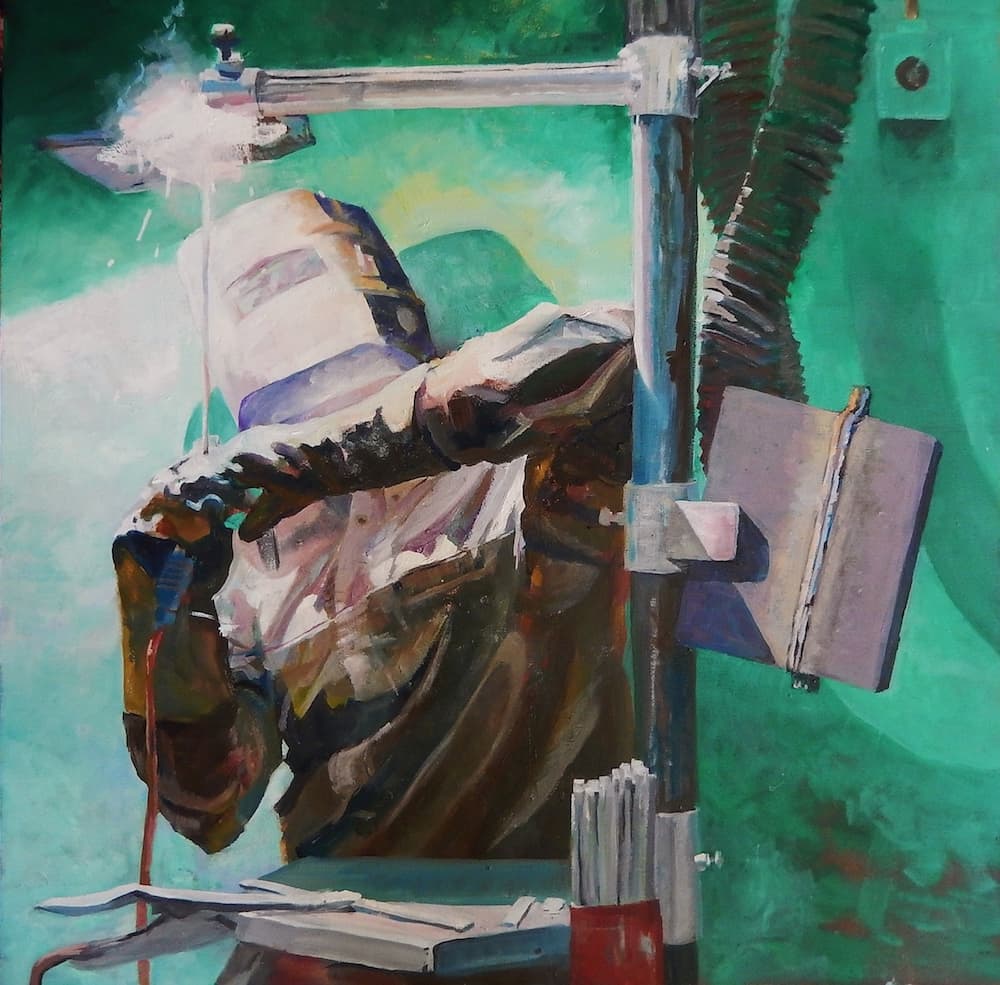
Her oils are observational, and often painted on site. Recently she had four paintings chosen for the Art in Public Buildings program at Eastern Wyoming College where they hang in the Career and Technical Education Center. The paintings are active scenes of the welding and cosmetology programs. They are colorful, full of details, and reflect the people and the skills taught in the programs.
Jon Madsen primarily paints with oils, though he too does many of his studies with watercolors. He paints landscapes, figurative images, and abstracts. Jon takes an imaginative approach to his work, not necessarily painting specific places. Many of his abstract pieces include roads, a familiar image to Wyoming residents. Of why he paints roads he said, “We are always moving in life in some direction. Going from here to there we can see a little or a long way.”
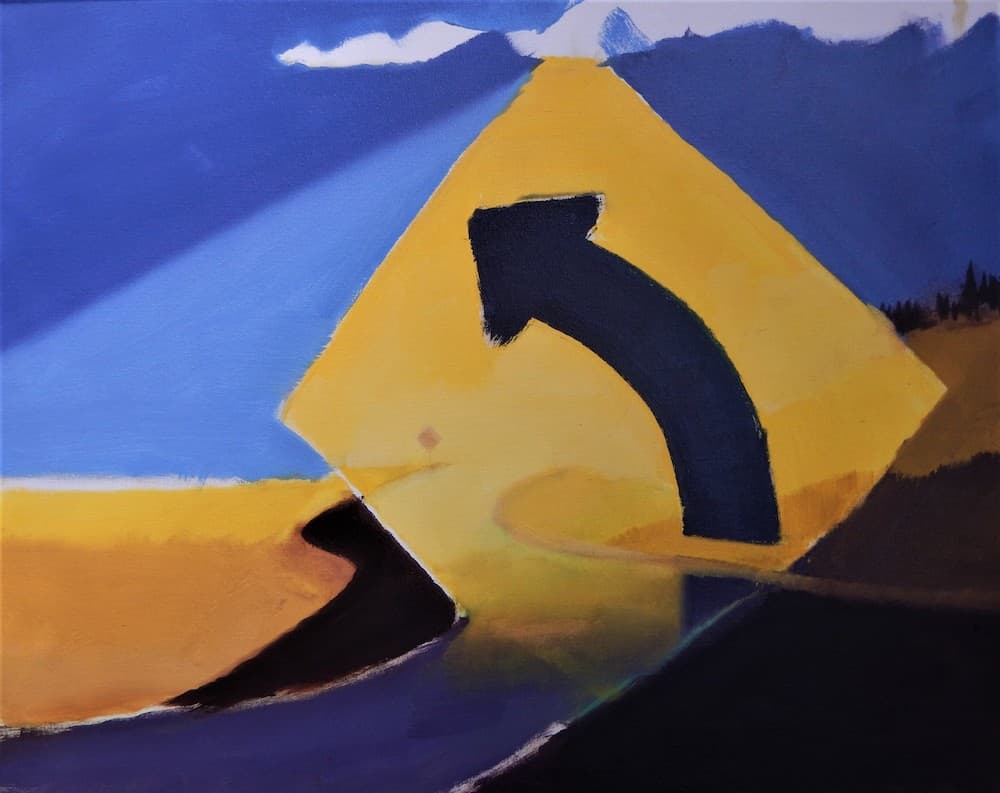
Just as roads may look as though they approach the sky, disappear and reappear along the horizon, the sense of movement and the illusions created by the imagery offer rich symbolism. A viewer might think about what is seen, and unseen, around the bend or in the distance. The road might also be a metaphor for movement, whether physical, mental, emotional or spiritual. “We are all making our way,” he said.
Jon has painted several figurative oils of Ginnie. I find his paintings of her endearing. His admiration of her is evident in his depiction of her routines — reading, knitting, resting in the sun. “Like a mechanic we have to know how appearances work,” he said of his examinations of light, shade and scale.
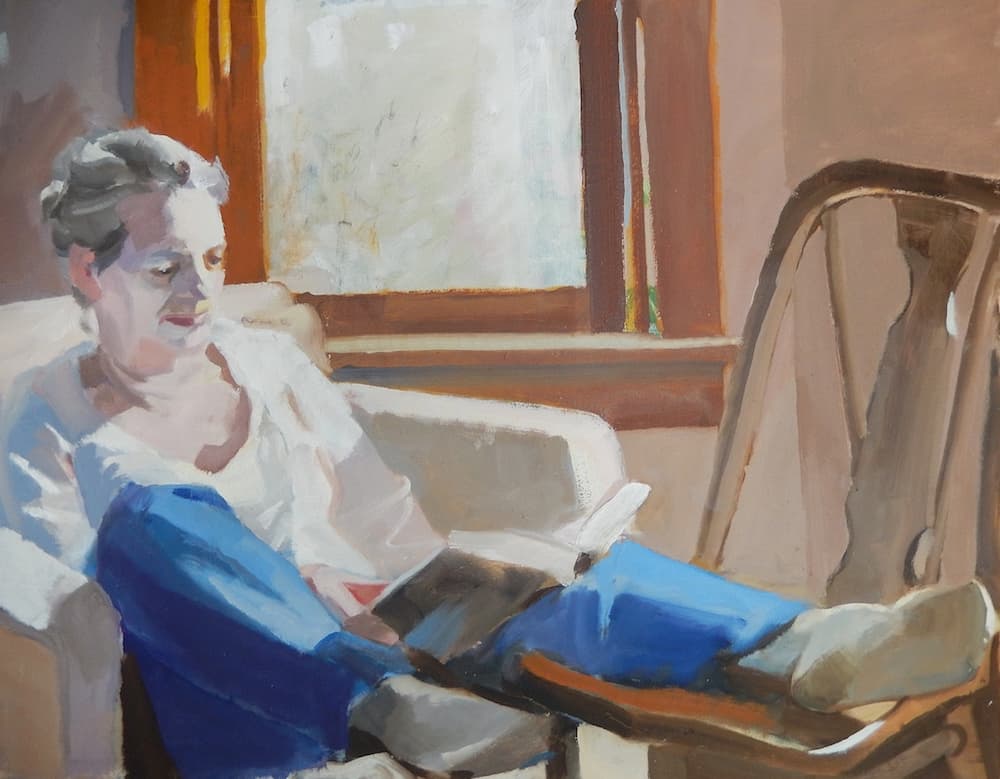
The Madsens often go out and study the landscape, together or separately. Jon considers this an important element of his work.
In many of his pieces he reduces the landscape, and uses simplification to suggest the bare minimum. Jon is constantly asking “how little can be said to convincingly convey the landscape?” In his paintings, he moves freely between abstract and specific and is more interested in the poetics of art than replication. Feelings are more important than the facts, he said. “If it feels right, it’s right.”
“Winter Essentials” is an example of how Jon looks at the landscape not necessarily to reproduce, but to build from. Black hints at the presence of a windbreak in the distance and a long line of cattle. It is fascinating how he adds just enough detail for the viewer to find the familiar and allow their minds to translate the rest.
Art lover? Subscribe to WyoFile’s free weekly newsletter for the latest on the gallery scene.
Pablo Picasso has been quoted as saying, “Every child is an artist. The problem is how to remain an artist once we grow up.” As the Madsen’s lives as artists continue to lengthen, their inquisitive natures persist, and they discover over and over why art is worthwhile. So too does the viewer of their pieces.
More of the Madsen’s work can be found at jonmadsenart.com, ginniemadsenart.com, The Brinton Museum in Big Horn and Crazy Woman Fine Art Gallery in Buffalo, WY. They also have work on display in Cheyenne at Art@The Hynds through January 2018.
Molly Bredehoft lives and writes in Laramie, WY. She recently completed her MFA in Creative Writing and Literary Arts through the University of Alaska Anchorage.