

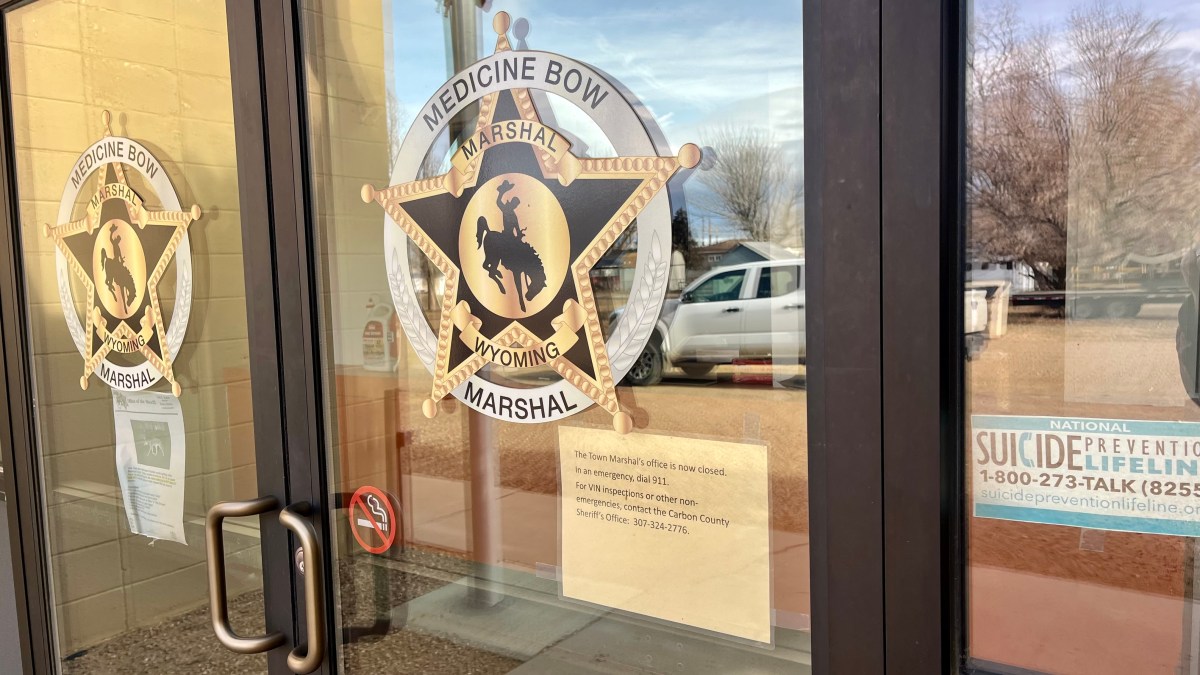
During a recent Medicine Bow Town Council meeting, a local radio station owner asked if the town could cite a resident for a barking dog. The answer is no, Mayor Justin George explained, because no local ordinances can be enforced without a functioning marshal’s department.
Nestled in the northeastern corner of Carbon County, Medicine Bow is home to fewer than 250 people. Made famous by Owen Wister’s 1902 novel “The Virginian,” the small town today struggles with sustaining law and order in such a remote enclave.
In early 2024, the Medicine Bow Town Council voted to dissolve its local law enforcement, the town’s Marshal’s Office. Soon after, the council traded three unused patrol cars and three rifles to the Carbon County Sheriff’s Office in return for $55,000 and 360 hours of annual patrol time. Before the agreement was finalized, Sheriff Alex Bakken made it clear that his deputies could not enforce local ordinances. Instead, deputies would spend the contracted time in Medicine Bow responding to emergency calls and monitoring traffic on Highway 30.
Last summer, the contract came up for renewal. During their regular August meeting, Medicine Bow Town Council members publicly criticized the coverage the sheriff’s department provided, citing multiple alleged instances of deputies’ vehicles facing away from the highway as traffic passed through town without slowing down. Due to those allegations, and a lack of funding, the council unanimously voted not to continue the partnership, leaving the community without a law enforcement contract.
Sheriff Bakken did not respond to a request for comment prior to publication.
Small-town justice
Between its founding in the late 1860s and 2019, Medicine Bow relied entirely on Carbon County to provide law enforcement. In 2019, flush with impact assistance funding from nearby wind projects such as the Ekola Flats wind farm, the Town Council voted to allocate $1 million to establish a Town Marshal’s Office. The plan was to maintain local law enforcement as long as possible using the impact money, while the marshal and his deputies supplemented the operating budget by writing citations.
But the experiment came to an abrupt end. In early 2024, with less than $400,000 left in the budget, the council decided to close the department and return law enforcement duties to the sheriff. Councilors said they had anticipated the funds would last longer than they ultimately did.
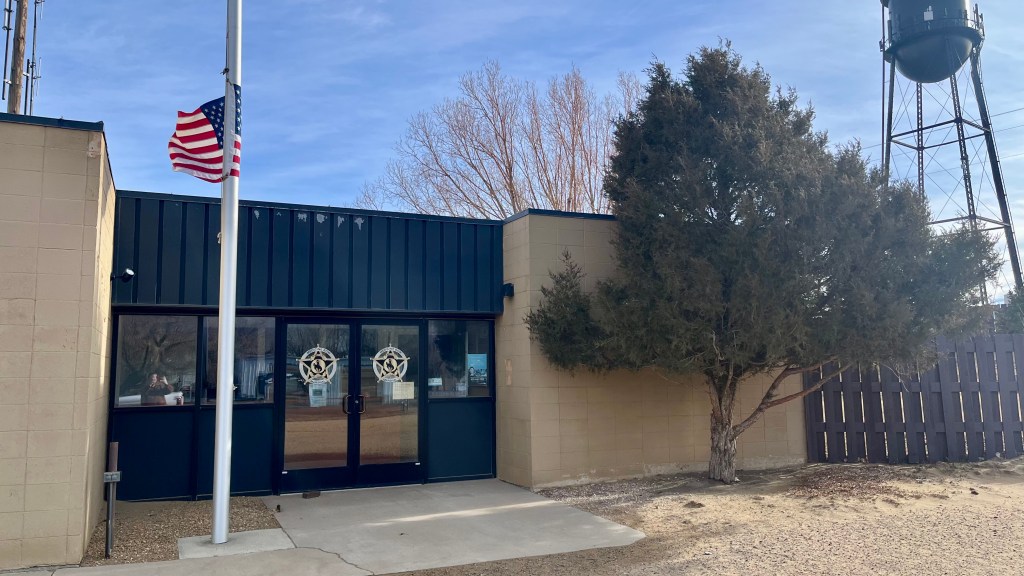
With the Medicine Bow Marshal’s Office now shuttered, the town was left with tens of thousands of dollars’ worth of equipment, including guns, ammunition and patrol vehicles. In July of 2025, the council voted to sell the weapons and equipment to a local firearms dealer. That’s when the council concluded that much of the money allocated to the marshals had been spent inefficiently.
In November 2025, Mayor Justin George ticked through an itemized list of leftover equipment from the closed office along with the cost to the town. As a whole, the governing body expressed disbelief at the amount of equipment purchased by the Medicine Bow Marshal’s Office during its five years of operation.
As an example of waste, the mayor reported that the department spent nearly $2,000 on 5,200 rounds of 9mm ammunition for mandatory firearms training. However, an inventory revealed that every bullet was present, indicating no training had occurred.
Additionally, the Marshal’s Office had purchased six $600 spike strips, three $200 combat-ready trauma bags with folding stretchers, three $120 bolt cutters, a $500 pair of Vortex-brand binoculars, and a black cowboy hat, valued at between $100 and $300.
“That was ridiculous, that stuff they had,” Councilwoman Kristi Wickizer said at the November meeting. “It was beyond ridiculous.”
Town policy allows department heads to spend up to $5,000 without prior approval from the council, the mayor said, adding that many of the questionable purchases fell just below the spending threshold.
Medicine Bow is set to recover $8,000 from the firearms sale, money that will be used to pay off outstanding debts from the marshal’s five-year stint, including a $17,000 Motorola radio service bill.
But two former mayors defended the marshal’s department, including its spending, and told WyoFile that they’re disappointed to see it disbanded.
In 2022, voters elected Sharron Biamon, who was on the council when the marshal’s department was established, as mayor. She resigned the following year, and Councilor Lucy Schofield was appointed to replace her as mayor. Schofield resigned that summer.
While none of the elected officials responsible for the formation of the Medicine Bow Marshal’s Office are still on the council, both Biamon and Schofield said their councils fully supported how the department was run. Purchases had been approved and backed by the council, they said. They added that if the roughly $200,000 in annual ticket revenue had been reinvested into the Marshal’s Office, instead of going into the town’s general budget, the department would still be operating today.
The price of enforcing laws
Medicine Bow isn’t the only Wyoming town struggling to maintain a dedicated law enforcement agency. Twenty miles to the west, in the former coal-mining town of Hanna, local officials continue to wrestle with the cost of operating their own marshal’s office.
Hanna was once a major supplier of coal for the Union Pacific Railroad. After more than a century of mining, however, the seams became increasingly difficult to reach, and by the early 2000s the last coal company had shut down. During the height of the coal era, the town established the Hanna Marshal’s Office to police its few thousand residents. With the mines now closed, Hanna’s population has fallen to fewer than 700. Despite the decline, the town continues to maintain its own law enforcement operation, now staffed by only two part‑time marshals. The Hanna Town Council has repeatedly said it cannot afford to hire any full-time officers.
Many municipalities in Carbon County are turning to the Sheriff’s Office for the entirety of their law enforcement coverage. Like Medicine Bow once did, the towns of Riverside and Baggs signed memorandums of understanding, agreeing to pay the county to have deputies spend a set number of hours in each community. Carbon County commissioners have said towns that rely on the Sheriff’s Office for policing should help fund the department, especially in light of recent state property tax relief measures.
When Carbon County saw 2025 property tax revenue drop by more than $900,000, commissioners cut services across a county spanning nearly 8,000 square miles.

Providing legally required core services, such as water, sewer and law enforcement, is becoming increasingly expensive. In Saratoga, rising equipment costs have led the town, which still maintains its own police force, to cede emergency dispatching duties to the Carbon County Sheriff’s Office. Sheriff Alex Bakken has spent years studying if all dispatching services should be consolidated under a joint powers board, a prospect the Rawlins Police Department doesn’t fully support.
Even as counties and municipalities struggle to provide law enforcement coverage, state legislators are pursuing additional cuts to property taxes — a primary mechanism of funding county and local governments — including proposals to eliminate residential property taxes entirely. Sheriff Bakken has said that consolidating all emergency dispatching services under one roof is inevitable. Facing increased costs and decreased funding, some local officials wonder whether the same may eventually apply to law enforcement departments themselves.
In the meantime, Medicine Bow residents must continue relying on the Sheriff’s Office, 40 miles away, for emergency response.
Correction: This article has been updated to reflect that the Carbon County Sheriff’s Office paid $55,000 to Medicine Bow and the sheriff supports combining dispatch under a joint powers board model. — Ed.

This is a horrible article and the responses are just as bad. Are you sure that the situation in Medicine Bow is the legislature’s fault?
The Mayor and the City Council certainly allowed waste to occur… they did not do the fiscal oversight for their citizens. and then they say they are in dire financial straights… does the reporter here have any clue on how to check those statements?
Heck no! The reporter takes everything at the word of those who did not do their duties like Mayor Justin George and Councilwoman Kristi Wickizer. But did the reporter even bother to look at the financial reports from the town? Heck no!
Well, here it is boys and girls!
https://drive.google.com/drive/folders/1tMlTyC7ZR2K3saV8cHn57XbkSNht34b2
Medicine Bow started the fiscal year with $2,327,848 Cash on hand and investments and ended with $2,722,500 at the end of the fiscal year. What? How can this be? They had Marshals spending money like drunken sailors and a 25% property tax cut for residential property ? and no fiscal oversight? But their position is better at the end of the year than at the beginning? Yea Buddy!
We should ask the question of how much did the city actually spend in fiscal 2025?
$715,573
Seriously, they have cash and investments that are 3.25 times expenses. Does the normal citizen have over three years of expenses in the bank? Isn’t that ratio a little high for a government entity? Does the reporter have over three years of expenses in the bank? Would the reporter like to be as flush with cash as Medicine Bow?
When people interviewed in the article say they have financial problems, and the reporter says there are financial problems… you should know that those problems are really reading the financial reports. Or they are just plain lying!
If you want to look yourselves, go to the external reports link on the Wyoming Department of Audit link below and read any of the reports from Wyoming government entities.
https://audit.wyo.gov/public-funds/reports
And Matt Copeland… not the reporter, but the Editor, Shame on you for not editing the reporting of the Medicine Bow story to include actual financial reports or even questioning the reporter about the coverage.
Kevin Lewis
Most of small town Wyoming law enforcement is bottom of the barrel crud (think of Byron, Manderson, Shoshoni, etc.) and these towns that lose money deserve it. Face it, small town cops are strictly utilized for speed trap revenue. The best way for the common folk to fight off these dirty lil’ villages is to to not stop there and don’t do business
Hear, hear! Byron is an inbred corrupt little berg and I usually throw some trash out the window when driving through there. Manderson was awhile back running 3 cop cars at same time and they’re just as dirty as Byron. There doesn’t seem to be any cops now in Manderson as I heard that some of the local business owners weren’t happy getting boycotted by potential customers, so they must of complained. To stop these corrupt towns, passerbys shouldn’t do any business there and hit’em back in the shorts financially
So interesting reading the responses. We are in a state that is slowly disintigrating just as our federal government is because folks elect legislators that have no other objective but to address their own personal needs, grievances, believe their job is addressing percieved social injustices. You get what you vote for and you get services you are willing to pay for. It is ironic, that in a state where the university has had an exceptional university Public Administration program, there seems to be a lack of understanding of principals of governing, and a lack of understanding of what it takes to provide basic services. Governing in a rural environment has challenges, and there are some good models out there. Governing is a management function, and governments fail, just like business fail, when people without the skills to succeed are electeed.
Maybe the legislature will make sure we never have to pay any taxes at all. Then we can spend the rest of our days begging for someone (of course, not us) to pay for all the services we so rightfully demand. We complain about things like potholes, snow on our streets, speeders, all the things we want to have taken care of, but don’t want to have to pay to have them handled. Comfort in our lives comes with some costs.
Jeffry Olson stares the issue very succinctly. We’re all being taken down by the non “Freedom Caucus”! Wake up voters…
I am always amused at the money spent by small towns on law enforcement. It appears, and perhaps I misunderstood that for 159 years Medicine Bow had no town cops, then they became “flush” and felt the urge to spend the increased revenue. It sounds like they had 3 squad cars (really folks for a population of 250), has no one ever heard of a car pool. I agree that $200K in annual ticket revenue sounds like they were spending more time running a speed trap than enforcing local ordinances. Some of this headache possibly could have been alleviated if the council hadn’t turned a blind eye to purchases. So they are back to where they started this fiasco in 2019, with $400K left in the “Marshalls fund” and some revenue from selling off stuff (how much for the cowboy hat?). But, here’s the big question, if the annual 200K is real, that would mean that 1M (200K for 5 years of operation) was revenue the city received in the general fund and therefore is money ahead. So, what am I missing here?
Nostalgia for “how it used to be” is increasingly revealed to be a dissolving pipe dream. “Make America Great Again” is slowly displaying itself as a way for rich people to get not-rich people to do their bidding – fake populism.
Copeland’s work talks about a bleak example of the above. Real people have real needs and rather than directing enough money to support struggling communities and counties, the legislature follows the party norm to search out waste and fraud, to engage in identity politics.
Over the next decade votes may or may not wake up to see the carnage the Freedom Caucus and their earlier versions have rendered Wyoming’s social landscape.
Rather than anticipating coal’s demise as an economic engine and beginning the process of building up small town physical and social infrastructure, the Legislature has continuously turned a blind eye to the slow death of the State’s small towns. Rawlins water system, Medicine Bow’s law enforcement issues, the dumb idea to build dams that benefit a small group of irrigators – all indicate Wyoming’s body is ill. These dire needs are boils on the social body that with a little prevention, a little creative thinking and policymaking, could have been avoided.
It really feels like the Legislature has shrugged its shoulders and looked away from small town needs for a couple decades as part of catering to the interests of the extractive industries. I really hope that Wyofile makes the effort to search out more examples of how the Legislature is NOT working for the citizens of Wyoming.
Where is the creative thinking necessary to make Wyoming’s future bright and attractive?
The failing Rawlins water system rest solely on the mismanagement of the system and the citizens for effectively freezing the rates for decades until 2022. Common sense would tell you that you have to reinvest in your community infrastructure so it does not fail. Rawlins failed to do that – expecting the rest of the state to pick up their tab is unrealistic when other communities increase fees to properly maintain their critical infrastructure.
Wyoming, like much of America, cannot afford the sprawl. Thanks for this cautionary tale.
“They added that if the roughly $200,000 in annual ticket revenue had been reinvested into the Marshal’s Office, instead of going into the town’s general budget, the department would still be operating today.”
For a blip on the map, that seems like a great deal of ticket revenue. I wonder who paid that tax and how they felt about passing through Medicine Bow?