


The Wyoming Legislature has less than two weeks to decide how to address its top non-budget priority — residential property taxes.
As home values have soared for much of the state in recent years, so too have property taxes. That’s because homes are taxed according to their value. But it’s been an expensive and difficult adjustment for a lot of homeowners, many of whom gave tearful and outraged testimony at legislative committee meetings throughout the legislative off-season, known as the interim.
Picking up where they left off last year, lawmakers filed 20 property-tax-related bills this session.
Just seven remain in play — more than half of which would create various homeowner exemptions. And even though the herd has thinned considerably, concerns have emerged that the Legislature has yet to narrow its focus this far along in the session. That’s particularly true in the House, where lawmakers voted to send six property tax bills over to the Senate for deliberation this week.
“There’s still a lot of bills alive at this point in time, which is concerning,” Rep. Liz Storer (D-Jackson) said at a press event last week. “If you add them all up, we would lose a lot of revenue. And these revenues go to local governments and schools.”
(Storer is president and CEO of the George B. Storer Foundation, a financial supporter of WyoFile.)
The amount of bills left on the table isn’t just a concern for House Democrats.
“As these different tax relief and reform bills start accumulating, it just seems that there’s a great chance that some of them may conflict in some way,” Rep. Art Washut (R-Casper) said Friday on the House floor.
“Could someone potentially get relief from more than one of these bills at the same time? What’s the cumulative effect of all that?” Washut asked.
“It’s something we’re going to have to work out,” Speaker of the House Albert Sommers (R-Pinedale) responded.
The Senate, meanwhile, sent only one property tax bill to the House for deliberation.
Background
There are a couple of reasons why lowering property taxes hasn’t been straightforward for lawmakers.
For one, the Wyoming Constitution groups residential property in the same tax class as commercial and industrial properties. That lumping together prevents the Legislature from making any isolated changes to how residential properties are taxed.
In November, however, voters will get the chance to amend the constitution and separate residential property into its own tax class. The measure will be on the ballot thanks to a bill lawmakers passed in 2023 with support from Democrats and both Republican caucuses. If House Bill 103 – Property tax-assessment ratio for residential property passes this session, voters will also be deciding whether to lower the assessment rate for residential property.
Another challenge is the risk of drying up revenue for local services.
There’s a popular misconception that when homeowners pay their property tax bill, that money fills state government coffers — even some lawmakers have been confused.
However, property taxes stay local.
Property taxes fund: K-12 education and transportation, elections, law enforcement, county jails, hospitals, landfills, libraries, water and sewer, museums, senior citizen centers, animal control, roads and bridges, community colleges, flood control, campgrounds, rodeos and fairs, golf courses, fire protection, weed control, cemeteries, airports and emergency preparedness.
This funding model is why some lawmakers won’t support legislation that cuts property taxes that doesn’t also include a backfill — a reimbursement from the state to local governments — and an expiration or sunset date.
Rep. Mike Yin (D-Jackson) has been pushing for 2027 sunset dates.
“I know that there are definitely several counties where this could have a really large effect on them,” Yin said while bringing a sunset amendment to HB 103. “And I just want to make sure that in three years we’ll be able to take care of everything impacted while still being able to provide relief.”
Yin’s amendment failed, but sunset dates are attached to three other bills, including House Bill 3 – Property tax exemption for long-term homeowners.
Exemptions
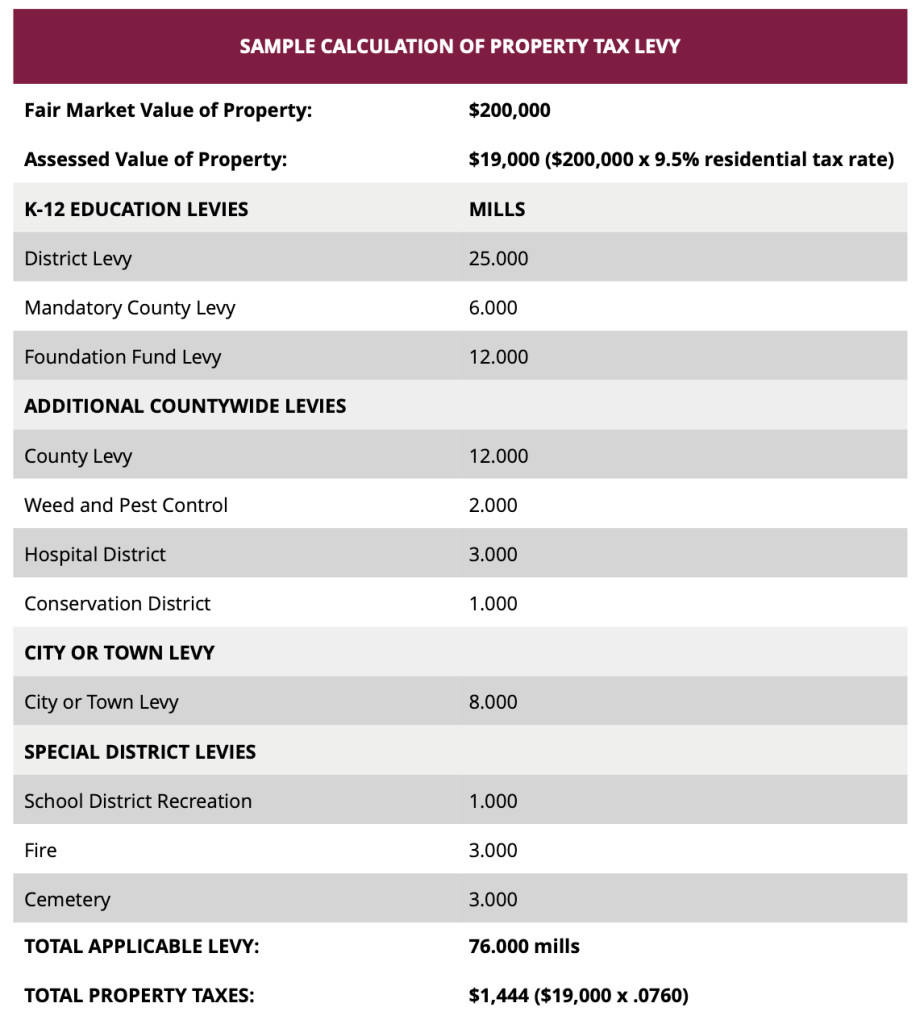
While property taxes depend on how much a home is worth, taxes are not applied to the entire market value of the property. Instead, an “assessed value” is used.
The assessment level in Wyoming for residential property is currently 9.5%.
So if you own a home that has a $200,000 fair market value, for example, your property taxes will be assessed at $19,000.
Sponsored by the Joint Revenue Committee, HB 3 would cut that $19,000 in half for certain residents by creating an exemption.
More specifically, HB 3 would exempt 50% of the assessed value of a home if the owner or the owner’s spouse is at least 65 years old and has paid property taxes in Wyoming for 25 years or more. Military personnel may also qualify. The bill does not contain a backfill but would sunset July 1, 2027.
House Bill 45 – Property tax exemption-residential structures and land, sponsored by Rep. Barry Crago (R-Buffalo), is a tax cap structured as an exemption. Put simply, the bill would place a 5% cap on annual residential property tax increases. It does not contain a backfill or a sunset date.
Speaker Sommers’ House Bill 52 – Property tax-homestead exemption is the one exemption bill to include both a sunset date and a backfill for local governments. The House voted Tuesday to also include language to address concerns about exemptions piling up. If a taxpayer receives this particular exemption — which will exclude the first $100,000 of the home’s fair market value — the new language restricts them from receiving most other exemptions.
Senate File 54 – homeowner tax exemption would also create an exemption on a portion of the fair market value of a home. The legislation, sponsored by the Joint Revenue Committee, is the sole property tax bill to survive the Senate.

Refunds and deferrals
The two remaining bills would revise existing programs.
House Bill 4 – Property tax refund program would broaden the income qualifications for a refund from 125% of the county’s median gross income to 165%. From there, a tiered system would calculate a successful applicant’s refund according to income level. Higher earners would get refunds at a smaller proportion of their property tax bill.
House Bill 4 has wide support, including from the governor and local government officials who prefer it over other bills since it would not disrupt revenue streams. It also passed third reading in the House with unanimous support.
Lastly, House Bill 134 – Property tax deferral program would move a program that allows homeowners to defer payment from local county commissioner boards to the Department of Revenue.
What’s next?
Because all but one of the remaining property tax bills started in the House, it will now largely be up to the Senate to decide what to do with each piece of legislation.
If the Senate follows the actions of the House and greenlights an entire slate of bills, the ultimate decision may rest outside the Legislature.
“If we pass three or four bills, the governor’s going to have to sit down and decide which one he vetoes,” Senate President Ogden Driskill (R-Devils Tower) told reporters last week.



Wyoming sinking its own boat. When I recently read about a plan to exempt the first 1 million in property value from taxes I thought that was a huge boon for the state. Once again politicians snatch defeat from the jaws of victory. Getting rid of property taxes, especially for non rich people, would be a huge draw for many of us to move there. You already have no income tax which puts you high on the list of options for people wanting to get out of high tax states. So I guess the search continues since none of these options are remotely attractive to those of us wanting to live without all the taxes and regulations. The first state to do away with property taxes wins big.
All property taxes for your personal home are wrong. Its just like you are living in a trailer court, but now the city, county, and the state really on your property and can take it away if you don’t pay them a fee. Increase the sales tax and make sure you’re collecting from online sites so that everyone pays their fair share, and would incentivizes property ownership, rather than when renting. An exemption for those over 65. Really! we’ve all had 40 or more years and plenty of warning all the way back from 1980 that Social Security wasn’t going to cover anything. Their failure to plan and spend more time planning their weekend then their future is nobody else’s problem but their own.
Shame! Your article indicates that HB 3 is among a handful of property tax bills to advance. HB 3 exempts 50% of the assessed value of a home for those 65 years old who have paid property taxes in Wyoming for 25 years or more. Correct me if I am wrong, but it seems to me this bill likely would provide relief to a high percentage of Wyoming legislators, their parents, their siblings, and their friends. Meanwhile, this “friends and family” bill would provide no relief to the vast majority of Wyoming residents. Those of us who have lived in Wyoming for “only” 1 year, 5 years, 10 years, 20 years, or 24 years (and have seen our taxes double in just the last 2 years) apparently deserve no consideration.
Your article repeatedly refers to legislators’ concern about the loss of revenue from reducing/cutting/capping growth of property taxes. But, in many counties, property tax revenues have doubled in just the last few years. Where has all that money gone? How can all the counties still be cash short after the enormous increase in property taxes over the last few years?
It does not seem to me that our Wyoming “representatives” are in fact representing Wyoming citizens. HB 3, in particular, seems a case in which our “representatives'” self-interest is far outweighing their interest in the welfare of all Wyoming citizens. Again, correct me if I am wrong, but it seems to me that our legislators, their families, and their friends will be big beneficiaries of HB 3 while a very small percentage of the general population will get any relief at all from the enormous increase in property taxes experienced in the last few years.
Shame on those who crafted and back HB 3. Wyoming needs broad, permanent property tax relief, not tax relief for the governing class. Telling citizens government does not have enough money to provide general relief is simply unacceptable after all the cash that has been collected by the property tax bonanza.
Sad to say, EVERY ONE of the bills currently under consideration would unfairly tax renters but not homeowners. All of them provide tax relief only for “single family” owner-occupied residences, which means that apartment buildings and rented houses don’t get a break. And if you have a “mother in law” apartment or an accessory dwelling unit on your own property, YOU do not get the exemption, even if you are a longtime homeowner and DO live in the property. And in many cases, you lose the exemption if you move, or move at the wrong time of year… even if you just move across the street. None of the committees during the rushed legislative budget session have had time to address these obvious problems, which could deny exemptions to worthy residents, deter UW grads from staying in our state, deter new businesses from COMING to our state, and restrict our already pinched entry level workforce. The issue of property tax relief should therefore go to the interim session; it hasn’t been adequately thought out to make it appropriate for ANY of the bills to become law.