Every court case comes with stakes. But those stakes are much higher when it’s your family — your children or grandchildren — involved.
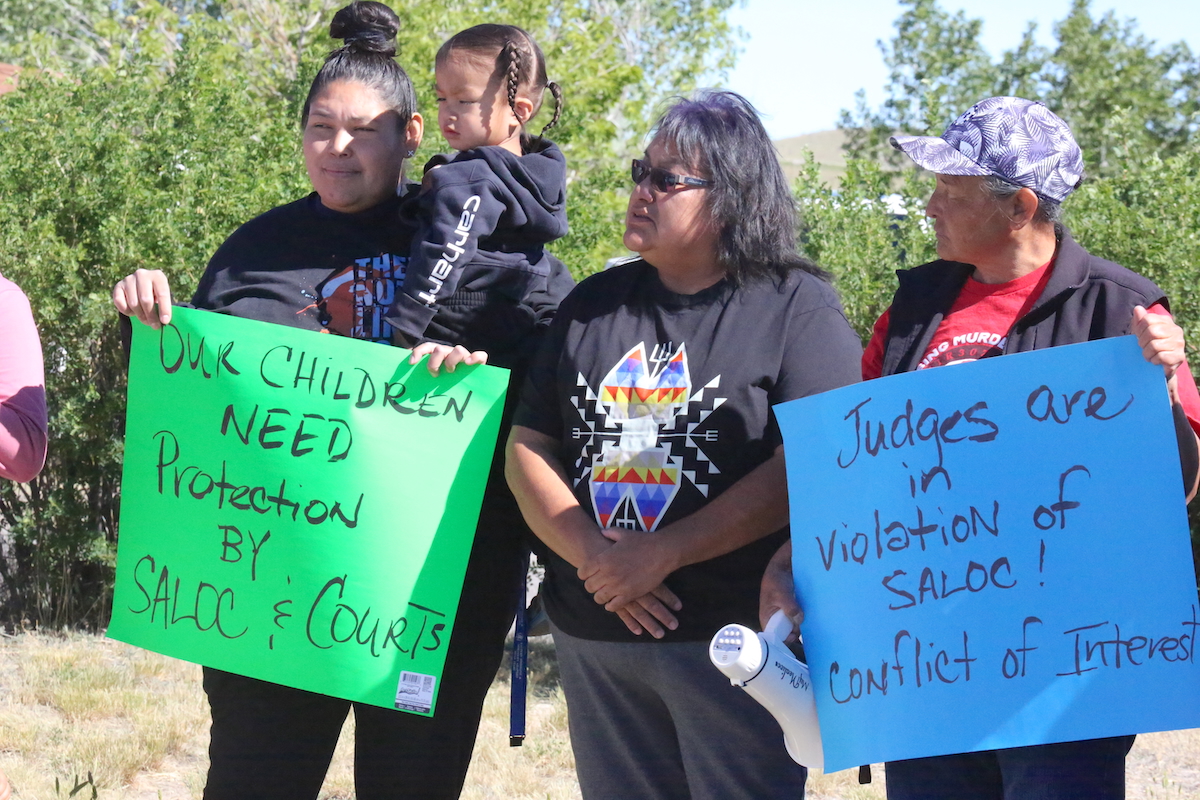
Protesters gathered Thursday outside the Tribal Court building in Fort Washakie as one of those cases played out. Objecting to what they called a “kangaroo court” and a “circus” inside, protesters said problems that plague the tribal court system are boiling over and it’s time for tribal leaders to step up and fix them.
“It is scary,” said Lynelle Shakespeare during the protest, as her daughter attended a court hearing inside regarding a custody dispute with her 7-year-old son. The court wouldn’t allow Shakespeare inside.
“That’s the bad part,” she added. “Because who’s holding them accountable? Nobody.”
“This has been going on with other families,” Northern Arapaho Business Council member Kim Whiteman Harjo said of problems with the court system. “Some of the filings — the truth hasn’t been in there.”
The hearing inside involving Shakespeare’s grandson, who is an enrolled member of the Northern Arapaho Tribe, also involves his father’s Crow Tribe in Montana, and multiple custody orders are on the books. It’s led to a confusing situation for the boy’s family here — and from their perspective, a nonfunctioning tribal court system on the Wind River Reservation has compounded the problems. One appeal in the custody case filed with Wind River Tribal Court took a year and eight months for a ruling, family members said.
Inside the courtroom, the Shakespeare family said the presiding judge is local attorney Griffin Coleman, a white attorney who has represented clients in tribal court before.
Protesters pointed to the Shoshone and Arapaho Law and Order Code, known as SALOC, which states: “All judges must be adult members of the Shoshone and Arapaho Tribes or any other tribe.”
Those protesting also said the judge should have recused himself from the case, since his wife is the child’s Individualized Education Program coordinator at school.
The protesters held signs demanding action from intertribal leaders on problems with the tribal court system: “Protect our children!” “Judges are in violation of SALOC! Conflict of Interest,” and “Children over Politics! Intertribal Council do your job!”
Some gathered there recounted their own troubling experiences in tribal court, particularly involving custody of children.
Victoria Shakespeare said she’s cared for her grandchild since they were 3 weeks old, and now at 15 months, clarity about guardianship has been hard to come by.
“It’s like nobody is trying to help you when you’re trying to fight for your rights,” she said.
Several protesters said when they’ve filed issues with the court system, they don’t even get a notice of when their court hearing is, and delays plague the system even when much is at stake.
“This is a circus here with these courts,” explained Liz Hodge. “Everybody’s got a story … So many people have so many issues with judges being biased and not recusing themselves. It’s this culture that we’ve created for this tribe. It’s all about who you know. All of our intertribal, our leadership, they’ve got to start making things right, because without good leadership, we’re pretty much doomed.”
In particular, said advocate Nicole Wagon, family court needs to function, rules need to be followed, and family members need to feel that justice is possible.
“Our kids are sacred,” she said. “This affects everybody. They need to get this Mickey Mouse court fixed because it’s affecting lives.”
The Shakespeare family reported that several business council leaders attempted to intervene in their custody case but were reportedly told their efforts wouldn’t be considered by the judge.
As the court hearing concluded, Lynelle Shakespeare read a passage from SALOC aloud over the phone, detailing how the tribal court is charged with protecting the interests of children and the safety and interest of the Shoshone and Arapaho tribes. The hearing hadn’t changed much in the custody dispute, and family members were left wondering whether the boy would be able to participate in sacred Sundance ceremonies this summer.
“Something needs to be done,” Lynelle Shakespeare said.