

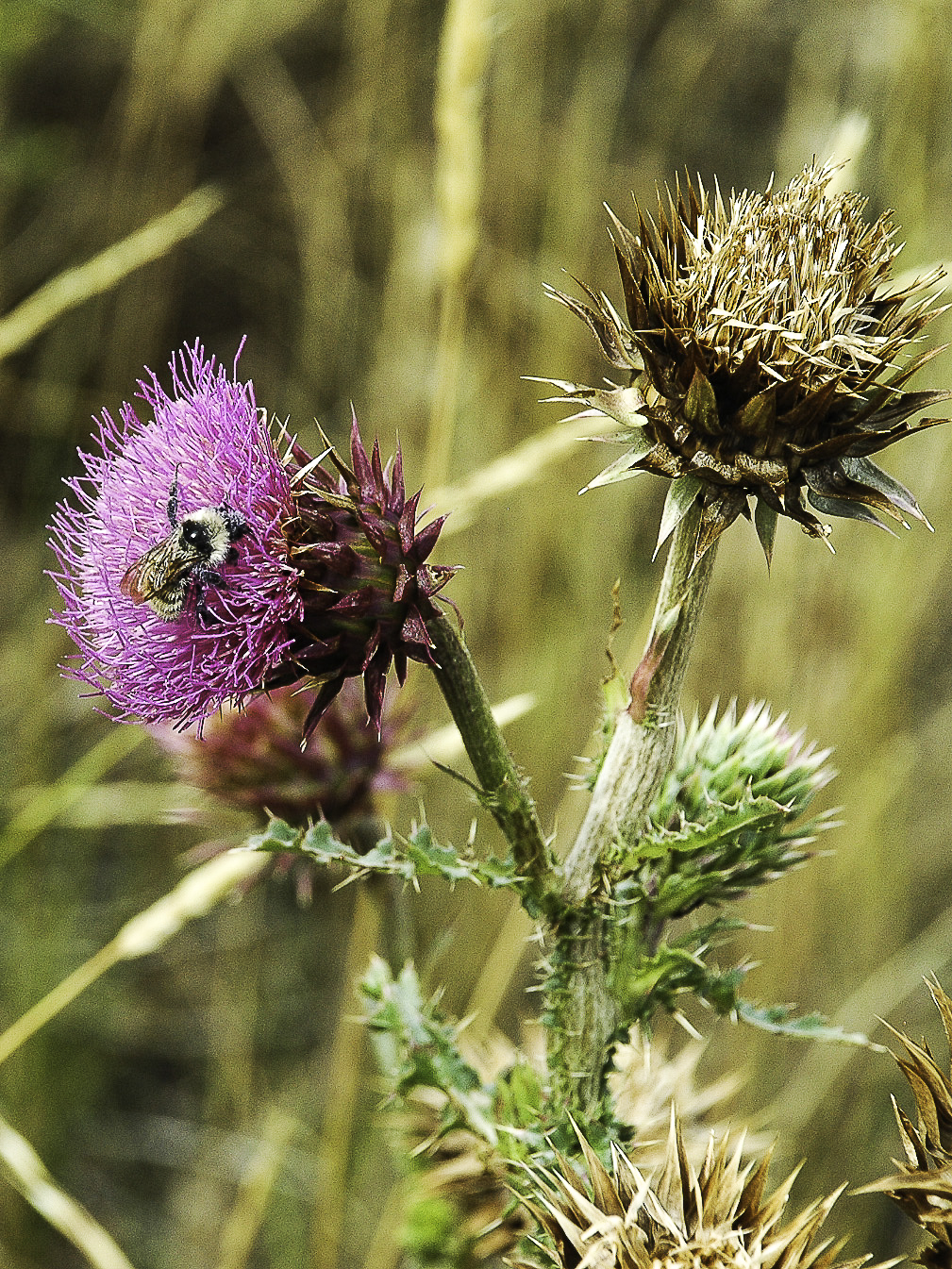
For the past few years, I’ve participated in “Thistle Thursdays,” targeting a popular trail near Jackson. The weekly weed party was organized in 2019 by Morgan Graham, wildlife habitat specialist with the Teton County Conservation District, and it attracts more volunteers each year — 16 of us in 2023.
Opinion
To slow the steady march of musk thistle, a fast-spreading weed from Eurasia, we spend Thursday morning each week bending down to tackle these interlopers. We know what we do is a drop in the bucket, but right here, along this trail, we see results.
Joining Morgan is a mixed crew: native plant enthusiasts, elk hunters, employees of nonprofits and the Forest Service, plus “youngsters” in their 30s and retirees like me.
My friend Mary, nearly 80, wins the prize as the oldest and most enthusiastic of the crew. While we were waiting for a friend at a trailhead this summer, she spotted a musk thistle on a steep slope, went to her car for some gloves and signaled for me to follow. “Let’s get that one,” she said. We ended up uprooting several.
Musk thistle (Carduus nutans) is an invasive weed, and like many invasive plants, it is adaptable and vigorous, producing prolific seeds. It competes for light and nutrients with native plants. Eventually, it can replace them.
To be fair, it has positive qualities. Bees, butterflies and other pollinators are attracted to its magenta flowers, and it blooms later than many native wildflowers, extending the season for insects. Songbirds eat its seeds.
But wildlife and livestock won’t eat musk thistle because of its spines. Where it grows, grazing animals must forage more heavily on other plants, reducing their vigor, which allows musk thistle to invade ever more space.
Tackling a stand of musk thistle requires determination. All flowers and buds are removed and placed in bags or bins. The plant, a long-lived biennial, must be cut off below the base, or pulled, to prevent further blooming.
All of us volunteers are suited up in protective gear that includes heavy gloves, long sleeves and sturdy boots. The work is hard, but the hours go quickly with conversation, laughter and impromptu contests to see who can pull out the largest thistle without tools.
We talk about plant ecology in general, but one question often comes up: “What makes it a weed?” Simply put, a plant is a weed if doesn’t belong where it’s growing. But as humans, we’re inconsistent.
To a farmer dependent on crops for a living, a weed is any plant, native or otherwise, that competes with the crop. To a hand spinner of wool, the invasive and noxious tansy is welcome for its rich golden dye. To a rancher whose cattle or sheep forage on public land, tall larkspur and several members of the pea family, all native plants, should be sprayed, for they are toxic.
We also pull out other invasives such as Canada thistle, hound’s tongue, salsify, toadflax and knapweed. Despite our best efforts, these plants are flourishing. As we work, it’s fun when bicyclists whizzing by yell out “thank you!” but some shake their heads. “You’re pissing in the wind,” one called.
But before-and-after photographs show that our hours of work make a difference. There is satisfaction in seeing the beds of two pickup trucks filled with bags of musk thistle blossoms.
Part of me admits that I’m not making a huge difference, but a bigger part is glad I have done my little bit for however long its effects may last. My Thistle Thursday friends agree.
That’s why we keep coming back. It’s a way to say, “I’m just going to enjoy my life for as long as it lasts.” Pulling weeds and filling buckets with their flowers is a lot like tending a garden at home. We’re just tending a larger garden, the Eden we all inherited.
Most of all, we’re expressing what is perhaps the most precarious of human sentiments these days: hope.
A longer version of this opinion from writersontherange.org also appeared in mountainjournal.org.

Great Post! “Pulling thistles, sowing hope” encapsulates the proactive and intentional efforts needed to address challenges and create an environment conducive to positive change and growth.
I enjoyed your article, Pulling Thistles, Sowing Hope. You are not alone. Here in Napa, hand pulling English Ivy at the Archer Taylor Preserve took over four years. Next we tackled yellow star thistle which is gone except for growth from the seedbank. Maltese star thistle showed up and is now pulled as well. We do what we can to eliminate other invasive species. Each bagged plant is satisfying but we need all the help we can get.