

This article originally appeared on Inside Climate News (hyperlink to the original story), a nonprofit, non-partisan news organization that covers climate, energy and the environment. Sign up for their newsletter here.
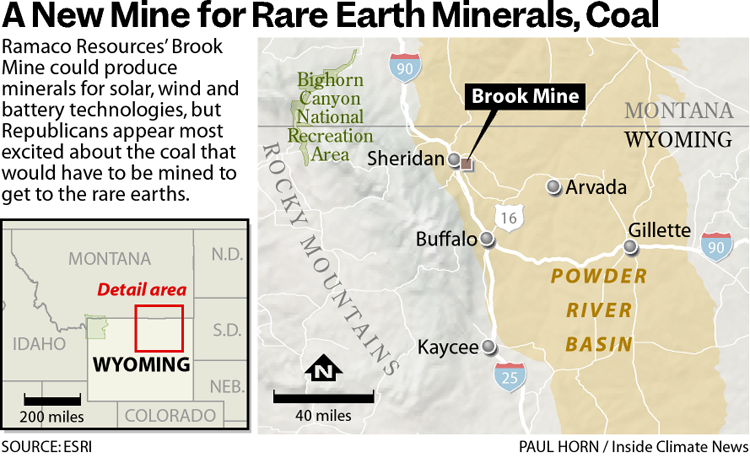
At the foot of Wyoming’s Bighorn Mountains sits a mine potentially full of minerals crucial for renewable energy, yet capable of drawing praise from some of the United States’ most ardent supporters of fossil fuels.
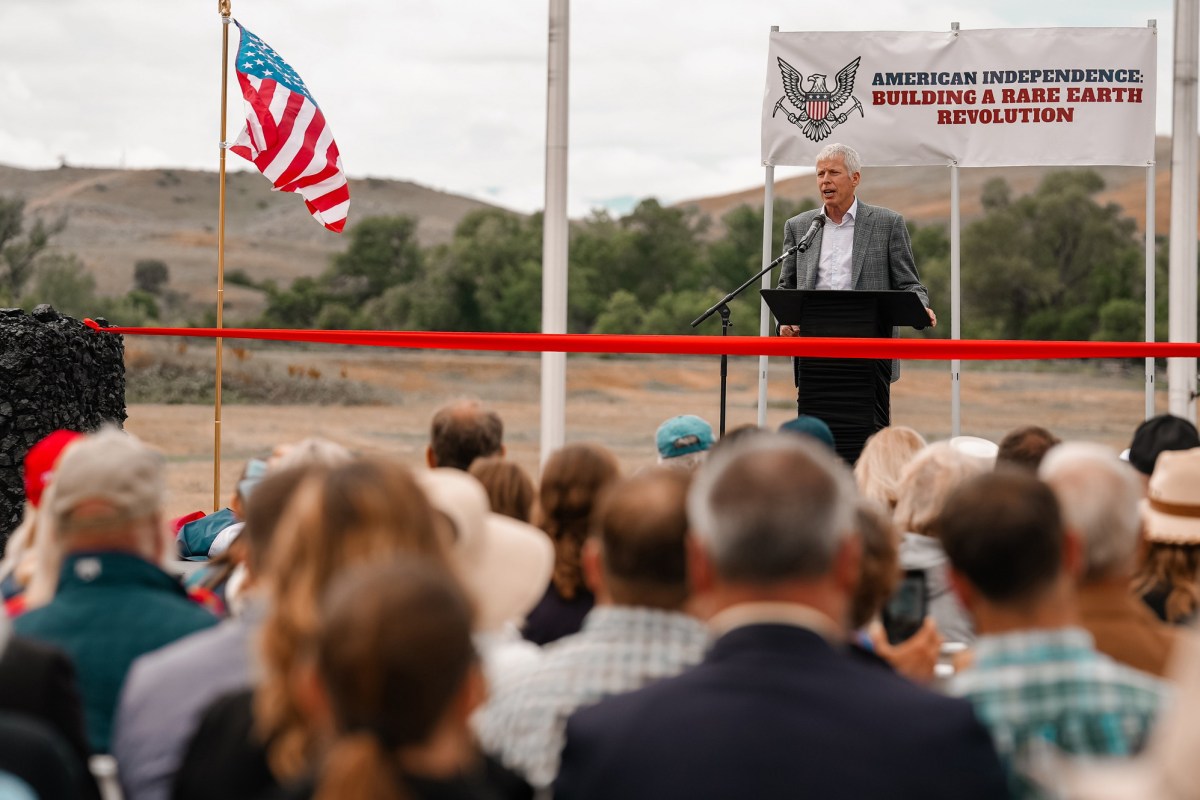
On July 11, the U.S. Secretary of Energy Chris Wright, the former CEO of a hydraulic fracturing company, joined former West Virginia Senator Joe Manchin and Wyoming’s congressional delegation and governor, Mark Gordon, at the ribbon cutting ceremony for Ramaco Resources’ Brook Mine, which could one day become just the second source of rare earth minerals in the U.S.
But the minerals, including but not limited to scandium, gallium, germanium, praseodymium, neodymium, terbium and dysprosium, are locked up in coal, according to Ramaco — and it is that coal that has driven Republican enthusiasm for the mine.
Rare earth minerals are critical components in a long list of technologies, including solar cells, wind turbine rotors, batteries, magnets, missiles, motors, semiconductors and smartphones. A vast majority of the world’s known critical mineral deposits lie in Asia, particularly in China.
But as Ramaco looks to bring the Brook Mine online in 2027 — July’s ribbon cutting marked the opening of a pilot plant — some wonder what kind of domestic market it will find after President Donald Trump and congressional Republicans gutted federal incentives to boost the development and manufacturing of renewable energy technologies earlier this month.
“I would argue that a large portion of the projected need [for rare earth minerals] is in clean energy,” said Steve Feldgus, former principal deputy assistant secretary for land and minerals management at the Department of the Interior.
Despite his disdain for renewable energy, Trump has been eager to mine more rare earth minerals, signing an executive order in March expediting the permitting process for mines to extract the elements.
Ramaco intends to sell some of the coal present in the mine, a costly form of energy and a major contributor to the climate crisis, but it should amount to less than 1% of all the coal exported from Wyoming, Jeremy Sussman, Ramaco’s chief financial officer, said in an email.
That small portion of coal didn’t stop Wright from touting the mineral as the mine’s major achievement. In a video posted on X, formerly Twitter, the secretary of energy said, “You’re going to see a lot more of big, beautiful, clean coal!” and noted that he was celebrating not only the opening of a mine for rare earth minerals, but also the first coal mine to open in Wyoming in 50 years.
Ramaco has analyzed one-third of the mineral deposit, according to a July letter to shareholders signed by CEO Randall Atkins, and Ramaco’s pilot project will test processing techniques for rare earths.
Broadly, “there is a rare earth element resource [in coal],” said Lauren Birgenheier, a professor of geology and geophysics at the University of Utah. In the Brook Mine’s case, “how excellent it is is still probably to be determined, but it appears excellent enough for them to feel like they can move forward.”
With only a third of the mine mapped and rare earth prices subject to change — Ramaco’s price estimate for scandium, a crucial component of fuels cells used in hydrogen-powered machines, was over 200% higher than the U.S. Geological Survey’s estimate of $1.2 million per metric ton — Feldgus said it was too soon to say for sure what the mine’s future holds.
“It’s still going to be a little bit longer before they can say that ‘this is actually what we’re going to mine,’” he said.
Sussman said Ramaco’s estimates were for 2028 and accounted for attempts from China “to manipulate pricing” by keeping rare earth values low, thereby “disincentivizing western projects.” He said he expects the market to improve as the U.S. tries to source rare earth minerals domestically, and pointed to a recent Department of Defense contract for neodymium at $110,000 per ton — twice the mineral’s typical spot price, according to Sussman — as evidence that the market for western critical minerals was improving.
Despite its support for policies that depress U.S. renewable energy markets, Wyoming’s congressional delegation, made up entirely of Republicans, lauded the effort to extract rare earth minerals in statements released after Ramaco’s groundbreaking ceremony.
Wyoming Sen. John Barrasso said the mine will “support American industries, and strengthen our supply chains.” Cynthia Lummis, the state’s other senator, added that the mine “will produce resources needed to achieve energy independence and grow our economy.”
But where the domestic demand for those minerals will come from is uncertain, as many of the industries they would supply face questionable near-term futures in the U.S. after Trump signed legislation earlier this month gutting many incentives for renewable energy technologies.
“The excitement over rare earths is sort of at odds with the destruction of demand for clean energy,” Feldgus said. “The magnets that a lot of these minerals go into, I mean, those are critically important for electric motors, for turbines, for anything that is built off the clean energy economy.”
The policy whiplash in the U.S. has left Sussman unfazed. “Our rare earth elements and critical minerals are vital to national defense,” he said. And those same technologies Feldgus outlined “are still projected to grow at a meaningful pace,” he said. “In fact, the [U.S. Department of Energy] projects wind capacity in the U.S. to grow from 113 [gigawatts] in 2020 to 404 [gigawatts] in [2050].”

Rube Goldberg inventions at least sort of worked. If this was feasible it would already be happening.
Appears to be an over hyped mining promotion job similar to the penny stock exchanges scams. I’m a mining engineer and have encountered similar promotions and even worked at one for a year. Its my understanding that there are about 300 rare earth deposits being promoted at this time and at least 90% will fail – it takes a very high grade deposit accessible under easy conditions with minimum regs in order to survive. I remember the moly over promotion where a number of properties were brought on line all at the same time causing the price of moly to crash – Tonopah had to be shut down within a few months of opening. The Ramaco project doesn’t quite pass the smell test – too many IFS involved and the pilot plant isn’t conclusive enough to prove its a feasible project. You need to be very wary investing in overly promoted mining projects – mining is all about PROMOTION, PROMOTION, PROMOTION. Beware. I had a mining professor who used to examine gold mines for Goldfield of South Africa years ago and he said that only one of 200 gold mines he looked at had real potential. Beware!!!
Man, this Brook Mine has a long, storied history of pivoting and hedging and going back to the trough that rivals even Two Elk. I’d love to see WyoFile add some of the context from its prior reporting on this place.
Consistency has never been a strong suit of the Wyoming GOP. Will you ever learn?