


Wyoming’s Powder, Bighorn and North Platte rivers serve as headwaters of the Missouri River. They begin as trickles in the mountains and rush down into bottomlands as they gain volume. Once, all three ran full with a buffet of warm- and cool-water fish, from the prehistoric, armor-plated shovelnose sturgeon to the shimmery goldeye.
That’s where their similarities end.
Today, the Powder River remains one of the longest free-flowing rivers in the West. The Bighorn River has several dams, but still retains some of its native species. The North Platte River, on the other hand, has been fundamentally altered. What pollution didn’t kill was largely extirpated by dams and irrigation projects.
“It was a pretty gnarly place. It wasn’t a fit fishery at all,” said Bill Mixer, a retired Casper College wastewater treatment professor and avid angler. Because of dam control, he said, “the river would go from 15,000 to 20,000 cubic feet per second down to 75 cfs. It wasn’t a sustainable fishery.”
It’s no surprise then, that the uninterrupted Powder River still retains the same suite of native fish as it had millennia ago. Sauger, plains minnow, sturgeon chub and many other species swim in its waters. The North Platte, meanwhile, transformed slowly over the course of the mid-to-late 1900s into a thriving cold-water fishery with trophy brown and rainbow trout.
But biologists see a future where at least some of those native fish can be restored not only to the Bighorn River, where species have been lost or are struggling, but also to the lower stretches of the North Platte.
Here’s a primer on some of the spotted, ancient-looking, once-abundant or big-eyed native fish species that some conservationists and biologists hope will once again inhabit at least some of their native waters.
Sauger
Sauger once ran up and down the North Platte River in such abundance that historical records show they were a major food source for soldiers stationed at Fort Laramie. Sauger are a bit smaller than their nonnative but more popular cousin the walleye, and have telltale black spots on their dorsal fins, said David Zafft, the Wyoming Game and Fish Department’s fisheries management coordinator.

Despite the apparent abundance, sauger became increasingly rare in the early 1900s, and the last one was seen in the North Platte River in the mid-1960s. Zafft blames dams and pollution, the same combination of issues that doomed other native species.
But where sauger struggled in the Platte, they held on in the undammed and relatively untouched Powder River. They can also be found in sections of the Wind River, and have maintained strongholds in the Bighorn River — the same stream by a different name — largely downstream of Worland.
And there they stayed for decades, until Game and Fish began reintroduction efforts in the North Platte in 2017 from sauger raised at the Garrison National Fish Hatchery in North Dakota. Biologists planted the most recent batch in early May downstream of the Dave Johnston Power Plant in the North Platte.
“We chose that stretch of river because it’s the least fragmented,” Zafft said.
Shovelnose sturgeon
If you wondered what a swimming dinosaur might have resembled, take a look at the shovelnose sturgeon.
The ancient fish is covered in armored plates and has a giant forked tail and long nose used to scoot sand away from river bottoms to find food. Wyoming’s state record is only 10 pounds — big but not notable for a fish in the state — but that record catch measured an impressive 44 inches long.

Unfortunately, the shovelnose sturgeon went the same way as the sauger in the North Platte River. It needs long expanses of uninterrupted running water to spawn and survive, something the Platte lacked once it was developed into a series of reservoirs.
They are doing well in the Powder River, but were largely extirpated from the Bighorn River until reintroduction efforts in the mid-90s, Zafft said. Shovelnose sturgeon were stocked almost every year between 1996 and 2020, when the final batch poured in.
Support science reporting with a tax-deductible donation today.
“They are a tough fish to manage in that they are really long lived,” Zafft said. “They can be about 30 years old, but don’t reach sexual maturity until they are 5 to 9 years old.”
They also only spawn every two to three years — which makes the task of growing large populations even harder.
Biologists hope they will now be self-sustaining. Researchers removed one plate from the armor of each fish stocked so anglers and biologists can tell if individuals are hatchery-raised or wild.
Channel catfish
One of the largest channel catfish recorded in the state in its native range came from a fish survey in Glendo Reservoir. Biologists estimated it weighed between 25 and 30 pounds, but an exact measurement proved impossible because it was too big for the scale.
Channel catfish are often associated with southern states, but they were also abundant in the Platte, Powder and Bighorn. Like the others, channel catfish were gone from the Platte by the mid-1900s, but unlike other species, they are now thriving in places like Glendo Reservoir, Zafft said.
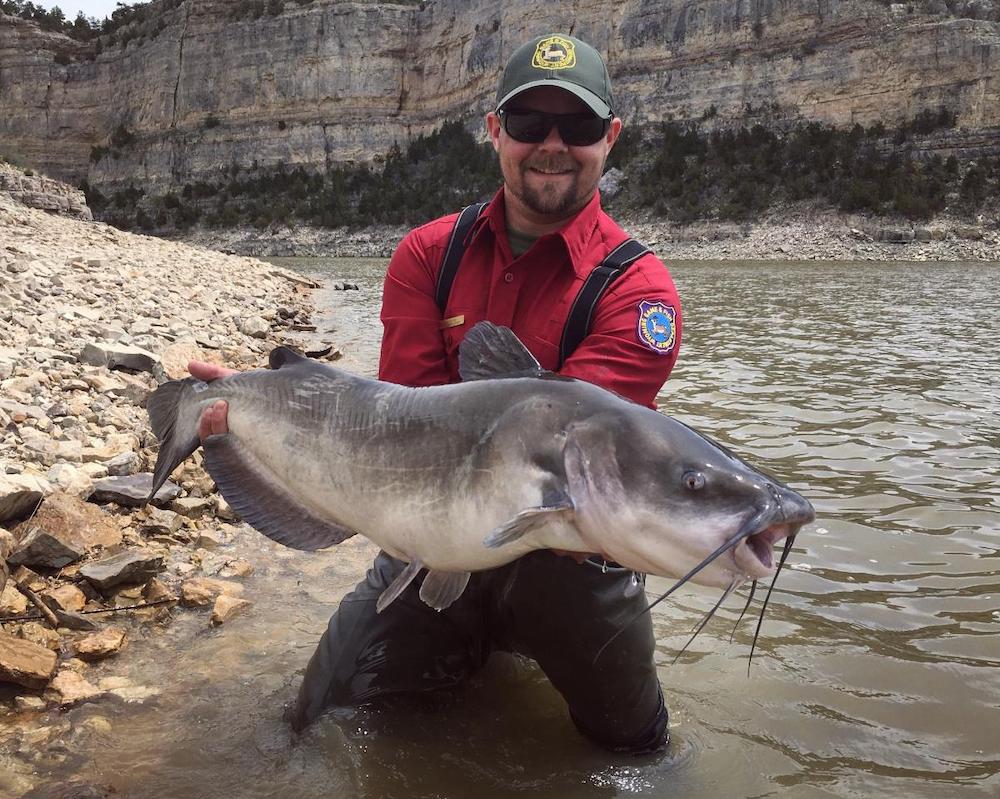
There, fisheries biologists have been stocking about 20,000 a year, with another 8,000 stocked in the North Platte River above Glendo. These catfish are not completely the original, though. Native channel catfish are part of a harder-to-obtain northern strain, and biologists have been reintroducing a southern strain imported from Arkansas.
Channel catfish are still sustainably reproducing in the Bighorn and Powder rivers, and are, according to Zafft, one of the state’s “most underutilized game fish.”
Goldeye
Somewhere in the slow-moving expanses of the Powder River near the Montana border is a nongame fish that looks like a herring.
The goldeye — a member of the mooneye family — has a compressed body, keeled belly and giant eyes.
They’re not classified as game fish, but they’re aggressive and “fight like crazy,” said Zafft. They also grow to be up to 15 inches long.
They’re gone now from the North Platte, and likely won’t be reintroduced. Biologists say they couldn’t naturally reproduce anymore because of the system of dams and reservoirs.
But goldeye are another fish that still thrives in the strange Powder River system.
“In the summer, portions of the Powder isn’t even free flowing,” Zafft said. “There are puddle stretches of water that the fish are highly, highly adapted to.”


The first paragraph states, “Wyoming’s Powder, Bighorn and North Platte rivers serve as headwaters of the Missouri River.”
Truth be told, the Madison, Gallatin, and Jefferson River’s in Montana are the headwaters of the Missouri River.
Excellent article and information, though.
It’s wonderful to see and hear of positive restoration efforts of the native fish populations.
Christine Peterson is a world class journalist with a gift of translating complex science into compelling stories. She is a great asset to Wyoming!
Simply a great article with information aplenty. Thank you WyoFile (and Christine Peterson) for a then and now trip along four of Wyoming’s rivers.