


CHEYENNE—Even before lawmakers in the House and Senate dove into their respective debates Tuesday on the state’s next two-year budget, the two chambers were expected to land in different places.
The House, with its Wyoming Freedom Caucus majority, appeared ready to hold the line on the budget crafted by the Legislature’s primary budgeting arm ahead of the session. The Senate, meanwhile, was expected to rebuff cuts.
The Freedom Caucus and its allies control the Joint Appropriations Committee, which crafted a budget largely defined by unprecedented cuts. Those included dismantling the state’s economic development agency, defunding Wyoming Public Media, axing $40 million from the University of Wyoming’s block grant, and stripping tens of millions from the Department of Health.
Ahead of Tuesday’s debate, the two chambers were also set to have very different days. The Senate had just 19 amendments to consider, compared to the House’s 122 revisions.

Right away in the upper chamber, things went as expected. In a single amendment, the Senate voted to restore the budget bill to Gov. Mark Gordon’s recommendations, adding more than $253 million back to the budget.
“This amendment, folks, is the BBA — big, beautiful amendment,” Sen. Ogden Driskill, R-Devils Tower, said, an apparent reference to the Big Beautiful Bill, a legislative package backed by President Donald Trump and passed by Congress last year.
Driskill, alongside 16 other senators, sponsored the amendment. The lawmakers did so, Driskill said, not as a means to rubber-stamp the governor’s proposed budget, but to provide the upper chamber with a better starting point.
“We have third reading to do whatever we need to do on it,” Driskill said, pointing to Thursday, when both chambers will once again consider amendments to the budget.
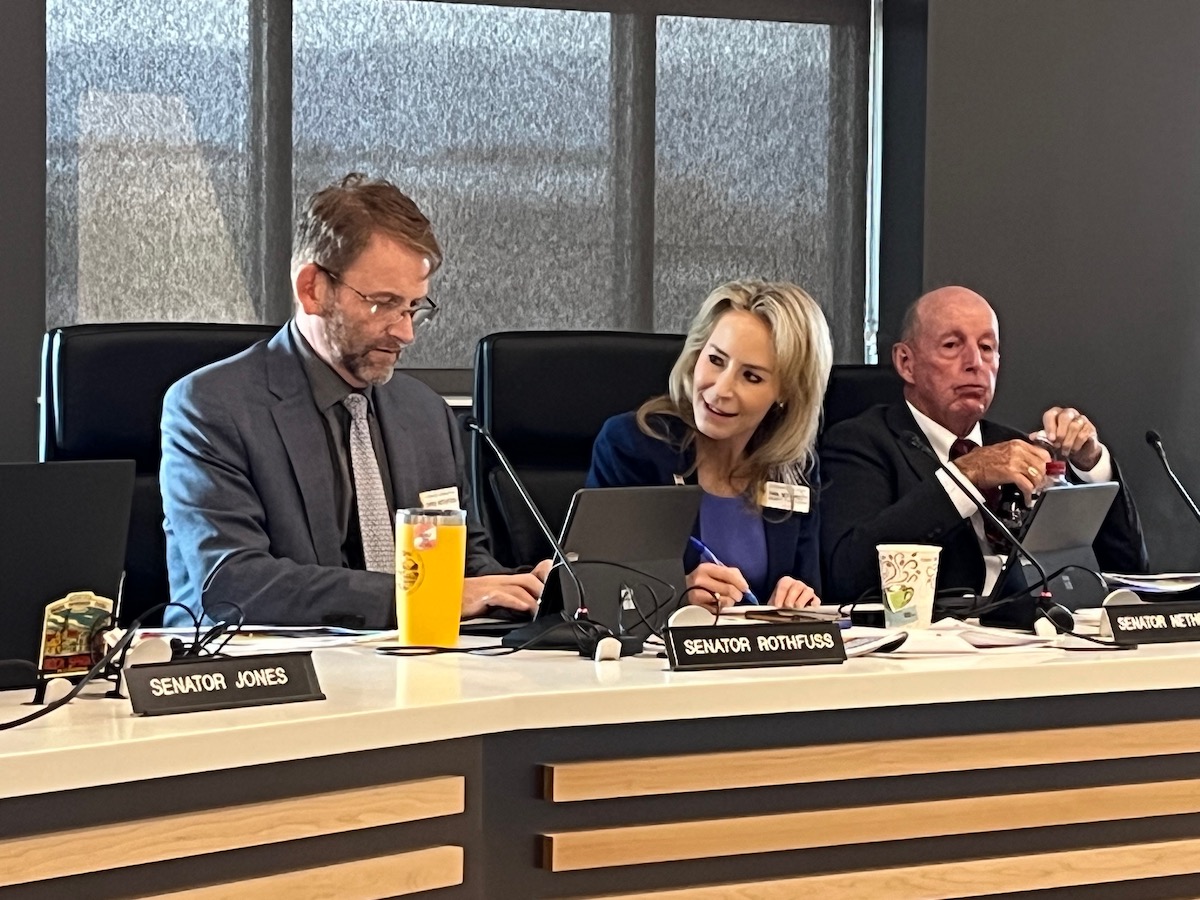
Senate Majority Floor Leader Tara Nethercott said the amendment “reflects the will of the people.”
“The people of Wyoming have spoken. And they have said, ‘fund our future,’” the Cheyenne Republican said. “And they have said, ‘fund our only state university.’ They said, ‘these cuts feel punitive and retaliatory.’ That’s what my constituents said, and that’s what I heard.”

Though Senate Appropriations Committee Chair Tim Salazar did not support Driskill’s amendment, he said it did not take him by surprise.
“I want to thank the Senate Appropriations Committee for their work. It was not in vain,” he said. “We had the ability to voice our views on these issues. I knew from day one … that the budget bill was going to be changed. I knew that. The question is, how much?”
The Senate’s six other adopted amendments were not nearly as sweeping. One successful amendment earmarked $5 million for litigation related to the Colorado River Basin. Another appropriated $75,000 in the Department of Family Service’s budget for sign language interpreters. The body also voted to add $497,477, dependent on the passage of a senate file that would establish a voluntary water conservation program, and approved a change that would free up as much as $2.5 million from the state shooting complex account.
Ten more Senate amendments were ultimately withdrawn, making the upper chamber’s affairs swift compared to down the hall in the House.
Lengthy House debate
The House kicked off negotiations with a lengthy amendment from Rep. Mike Yin, D-Jackson, that was similar to Driskill’s.
“What this does give us is a chance, in third reading, to decide, ‘OK, where do we want to go from the governor’s rec,’ rather than the position of JAC, which, unfortunately, I cannot agree with,” Yin said.

The amendment, which ultimately failed, spurred more than an hour of debate. Lawmakers opposed to the change argued that it would erase the weeks of work that the JAC had put into its recommendation and relinquish power over the budget to the governor. “If we pass this right now, what we’ve effectively done is eliminated our voice and eliminated one of our readings of the budget,” Rep. Jeremy Haroldson, R-Wheatland, argued. Rep. Jayme Lien, R-Casper, reminded her colleagues that they have a “constitutional obligation” to “control the purse strings.”
Meanwhile, lawmakers who wanted to restore the governor’s recommendations described what they believed was a lack of transparency around the JAC’s decisions to make certain budget cuts.
“Public testimony was so isolated by the JAC and extremely limited in time, and it made it extremely difficult for these concerns that other people might have to arise so we could consider them ourselves as well as we look at the recommendations of the JAC,” Rep. Martha Lawley, R-Worland, said.
Others felt that state agencies were also not given enough opportunity to provide feedback on the committee’s cuts.
What’s more, House lawmakers argued that the JAC’s budget recommendation isn’t sacred. “I respectfully would submit that it’s not our obligation to accept the work of the JAC if we disagree,” Rep. Bob Nicholas, R-Cheyenne, said.
After Yin’s amendment failed, lawmakers struck down a list of smaller changes that proposed to restore some funding. House members also rejected an amendment from Rep. Tony Locke, R-Casper, to slash the state’s budget even further. By 5:30 p.m., they had approved one amendment to add $295,938 to pay for two additional employees for the Wyoming State Fair.
By that time, the Senate had long finished its business on the budget. The House still had more than 100 amendments to sort through.
For more legislative coverage, click here.



Will this stark divergence force the Legislature into overtime? It might. And if it does, it will be better than rubber stamping the Governor’s proposal.
Not all of the JAC’s cuts are bad ideas. The severity of the cuts to UW is ill-advised, but a little might be trimmed. Defunding WPR is shortsighted and a disservice to those of us who use it as a source of statewide news and good entertainment. On the other hand, dismantling the dysfunctional, bureaucratic, opaque Wyoming Business Council – whose purpose seems to be to undermine local Wyoming businesses in favor of large ones based out of state – is LONG overdue.
We have a system of checks and balances, and therefore should not take the Governor’s draft as divine writ. Hopefully, the Senate vote won’t be too major a setback.