


CHEYENNE—For nearly seven months, the high-profile lawsuit challenging a University of Wyoming sorority for admitting a transgender woman has sat pending in federal court, but not for a lack of a ruling.
Instead, the plaintiffs — a group of Kappa Kappa Gamma sorority sisters — have not taken any action since June when the 10th Circuit Court of Appeals rejected their appeal and gave them two choices — amend their complaint or ask the lower court for a final judgment.
In an effort to find out how the plaintiffs were planning to proceed, U.S. District Judge Alan B. Johnson held a scheduling conference Tuesday. But they provided few details to the court.
“I don’t have an answer for you,” John Knepper, an attorney for the plaintiffs, told Johnson.
Knepper added that his clients are in “various places in their lives” and he needed to confer with them about next steps.
The lawsuit caught international attention after it was initially filed anonymously and then with names attached in April 2023.
The plaintiffs — Jaylyn Westenbroek, Hannah Holtmeier, Allison Coghan, Grace Choate, Madeline Ramar and Megan Kosar — accused the sorority of breaking its bylaws, breaching housing contracts and misleading sisters when it admitted Artemis Langford by a vote of its members.
Johnson dismissed the lawsuit in August 2023, ruling that the government cannot interfere with how a private, voluntary organization determines its membership. An appeal was rejected last June.
Since then, a tangle of other litigation has unfurled. Langford sued the plaintiffs’ attorneys — Knepper and Cassie Craven — last year for allegedly abusing the legal process by including salacious but irrelevant accusations in their lawsuit, according to the Wyoming Tribune-Eagle. And last month, an Ohio court transferred a lawsuit to Wyoming’s U.S. District Court because of its similarity to the case.
Rachel Berkness, attorney for Langford, told the court Tuesday she agreed with plaintiffs that the Ohio transfer complicates matters, but the plaintiffs “had months to consider next steps” before that.
Johnson asked both parties to attend another scheduling hearing later this month.
“We all need to get more up to speed,” Johnson said, adding that Natalie McLaughlin, attorney for the sorority, was the “most knowledgeable.”
The next hearing will include counsel for the Ohio case to decide whether to consolidate the cases.
Ohio details
Knepper told the court he was surprised by the transfer of the Ohio case.
That legal battle involves Patsy Levang and Cheryl Tuck-Smith, two Kappa Kappa Gamma alumni, who sued the organization in the U.S. District Court for the Southern District of Ohio after they were expelled from it.
Levang and Tuck-Smith openly opposed Kappa’s trans-inclusive policy and supported the plaintiffs in the Wyoming case, and say their expulsion was retaliatory. Kappa, meanwhile, has maintained that Levang and Tuck-Smith violated the organization’s rules and their membership was terminated by a vote of the organization’s board of directors.
U.S. District Court Judge Michael H. Watson transferred the Ohio case to Wyoming, citing the “first-to-file rule,” which calls for the court in which the first suit was filed to oversee subsequent cases, too.
Watson noted the Wyoming plaintiffs’ dithering in his decision, arguing that to not transfer the case “would be to condone forum-shopping.”
McLaughlin, attorney for the sorority, pointed to this in court Tuesday, while Knepper pushed back, arguing that the only deadline currently in play is the statute of limitations.
Berkness, meanwhile, voiced concern that the 10-year statute of limitations in the matter will leave her client, Langford, a party to federal litigation for far too long if the case remains pending.

Knepper then told the court the only reason Langford was included in the lawsuit was a concern that the case would be dismissed without her. The allegations against Langford for behaving inappropriately were the most salacious parts of the complaint, and were also shown to have been unfounded. But that came after they were widely shared in the media.
Berkness said she would consider filing a motion to drop Langford from the case and to strike the allegations in the complaint along with it.
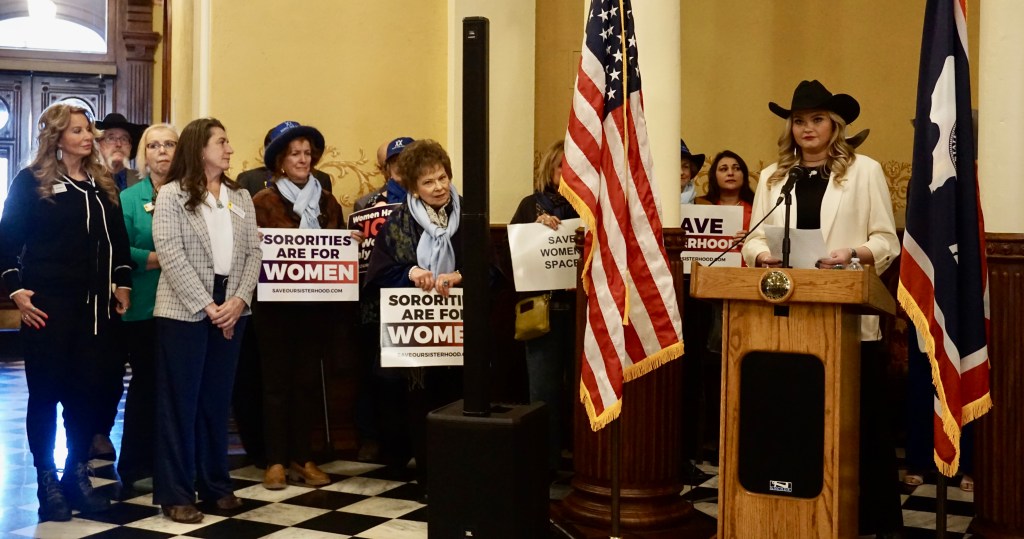
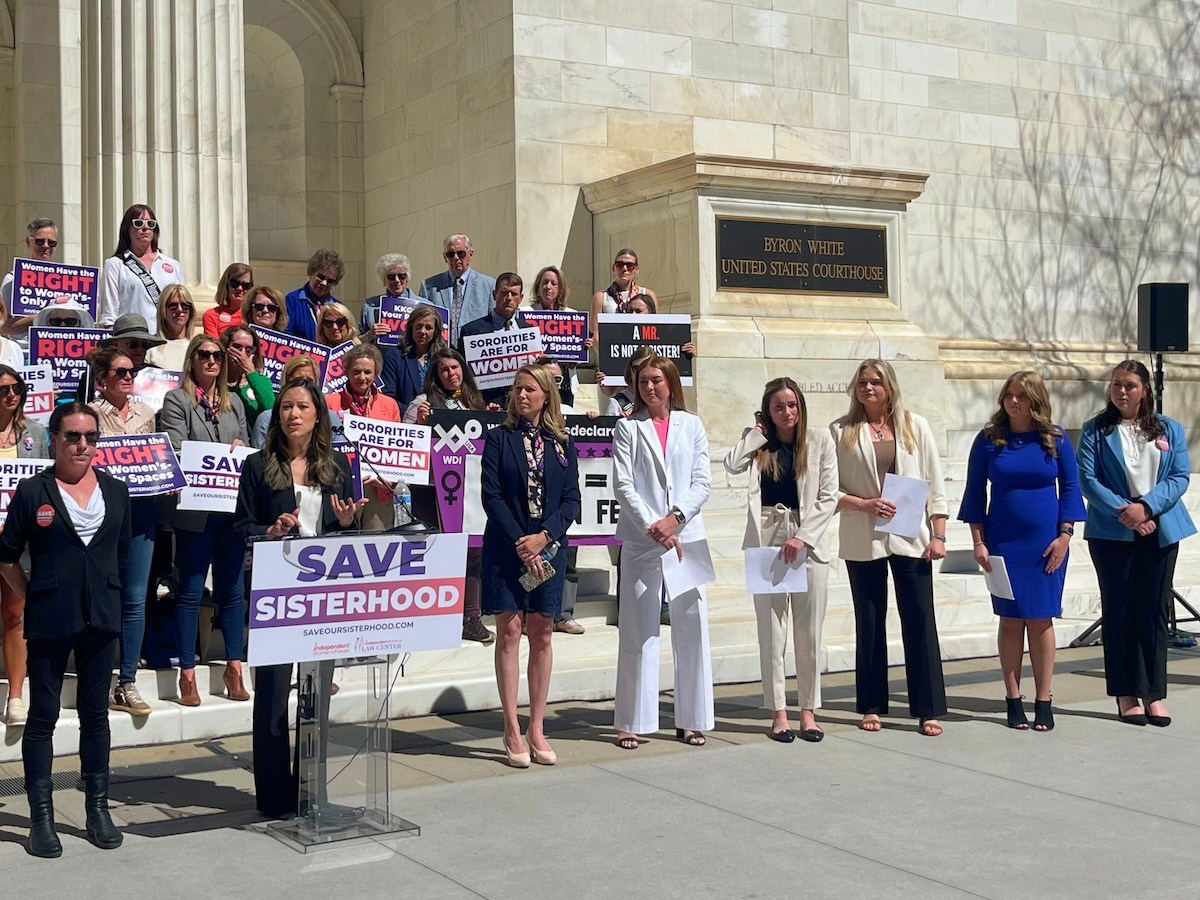
Following the hearing, Craven, counsel for the sorority sisters, was a special guest alongside three of the plaintiffs at a press conference for the Wyoming Freedom Caucus. When asked what the plan for her clients was, Craven reiterated a lack of direction in the case.
“I have nothing to announce,” Craven said.
The next hearing in the case is set for Jan. 29.


Good grief, why all of the fuss? If they want to pretend to be what they aren’t let them, but they should not throw a fit when someone recognizes the fact and not the wish. It is one thing to insist I am 6 ft tall, but everyone else is going to recognize
that I am only 5 foot no matter what kind of fit I throw about my “rights”.
I would hope that the plaintiffs would give very careful consideration to their ongoing battle. It’s bad enough that they tried to forum shop and lied about Langford, but joining forces with Wyoming’s Freedom Caucus seals their legacy as failed judicial activists.
History has not been kind to the likes of Orval Faubus, George Wallace or Anita Bryant. While I hope that this lawsuit turns out to be a minor footnote in the history of transphobic hatred, it is sure to be an enduring source of shame for Wyoming, the University and the litigants themselves.