
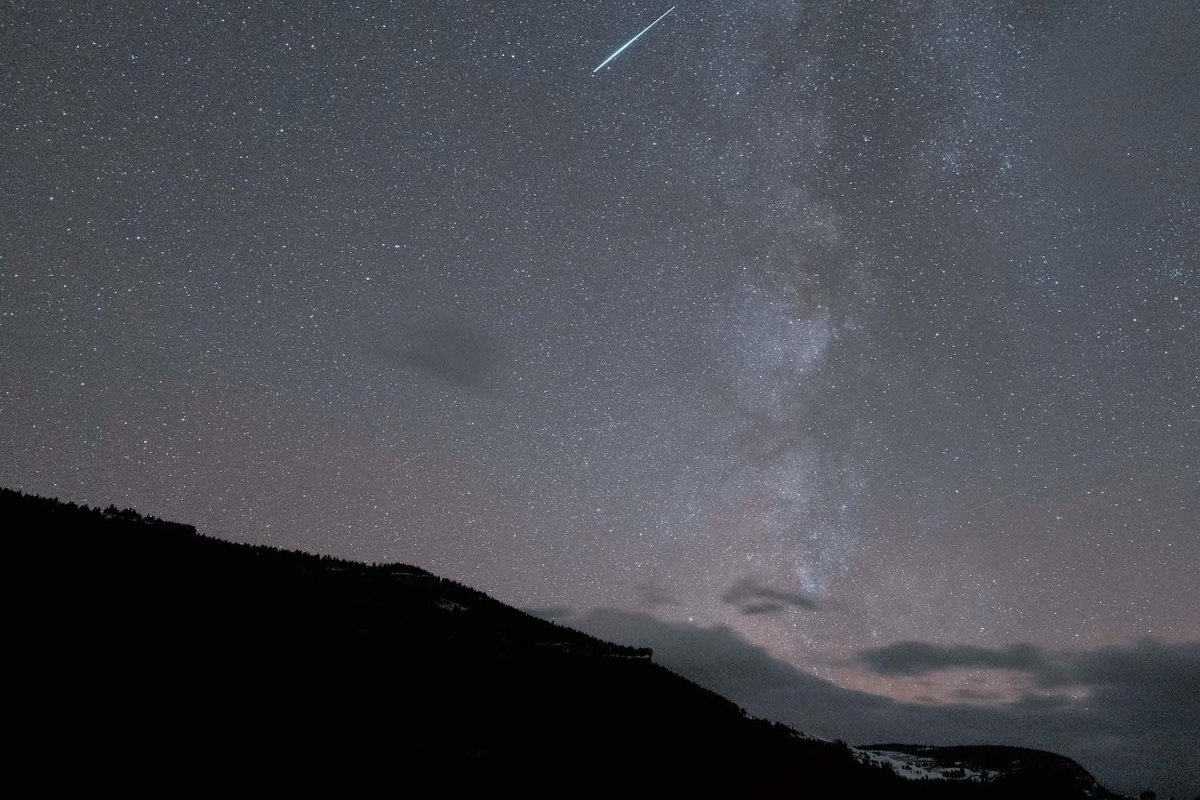
As the Earth’s axis tips Wyoming toward the shortest day of the year, residents may find themselves ruminating on darkness. Some tolerate the absence of sunlight, and others abhor it. Sinks Canyon State Park, meanwhile, celebrates it.

The park recently earned Wyoming’s first official dark-sky designation when it became an International Dark Sky Park. To gain the title, Sinks Canyon had to meet criteria around preventing light pollution and demonstrate its commitment to keeping the park dark.

Park employees began pursuing the designation in 2019. The application to DarkSky International also entailed holding educational events and securing a nomination — a Wyoming stargazing association director vouched for the park.

The designation signals that Sinks Canyon is an ideal place to see the Milky Way, constellations and other astronomical marvels, Superintendent Jessica Moore said. Though Sinks Canyon is only 10 miles from the city of Lander, steep canyon walls provide natural shielding from the town’s urban glow, while the Shoshone National Forest, and miles upon miles of wilderness, buffer it from light on the other end. 

The park itself only has 22 lights, Moore said, but the application entailed inventorying and retrofitting them to be dark-sky compliant — or fitted with shielding so the lumens point downward. 

The designation also helps highlight the importance of darkness, Moore said. It can be easy for humans, who have long overruled natural light cycles with fire, incandescent light bulbs and illuminated screens, to forget the value of darkness or the awesome smear of the Milky Way. 

But darkness plays an important part in the health of critters and people alike, Moore said. “It’s good for our wildlife. It’s good for the people here.” 

Wyoming is rich in dark resources, Moore said. 

“I know we’re not the darkest place in Wyoming,” Moore said. “I know we’re not the only dark place in Wyoming. But by getting this designation, what this does is it brings awareness to it. And I would hope that we will be the first of many dark-sky designations. So that collectively, we work together to keep Wyoming dark.”

Katie Klingsporn reports on outdoor recreation, public lands, education and general news for WyoFile. She’s been a journalist and editor covering the American West for 20 years. Her freelance work has...

Join the Conversation

2 Comments

WyoFile's goal is to provide readers with information and ideas that foster constructive conversations about the issues and opportunities our communities face. One small piece of how we do that is by offering a space below each story for readers to share perspectives, experiences and insights. For this to work, we need your help.

What we're looking for: 

  • Your real name — first and last. 
  • Direct responses to the article. Tell us how your experience relates to the story.
  • The truth. Share factual information that adds context to the reporting.
  • Thoughtful answers to questions raised by the reporting or other commenters.
  • Tips that could advance our reporting on the topic.
  • No more than three comments per story, including replies. 

What we block from our comments section, when we see it:

  • Pseudonyms. WyoFile stands behind everything we publish, and we expect commenters to do the same by using their real name.
  • Comments that are not directly relevant to the article. 
  • Demonstrably false claims, what-about-isms, references to debunked lines of rhetoric, professional political talking points or links to sites trafficking in misinformation.
  • Personal attacks, profanity, discriminatory language or threats.
  • Arguments with other commenters.

Other important things to know: 

  • Appearing in WyoFile’s comments section is a privilege, not a right or entitlement. 
  • We’re a small team and our first priority is reporting. Depending on what’s going on, comments may be moderated 24 to 48 hours from when they’re submitted — or even later. If you comment in the evening or on the weekend, please be patient. We’ll get to it when we’re back in the office.
  • We’re not interested in managing squeaky wheels, and even if we wanted to, we don't have time to address every single commenter’s grievance. 
  • Try as we might, we will make mistakes. We’ll fail to catch aliases, mistakenly allow folks to exceed the comment limit and occasionally miss false statements. If that’s going to upset you, it’s probably best to just stick with our journalism and avoid the comments section.
  • We don’t mediate disputes between commenters. If you have concerns about another commenter, please don’t bring them to us.

The bottom line:

If you repeatedly push the boundaries, make unreasonable demands, get caught lying or generally cause trouble, we will stop approving your comments — maybe forever. Such moderation decisions are not negotiable or subject to explanation. If civil and constructive conversation is not your goal, then our comments section is not for you. 

Your email address will not be published. Required fields are marked *

  1. Great article. I was happy to help Sinks Canyon in their initial stages of acquiring this dark sky certificate. They invited me up in 2019 to measure how dark their skies were and then to have public star parties and constellation walks over the last couple of summers. If any of your other readers or reporters want to discuss light pollution a bit more in detail then what was in this article, I am a advocate for the International Dark Sky Association and always happy to discuss.

  2. I recently read “ The End of Night”. Great read. Darkness is very important for our well being, indeed for our environment and ecosystems! I’m all for this and many more!