
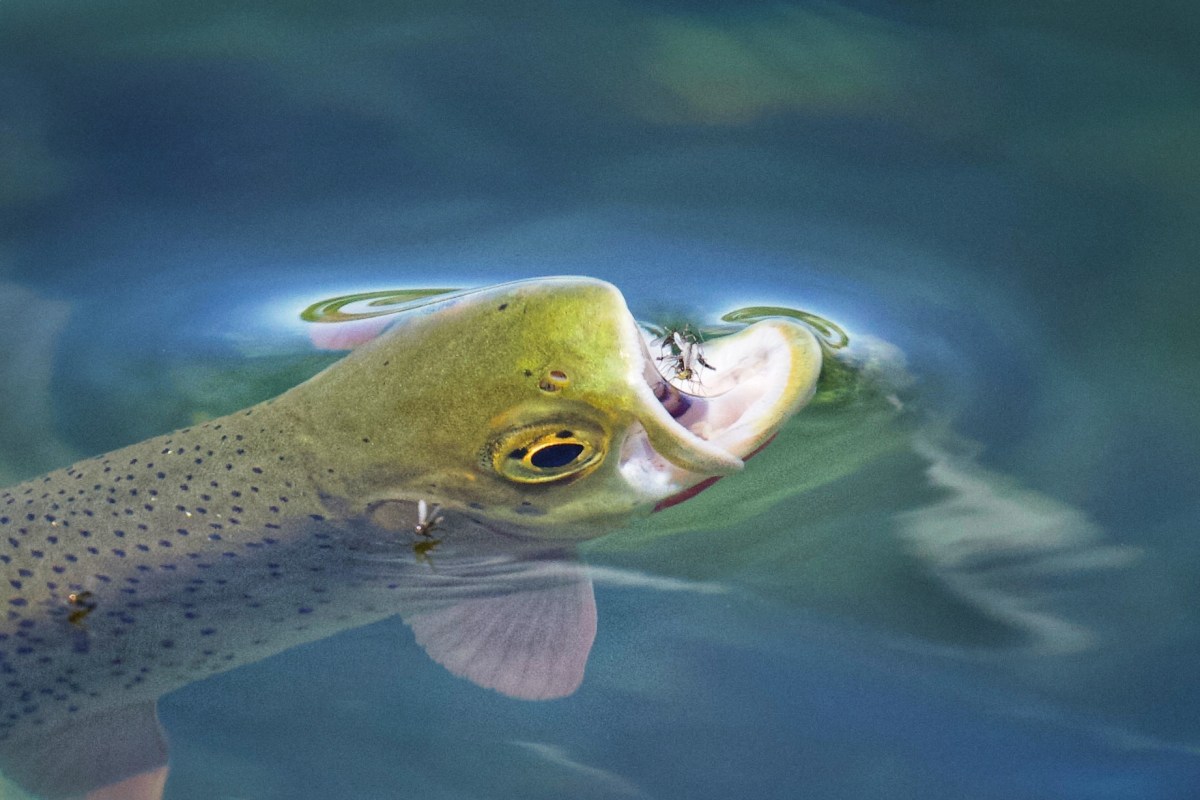
At first Jim Sorensen was just messing around trying to capture the rise rings of one surface-feeding trout.

Then he got hooked. 

The setting of his obsession? A spring-fed slough on the west bank of the Snake River, right in the Wilson resident’s backyard. Near the outflow, cutthroat tend to school up. When the hatch picks up some late afternoons, the camera-wielding accountant heads for the cover of a nearby willow tree. 

“I just sit there,” Sorensen said. “If you fish, you know there’s that anticipation when you put that cast out. Whether the fish rises or not, there’s still that moment of anticipation. It’s kind of the same thing.”
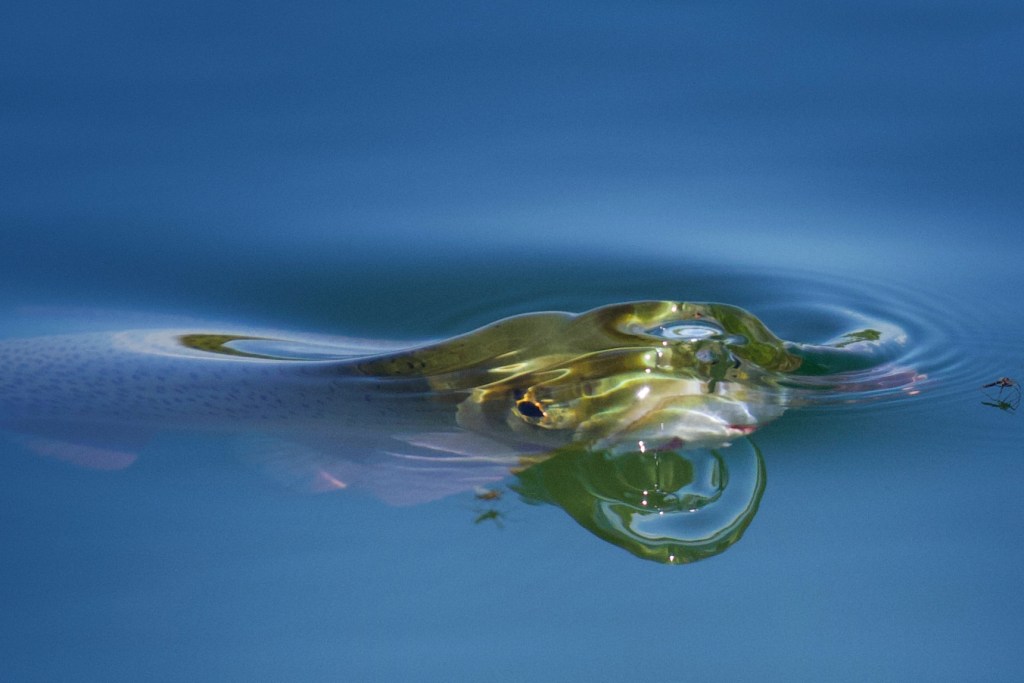
Distorted by an underwater upheaval of its own making, a frog-faced Snake River cutthroat trout rises to an easy meal in Wilson resident Jim Sorensen’s backyard trout pond. (Jim Sorensen)

Much like fishing for high-country cutthroat, photography is not a highly technical endeavor. 

“Turn it on at high shutter speed,” Sorensen, “and start firing away at 400 millimeters.” 

Many shots come in blurry and get deleted on the scene. Other times, everything lines up. 

“It’s pretty interesting how the water moves across the trout,” Sorensen said. “And the laminar flows. Their tails will create this flow of water behind them.” 

Sorensen’s summer photography project is not set in some manicured, temperature-controlled trout pond. Tied into the Fish Creek watershed, it’s a springfed system with no surface inflow that seems to support self-sustaining populations of native Snake River cutthroat, brook trout and mountain whitefish, he said.
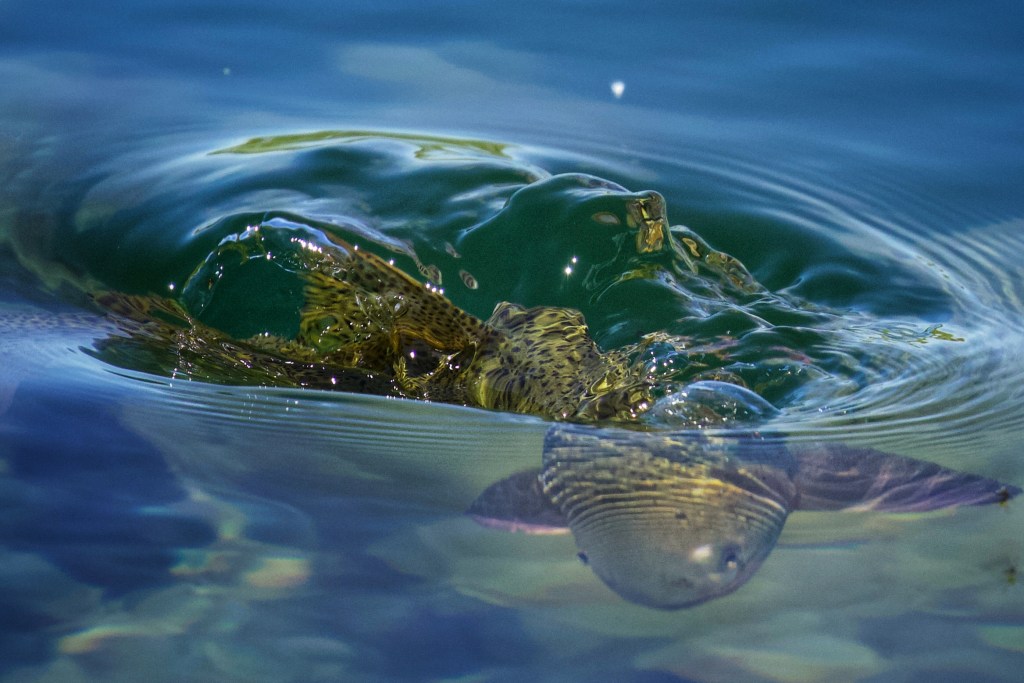
Aqueous turbulence abounds in the aftermath of a cutthroat trout’s insect snack in a backyard pond north of Wilson. (Jim Sorensen)

Toothy terrestrial critters and birds of prey are known to take advantage.  While Sorensen was on the phone describing his project to WyoFile, a weasel scampered over a backyard bridge, disrupting his focus. He’s also documented fish-eating otters and great blue herons through his lens. And once, via a remote trail camera, he captured footage of a much less likely trout hunter. 

“One night it picked up a great horned owl that caught a brook trout,” Sorensen recalled. “In one scene you can see it flopping across the shallows with the fish, then it brought it up and sat underneath the camera. It was a decent-sized brookie.”

Mike Koshmrl reports on Wyoming's wildlife and natural resources. Prior to joining WyoFile, he spent nearly a decade covering the Greater Yellowstone Ecosystem’s wild places and creatures for the Jackson...

Join the Conversation

2 Comments

WyoFile's goal is to provide readers with information and ideas that foster constructive conversations about the issues and opportunities our communities face. One small piece of how we do that is by offering a space below each story for readers to share perspectives, experiences and insights. For this to work, we need your help.

What we're looking for: 

  • Your real name — first and last. 
  • Direct responses to the article. Tell us how your experience relates to the story.
  • The truth. Share factual information that adds context to the reporting.
  • Thoughtful answers to questions raised by the reporting or other commenters.
  • Tips that could advance our reporting on the topic.
  • No more than three comments per story, including replies. 

What we block from our comments section, when we see it:

  • Pseudonyms. WyoFile stands behind everything we publish, and we expect commenters to do the same by using their real name.
  • Comments that are not directly relevant to the article. 
  • Demonstrably false claims, what-about-isms, references to debunked lines of rhetoric, professional political talking points or links to sites trafficking in misinformation.
  • Personal attacks, profanity, discriminatory language or threats.
  • Arguments with other commenters.

Other important things to know: 

  • Appearing in WyoFile’s comments section is a privilege, not a right or entitlement. 
  • We’re a small team and our first priority is reporting. Depending on what’s going on, comments may be moderated 24 to 48 hours from when they’re submitted — or even later. If you comment in the evening or on the weekend, please be patient. We’ll get to it when we’re back in the office.
  • We’re not interested in managing squeaky wheels, and even if we wanted to, we don't have time to address every single commenter’s grievance. 
  • Try as we might, we will make mistakes. We’ll fail to catch aliases, mistakenly allow folks to exceed the comment limit and occasionally miss false statements. If that’s going to upset you, it’s probably best to just stick with our journalism and avoid the comments section.
  • We don’t mediate disputes between commenters. If you have concerns about another commenter, please don’t bring them to us.

The bottom line:

If you repeatedly push the boundaries, make unreasonable demands, get caught lying or generally cause trouble, we will stop approving your comments — maybe forever. Such moderation decisions are not negotiable or subject to explanation. If civil and constructive conversation is not your goal, then our comments section is not for you. 

Your email address will not be published. Required fields are marked *

  1. Nice article. In the divisive times we live in we could use more stories like this.