


The U.S. Supreme Court should not review the Elk Mountain Ranch owner’s failed trespass lawsuit against four men who corner crossed to hunt on public land in Carbon County, the hunters’ lawyers say in a 39-page document filed Wednesday.
Ranch owner Fred Eshelman’s petition to the high court to take up the case is “procedurally deficient and doctrinally unfounded,” the new filing states. Eshelman’s claim that corner crossing is an unconstitutional taking of private property was not fully and fairly presented to lower courts and is therefore moot, the hunters contend.
Eshelman asserts, among other things, that corner crossing is an unconstitutional taking of private property without compensation. But he and his landowning company Iron Bar Holdings raised that argument late in the legal process, and almost in passing, the hunters say.
For the Supreme Court to consider Eshelman’s takings argument, the ranch owner had to first fully argue the issue in the lower courts, thereby exhausting all his other remedies, according to the hunters’ brief.
“This Court should not take this case to explore Iron Bar’s procedurally deficient and doctrinally unfounded takings theory,” attorneys Ryan Semerad and Lee Mickus wrote.
“Been here before”
Eshelman’s Elk Mountain Ranch covers some 20,000 acres of a wildlife-rich peak that soars to 11,156 feet. The North Carolina owner and pharmaceutical magnate is a hunter whose property surrounds 6,000 acres or more of public land owned by all Americans and controlled by the Bureau of Land Management.
Across southern Wyoming, property ownership is laid out in a checkerboard pattern of public and private square-mile sections, a vestige of the railroad building and land-grant era of the mid 1800s.
“Iron Bar complains that this narrow decision effectively legalized trespassing across the country, destroying billions of dollars in property value. The hyperbole is misplaced.”
Ryan Semerad and Lee Mickus
“Many public-land squares on these checkerboards are accessible only by ‘corner crossing,’” the hunters’ attorneys explain. That is by “stepping from one public-land square to the next one across the public-private corner without touching the private-land squares.”
To corner cross, one must inevitably pass through the airspace above private property. Based on the common-law “ad coelum” dictum that presumes a landowner also owns the airspace above his or her property, Eshelman contends corner crossing is a trespass.
The onX digital mapping company estimated that 8.3 million acres of public land in the West would be inaccessible to the public if corner crossing is found to be an illegal trespass.
That’s what Missouri hunters Bradly Cape, John Slowensky and Phillip Yeomans did in 2020, and with Zachary Smith again in 2021. The Carbon County attorney cited them for trespass and a jury found them not guilty of the misdemeanor in 2022.
Eshelman sued the four in civil court that year, seeking to bar them and others from corner crossing to reach public land on Elk Mountain. A federal judge in Wyoming decided that Eshelman could not block the hunters from landlocked public land in the checkerboard part of Wyoming and the 10th Circuit Court of Appeals agreed when Eshelman took his case to that venue.
The Wyoming chapter of Backcountry Hunters and Anglers has backed the hunters, saying they needed to have their case heard and required financial support to balance Eshelman’s wealth and resources.
Eshelman’s petition to the Supreme Court said the 10th Circuit decision against him “steamrolls state law, takes easements, and revolutionizes property law affecting up to 150 million acres of private land.”
Disarming Eshelman’s takings arguments was one of several points the hunters made in their response, including that “this [Supreme] court has been here before” and decided in favor of public access to public land. The 10th Circuit Court of Appeals correctly applied the text of the 1885 Unlawful Inclosures Act and the precedent set by other cases that revolved around that law, the hunters say.
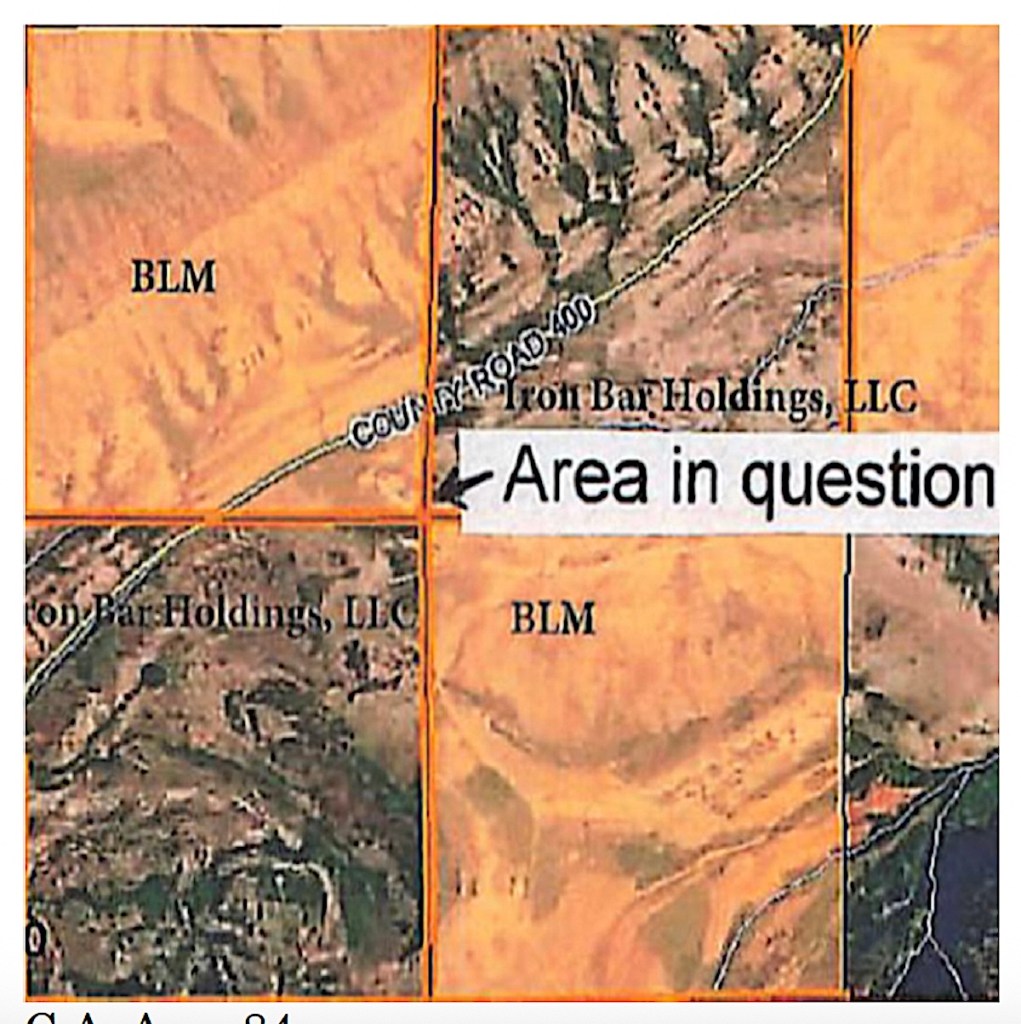
Congress passed the 1885 act during checkerboard scuffles to prohibit blocking public access to public land, including by using fences, other physical barriers and even threats and intimidation.
The appeals court’s decision is narrow, doesn’t break new ground and is not in conflict with decisions in other appeals court circuits, the hunters’ response states. Those are all reasons to let the lower court ruling stand, they say.
Eshelman also failed to fully argue in lower courts that the 1885 Unlawful Inclosures Act does not automatically supersede Wyoming’s trespass laws. “Ordinarily, this [Supreme] Court does not decide questions not raised or resolved in the lower court,” the hunters state.
Bye bye Leo Sheep
Eshelman and his landowning company Iron Bar Holdings have argued that courts decided another Carbon County checkerboard case — known as Leo Sheep — in favor of blocking public access to public land across checkboard corners. In that instance, the BLM sought to build a road across a common corner to provide public access to a reservoir.

Courts ruled against the BLM. Eshelman’s attorneys use that decision to argue that the federal government never reserved an easement allowing the public to corner cross.
The hunters disagree.
“As the Tenth Circuit explained, Leo Sheep doesn’t apply to Iron Bar’s claims,” the hunters say. The Supreme Court has already said that the 1885 act, on which the hunters hang their hats, “played no role” in Leo Sheep, Wednesday’s filing states.
“But Iron Bar raises a categorically different question,” the hunters continue, “whether checkerboard landowners can affirmatively extinguish all access to neighboring checkerboarded public land.” The Supreme Court rejected a petition to review a case that “invoked Leo Sheep in the same flawed way,” the hunters say.
The hunters’ response elaborates on a couple of other points, emphasizing the effects of finding that corner crossing is an illegal trespass.
“The UIA supplants conflicting state law since a different rule would place the public domain of the United States completely at the mercy of state legislation,” the filing states. In other words, by blocking the public from public property, Eshelman can enjoy that public land and its bounty for himself, the hunters say.
Semerad and Mickus note that the 1885 UIA was in effect ages before Eshelman ever laid eyes on Elk Mountain.


“Iron Bar bought checkerboarded property in 2005,” the attorneys wrote. “[Eshelman’s] rights have always been subject to the limits imposed by the UIA.”
Although the 10th Circuit decision is focused, the hunters say Eshelman exaggerates its effects.
“Iron Bar complains that this narrow decision effectively legalized trespassing across the country, destroying billions of dollars in property value,” the filing reads. “The hyperbole is misplaced.”
“The [appeals] court did not immunize a trespasser who marches straight down the middle of private property,” as Eshelman contends, the hunters say. “Rather, the court held only that if access to public lands is otherwise restricted, a checkerboard landowner cannot sue a corner crosser for trespassing so long as they did not physically touch [private] land.”

Makes a guy want to go for a walk. This is getting ridiculous. The SCOTUS should flush this down the toilet.
Great article. Eshelman is pushing this to the Supreme Court of the U.S. for one reason — he knows he will win. This Supreme court will always find in favor of their billionaire bros. It’s a sad state of affairs and so frustrating to us old folk that use to think the SCOTUS were so smart, gifted, and worked hard to interpret the constitution of the U.S., those days are gone. .
Remember that the majority of the Justices were put in their roles by Republicans. Which Wyoming always votes for .
Why is it that we, the public are taking “corner crossing is an unconstitutional taking of private property” but by his or their blocking access from public to public land, they are not the ones “corner crossing is an unconstitutional taking of PUBLIC property”? Further, when a ranch is sold, the public ground is an asset they, the rancher, is getting compensated for, ie.. they are selling our public land as part of the ranch. I dont understand exactly how that works, but its a heck of deal to get paid for land you dont own…
According to the unlawful inclosures act fences in checkerboard are illegal. I think it would be great if it was made clear that not only are corner crossings legal, but fences are illegal. As one ruling clarified, those who purchased in the checker board were “knowing buyers.” They knew what the law was.
In Leo Sheep ruling the BLM built the road without obtaining a legal access across private. Building a road is way different that walking across or livestock being trailed across.
You never know what Dumps supreme court ( or any other dump goofball) is going to do, however they usually support the wealthy. We need to change the way justices are chosen. Only the citizens can make that change. Our government panders to money, what a shame.
Our government includes plenty of democrats, in case you were unaware. They are also a part of government, and just as money hungry as the republicans you love to demonize.
But it’s the Repos doing this, isn’t it. Are there any Democrats in Wyomings delegation?
Fred, it’s over. The leveraging of your pawns and go’fers was an epic failure. You had the backwater Carbon County Sheriff in your pocket, the bought and paid for Carbon County Attorney and their attempted assembly of a kangaroo court and the cowardly Wyoming Game & Fish that shied away from rightfully charging you and your ranch employee/goons with hunter harassment. It all failed. All of these suckers were enamored with your money and false sense of power. Four common folk Missouri hunters kicked your behind. Don’t go away mad, Eshelman just get the you-know-what out of Wyoming.