

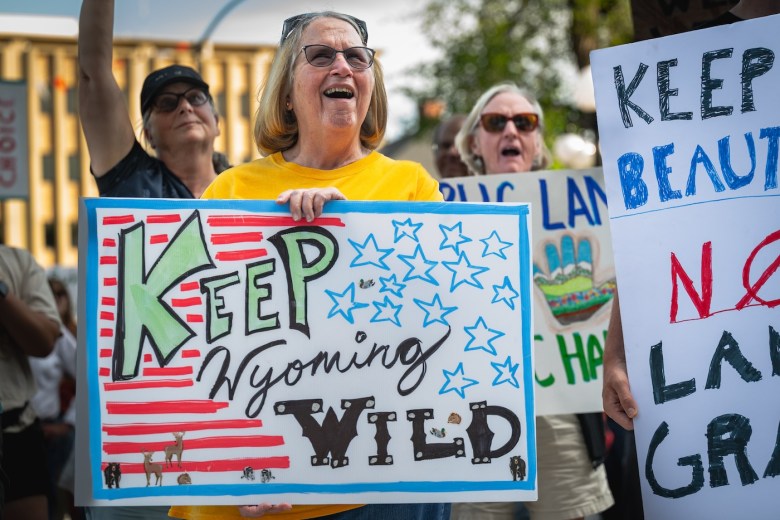
So, under pressure from hundreds of thousands of Americans, Utah’s land-grabbing Sen. Mike Lee withdrew his proposal to put the nation’s public domain up for sale. Much justifiable celebration has ensued. Largely lost in the outcry over his provision in the Big Beautiful Bill Act was an announcement by Secretary of Agriculture Brooke Rollins: The Department of Agriculture is rescinding the 2001 Roadless Rule that has prohibited road construction and timbering on 58.5 million acres of national forest.
Opinion
Rollins brought her vast experience with federal lands from her home in Texas to Washington, D.C., where she served as a minor functionary in the first Trump administration and later as the co-founder of a D.C. lobbying group, America First Policy Institute. What she knows about the issues surrounding federal land use could be comfortably contained in a thimble.
Her order was a canny political move, since it’s likely to split the constituency that voiced outrage over the outright sale of federal land. A substantial part of that opposition came from users of ATVs, snowmobiles and other vehicles designed to move people into the backcountry with minimal sweat. Many will be happy to hear a huge swath of federal land is now open to motor vehicles.
Even more will be alarmed. Backpackers and other wilderness aficionados prefer their forests roadless. So do many big game hunters, since elk, mule deer and bighorn sheep shy away from roads, even the seldom-used two-tracks that wind their way through the public domain. The first step in planning a big-game hunt on federal land is to spread out a map and look for the places the roads don’t go — those are the places big game is likely to be found, especially after the opening morning of the season.
I mention this proposal for a couple of reasons. First, if it isn’t quickly rescinded, it will have dire consequences for those of us who prefer to maintain some places only a horse or boot leather can take us. Over decades of debate, we’ve struck a balance between motorized access on national forests and the unique character of true backcountry. I’m not surprised that a president whose idea of wilderness is the rough on a golf course appointed a woman who comes from one of the most fenced-in, jealously guarded, privately held states in the nation to oversee a system of federal lands that is a powerful symbol of freedom for tens of millions of Americans. Not surprised, just deeply disappointed.
The second reason I raise this matter is to consider the way it fits in the fight over federal land, a fight that started almost as soon as Yellowstone, the nation’s first national park, was set aside in 1872. In the years that followed that unprecedented action, powerful economic interests in the West started a campaign to get control of the park, maneuvering to build a rail line in Montana from Gardiner to Cooke City, slicing off the northern and western edges of the park in the process. One of the park’s first superintendents, Robert E. Carpenter, was fired when his part in the scheme came to light.
In 1891, President Benjamin Harrison created America’s first forest reserve, a huge tract of high-country timber east of Yellowstone Park that would eventually become the Shoshone National Forest. At first, residents ignored the regulations intended to protect timber, pasture and watersheds from senseless abuse. Then, as the regulations were enforced, the locals pressed their representatives in Washington, D.C., for relief. Several congressmen from the West took up that cause, which was eventually adopted by Speaker of the House Joe Cannon of Illinois.
In 1907, the western anti-forest coalition managed to attach an amendment to a large agriculture appropriations bill. It appropriated $125,000 for the Forest Service, provided: “that hereafter no forest reserve shall be created, nor shall any additions be made to one heretofore created within the limits of the States of Oregon, Washington, Idaho, Montana, Colorado, or Wyoming, except by Act of Congress.” The identities of the authors of this provision are lost in the minutiae of congressional records, but the list of states it was supposed to protect from President Teddy Roosevelt’s ongoing campaign to establish national forests tells us where they lived.
While this contest was simmering in Washington, westerners fought federal authority on the ground. In 1906, rancher Fred Light turned 500 head of cattle loose on the Holy Cross Forest Reserve in Colorado without a permit from the Forest Service. The resulting legal battle went all the way to the U.S. Supreme Court, funded by a special appropriation from the Colorado Legislature. A similar case in California also made its way to the Supreme Court. The ranchers lost their bid to undermine Forest Service regulations — the court supported congressional authority to establish federal reserves and appoint officials to control the ways they’re used.
Supreme Court decisions notwithstanding, stockgrowers and settlers near the public domain continued to flout regulations and dodge limited enforcement, and the damage to federal land deepened and widened. In 1923, Aldo Leopold, then an assistant Forest Service supervisor in the department’s Southwest region, reported that, on the forests in his district, “overgrazing is responsible for much more abnormal erosion than all other causes combined.”
The situation worsened as the region descended into the droughts of the 1930s, which led conservation-minded legislators to impose some sort of reasonable management on federal lands, especially the parts of the public domain that were neither part of the national systems of parks and forests nor owned by private interests. The Taylor Grazing Act of 1934 allowed the secretary of the interior to organize “grazing districts” on those orphan federal lands, issue permits to control grazing and charge a fee for those permits. Oddly enough, the sponsor of the law, Congressman Edward Taylor of Colorado, was an opponent of federal controls and hoped to give locals control over the new federal grazing bureau.
One of the most entrenched opponents of the Taylor Grazing Act was Pat McCarran, U.S. senator from Nevada. When the act took effect, McCarran set about undermining the new federal Grazing Service. He set standards for the election of local advisory boards that favored the biggest ranchers; he made sure the boards could set grazing fees well below prevailing market prices; he pushed regulatory loopholes that favored ranches controlled by banks and he pressed board members to buy their grazing districts outright. Over the next 20 years, he attacked Grazing Service employees for alleged abuses of authority and fought proposals to increase grazing fees. He was his generation’s leader in a war against federal land that was already 50 years old.
After World War II, U.S. Sen. Ed Robertson from Wyoming took up the cause, introducing a bill that would have turned over federal grazing lands to the states in which they were found and holding extensive “investigative hearings” across the West to root out instances of Bureau of Land Management (formerly the Grazing Services) employees abusing their authority. He pressured the Department of Agriculture to maintain unsustainable stocking rates for sheep and cattle on national forests and helped strangle BLM efforts by slashing the agency’s budget. Other members of Congress championed laws that expanded assistance to permittees grazing public land and limited BLM and Forest Service professionals’ authority to regulate grazing. Frank Barrett, a Wyoming senator, introduced a bill that would have allowed permittees to sell their permits. Thankfully, it failed. At the same time, timber harvests on federal land expanded drastically, with no attention given to restrictions explicit in the federal laws that were supposed to control the Forest Service.
Through the 1960s and 1970s, the American public at large reacted to the longstanding hegemony local interests had exercised over federal lands. The Wilderness Act, the Wild and Scenic Rivers Act, and other federal laws sought to protect amenities the nation at large valued, and the Federal Land Policy and Management Act of 1976 kept BLM lands in federal hands while mandating management that considered “the long-term needs of future generations for natural scenic, scientific and historical values” as well as “recreation, range, timber, minerals, watershed, wildlife and fish.” All of this was to be done “without permanent impairments of the land and the quality of the environment.”
The Federal Land Policy and Management Act was a glove in the face of the traditional masters of the public domain, and it elicited a response that came to be known as the Sagebrush Rebellion, yet another attempt to cede federal land to the states. Prominent in the movement at that moment were candidate Ronald Reagan and Orrin Hatch, U.S. senator from Utah.
This brings us into the realm of living memory. Following the Sagebrush Rebellion, Cliven Bundy and his son, Ammon, dared the federal government to enforce its regulations concerning the use of public land. Ammon was found not guilty of occupying a national wildlife refuge at gunpoint, and, after 10 years, Cliven is still grazing his stock illegally on BLM land.
And now comes Mike Lee at the head of the most recent insurgent action in a fight that has stretched on for 140 years. Should anyone mistake his intentions after his land sale provision was taken off the table, he said that he “continues to believe the federal government owns far too much land — land it is mismanaging and in many cases ruining for the next generation. Massive swaths of the West are being locked away from the people who live there.” He promised to continue his efforts to “put underutilized federal land to work for American families.” We have a century of abuse of the public domain by a tiny minority of people to help us define what he means by “work” and “American families.”
Forcing Lee and his cronies to back down was a signal victory, well worth celebrating. So find a friend, face your favorite corner of public land, the place that always brings a smile to your face and raise a libation to success. Then get a good night’s sleep. Tomorrow morning, they’ll be at it again.
Sources:
- Haines, Aubrey L., 1996. The Yellowstone Story: A history of our first national park. University Press of Colorado, Boulder, CO.
- Steen, Harold K., 2004. The U.S. Forest Service: A history. Forest History Association and University of Washington Press, Seattle, WA.
- Anon, 1907. Public laws of the United States of America passed by the Fifty-ninth Congress, 1905-1907. Session II, Chapter 2907. P.1271. Accessed July 3, 2025.
- Lamar, Lucius, 1911. Fred Light, Appt., v. United States. https://www.law.cornell.edu/supremecourt/text/220/523. Accessed July 3, 2025.
- Leshy, John D., 2021. Our common ground: A history of America’s public lands. Yale University Press, New Haven, CT. Accessed July 4, 2025.
- Leopold, Aldo, 1923. Watershed handbook. U.S. Forest Service, Southwestern District. Accessed July 4, 2025.
- Schweber, Nate, 2022. This America of ours. Mariner Books, Boston, MA, and New York, NY.

Thanks Chris, for an excellent history of the efforts to take away our public land. I will be following your advice. I am resting up and getting out on public lands to remind me why I am in the fight. I will be ready for the next battle.
Death by a thousand cuts. That’s what we can look forward to if we don’t step up and defend what is precious to us. Many still think that progress is making all these lands available to use however we see fit, be it for our motorized recreation, or for our poorly managed timber harvests. If we don’t start protecting what we have, we will lose our and be wondering how it happened.
Thanks for the article. As always you are a champion for those who truly care about this great resource we have.
This land grab debacle proves that the Wyo 3 in D.C. have a #1 priority to kiss the ring of their messiah, the the orange toned Chump. If anybody in this State thinks the 3 represents your interest, you’d be foolishly mistaken. The U.S. has become an oligarch obsessed nation and public lands that were targeted wouldn’t of been used for “housing”…they would of turned into million acre compounds for the likes of Musk, other tech giants are even sold off to foreign enemies that had the “bucks”. We as voters surely don’t do our homework nor promote good people to represent our interests. Closer to home, the UnFreedom Caucus idiots, such as Bear, Rod/Williams and the USDA Subsidy Check casher himself, the “rugged individualist” Madam Chairman French would sell you out in a heartbeat. Wise’n up, people and put some good people in charge and end this 2 faced nonsense
Hageman must be worried about her job. I received one of her dystopian emails stating that she didn’t vote to sell off public land. Of course she didn’t, the house didn’t vote on it. She’s trying to fool the public. She is and was 100% FOR selling public land, same as Pinocchio and Lummis.
Excellent writing as usual. The warning should resonate with all public land users
Interesting point about ORVs. I started using public lands back in the 1960s. In the last couple of decades, I have heard many ORV riders complain that public land vehicle closures are taking away my rights (to turn everything everywhere to dust). In recent years I have seen much more access of all kinds come lost because of private land sales resulting in denial of access to public lands.
The will of the people, not just the wealthy people that can line their pockets, is supposed to be what our members of Congress were elected to champion. Somewhere that is lost on Moe, Curly, and Larry who are in DC now as lawmakers representing the 307. Hopefully the memories of voters are not of the short term ilk.
I have been at the table for many land use decisions. What I have found is that consensus leads to multiple use where few users are willing to accept restraints.
Ironically most love the wide open landscapes of the west and don’t seem to understand that it can be multiple used to death.
I had one rancher tell me years ago that wilderness areas are of no use. But, what makes Wyoming special are all those wilderness, roadless areas where man and beast finds sanctuary. Even that rancher and others like him are found seeking solace in our wild areas without understanding the importance of keeping them.
Chris Madson has as deep and broad a knowledge of the conservation of public lands and wildlife as anyone I know. His historical essay here describes the battle between conservation for the public good and the determination of well-heeled and powerful privateers to continue Manifest Destiny–the theft and rapine of the West that goes back to the fur trade and the theft of tribal lands.
From the logging, mining, dam-building, oil & gas, tourism, and livestock industries through the Sagebrush Rebellion and Wise Use Movement to the urban developers of cities and towns in the water-starved West, we see that the greed for destruction in the name of profit has never ceased, although it has ebbed and flowed over the last century. Now, under Trump and MAGA, Manifest Destiny is roaring back.
I despair that the political strategies and tactics of legislative democracy we used in the 20th century to create and sustain institutions and agencies for the conservation of public resources are no longer available to us. Trump and MAGA’s main target is democracy, and once democracy is damaged and even destroyed, what is left to us?
A suggestion: we follow the example of the Civil Rights Movement and engage in widespread civil disobedience against the destruction of public lands, waters, air, and wildlife.
I highly recommend that conservationists and other defenders of democracy read military historian Thomas Ricks’ book, Waging a Good War: A Military History of the Civil Rights Movement, 1954-1968. In it, he describes the strategies, operations, and tactics of the Movement to defeat Jim Crow in the South. What’s most important to the history of the Movement is not just the marches, the sit-ins, the rallies, and lawsuits, but the thinking behind the campaigns of non-violent civil disobedience. The intellectually sophisticated work of the Movement was as important to success as was the courage of those on the streets. The Civil Rights movement knew what it wanted and worked out in detail how to get it. Then, the Movement acted to achieve its goal. The Movement was in every sense a disciplined military campaign, from the leadership down to the troops on the ground. It was a war for freedom.
We should understand that the Civil Rights Movement of the 20th century grew out of centuries of slavery and slave rebellions, a bloody Civil War, and Jim Crow. Most of us who work to protect public lands as well as democracy do not have the experience of that oppressive history to prepare and steel us against what’s to come. (Indian Tribes of course do have that history and experience, and they’ll need it to defend their sovereignty and their lands, because Manifest Destiny wants to destroy those too). The only way to acquire that experience is to do it, and learn. There will be a cost to that education.
I don’t see any other option.
This is a very interesting article. It shows the long time effort to grab public land for private interests and the greed of users. I truly fear for the future of our lands.
Thanks for this very informative piece of journalism. Under Trump, we can only expect chaos and grift. We will all have to remain vigilant in our fight for OUR land. The best way to fight is by voting. In Wyoming, Barrasso, Lummis and Hageman must be removed from office. We can only hope that the good folks in Utah can see that Mr. Lee isn’t working for them.
Who are the candidates stepping up to oppose our trifecta of sycophants? We need to find them, and start supporting them, and we need them to propose loud and clear an alternative to what we’ve got, which is blind submission to MAGa on all issues.
I don’t know. That’s a tough one in Wyoming. It’s very hard to get out from underneath the rightwing goofballs.