


Opinion
Agriculture is routinely invoked as one of the foundations of Wyoming’s economy, particularly when decisions involve public lands and access, water or wildlife. But if an industry is truly an economic “backbone,” the data should support that assertion. It should account for a substantial share of employment, wages and economic production.
Agriculture does none of those things.
The most recent annual employment data from the Wyoming Department of Workforce Services show that the entire private agriculture, forestry, fishing and hunting sector supported almost exactly 1% of Wyoming employment.

Beef cattle ranching and farming, the industry arguably most synonymous with the Cowboy State, accounted for just 0.6% of 2025 statewide employment.
The wage numbers also fail to surpass 1% of Wyoming’s overall wages. Agriculture, forestry, fishing and hunting generated approximately 0.74% of Wyoming wages. Average annual pay in the agriculture sector was $46,709, well below the state average of $63,511. In 2024, the entire agriculture, forestry, fishing and hunting sector — which combines livestock grazing on public and private lands, farming, and guiding and outfitting business — generated just 1.5% of state gross domestic product.

That was not an anomalous year. Looking back through the U.S. Bureau of Economic Analysis data, agriculture has produced a small fraction of Wyoming’s total economic output for decades.
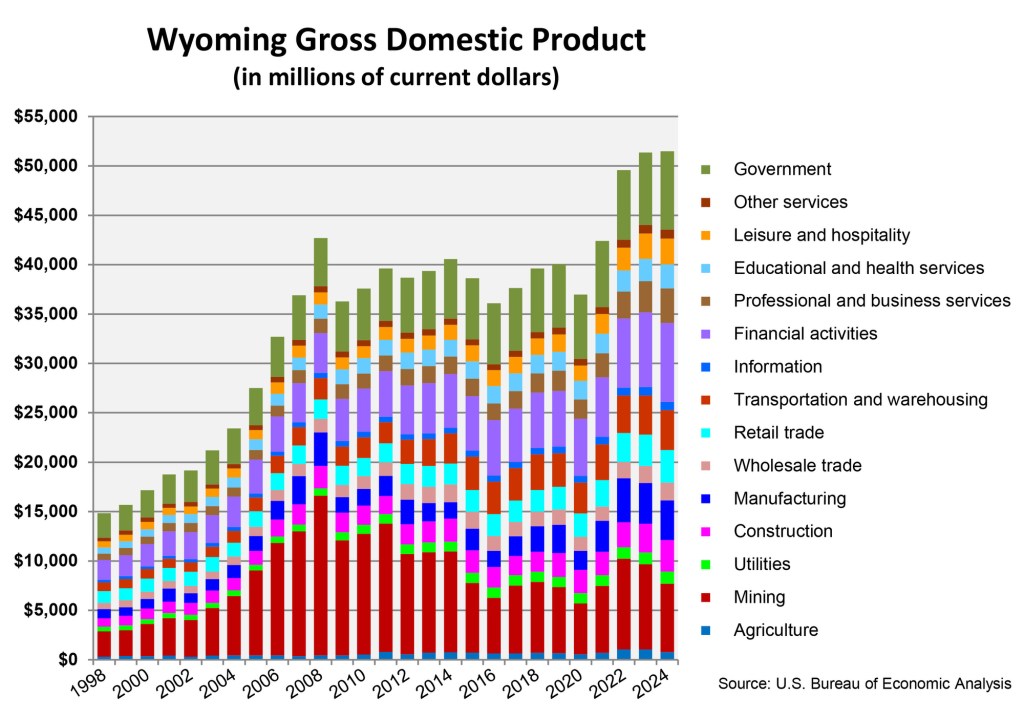
For comparison, the mining industry (which includes oil and gas) generated approximately $6.9 billion of the $51 billion Wyoming GDP in 2024, more than 10 times the value added by agriculture. Construction generated approximately $3.2 billion.
Perhaps more revealing is outdoor recreation.
In 2024, the Bureau of Economic Analysis calculated that outdoor recreation generated 4.5% of state GDP, more than three times the economic contribution of crop and animal production, and supported 16,545 jobs.
The contrast becomes even more striking when economic footprint is compared with physical footprint.
The University of Wyoming Extension identifies irrigated agriculture as Wyoming’s largest consumptive water use by far. Its statewide water analysis estimates that irrigated agriculture accounts for 80 to 85% of all consumptive water use (water removed from the available supply and not returned to the hydrologic system) in Wyoming. The U.S. Department of Agriculture’s 2023 Irrigation and Water Management Survey found that about 87% of Wyoming’s irrigated acreage was devoted to alfalfa, other hay, or pasture, forage and grazing resources used to support livestock production.

USDA’s 2024 Wyoming agricultural statistics report estimates that the state’s agricultural exports were worth $409.6 million, equivalent to about 21.5% of total farm cash receipts.
The much larger numbers commonly cited for agriculture measure something different. The familiar $1.6 billion figure cited in the news represents gross agricultural sales, not value added, while University of Wyoming’s $2.5 billion ‘economic impact’ estimate also includes spending by suppliers and households. Those ripple effects occur in every industry, which is why economic impact totals should not be compared directly with GDP.
This complicates a political argument Wyoming residents hear constantly: that extraordinary public accommodation of agriculture is necessary because ranching is indispensable to Wyoming’s economy, or because Wyoming agriculture is necessary to “feed America.” Wyoming’s outsized resource commitment does not translate into outsized cattle production: The state produced just 1.2% of the nation’s cattle and calves by weight in 2025, while Wisconsin produced nearly three times as much.
Agriculture is a small part of Wyoming’s modern economy, but an enormous consumer of its natural resources. Ranching interests are routinely given extraordinary weight in debates over public lands, water allocation, large carnivore management, wildlife habitat and federal land policy. If Wyoming is going to make consequential choices about finite public resources, those choices should proportionately reflect the scale of each sector’s economic benefits and costs, not an inherited and outdated assumption of agricultural dominance.

A great article. Then I reflect on the fact that the foundation of a successful society is successful Agriculture. Without it, things ain’t so great…
Best not to forget the hundreds of thousands of yearlings which come from all over the country to summer and graze. The income from these grazing cattle has a trickledown effect on Wyoming’s economy. They graze on private ranches and then leave the state
I guess if we want to look strictly at dollars and percentages, then Wyoming ag doesn’t contribute much on the national and state GDP scale. That said, I like that I can buy a half beef from a local ranch rather than buy mystery meat at the store. I like that ranchers use their land for grazing rather than selling it to developers for the millionaires and billionaires to build their vacation homes on. Yes, Wisconsin produces way more beef than us. They are also losing an insane amount of productive farmland to giant solar energy deveopments and AI data centers. Those cows don’t feed themselves. I would rather see cows grazing our public land than see our government find a different “multi use ” by turning it into a giant solar field or AI data center. As diesel prices go up and the “Big Four” continue their stranglehold on our food system, it might be wise to look local and support these producers rather than cuss them out for their grazing lease. We all have to eat, and it is pretty foolish to try and put your local producers out of business while lamenting high prices and low stock at the grocery store. With what is ahead for our country, we should be supporting more local food production rather than less.
Sam Western wrote a terrific book about this very myth – Pushed Off The Mountain, Sold Down The River. Wyoming’s false hero worship certainly isn’t new, but it is becoming more fracturing as we try to hide in the myths of the past rather than deal with current reality.
Farmers and ranchers deserve our respect, our admiration and our appreciation. They endure and sacrifice to grow our food. They deserve a fair price for their goods. That being said, Wyoming’s willingness to subsidize, to prop up, to not tax fairly, and to overly fund the myth of agriculture is foolish and counterproductive.
Our state needs a reality check. We need our industries, including agriculture, to pay their fair share and to be equal partners in moving into the future. We can remember the past (honestly) while still adapting to the new realities that our future holds. We can keep young people in our state if we have businesses that employ them, and stop worshipping massive ranches that employ 4 or 5 cowboys or cowgirls, usually from the same family.
Excellent coverage of a topic long overdue for exploration. We love our agriculture, but today it does not represent what we’ve historically had.
It’s not unreasonable to question the environmental impact on resources that belong to all of us.
Nice article. Now would you share your recipes for coal, gas and oil?
Do you fry them, bake, them or cook them on the grill? I’m curious, too, how do they taste, Do they put the nutrition labels on the package? Just asking.
Weak. Just another evasion in this revealing discussion. There are plenty of other things to eat besides beef.
You cant drink animal feed Mike. No ones saying that ag doesnt provide essential goods, theyre saying theyre outrageiously water inefficent. One need only take a drive near torrington to see a pivot throwing gallons of water into the wind for an example. There should probably be an incentive for farmees to adopt best industry practices for irrigation given the frequent droughts and ongoing concerns about water use across the west.
The point of the article is the oversized influence of ranching in this state when agriculture contributes very little to the economy of the state and is but a tiny blip to the nation. Heck, the hated bastions of wokeness in California, Colorado and Washington produce more agricultural receipts by an exponential number. Some decry how much water is used on a golf course in Arizona (which reuse a lot of water) what about how much water it takes per head here compared to more fertile states in our western USA neighborhood? This is not an ideal place to raise cattle, if it wasn’t for irrigation you would have no natural way to feed them here and if there were no fences or cattle guards they’d probably all slowly drift south to a sunnier and warmer place. Slowly nibbling the barren ground cover on their way.
Right on. Very accurate. Ranchers are hay farmers with stray cows wandering around, operating like its still the 1950s.
Wow! wonderful in-depth and factual reporting.
I wonder if the facts will make a difference to any of the decision-makers?
Thanks for starting the conversation for us, the general public/voters/Public Land Owners!
Bravo! Let’s share far and wide.
In fact, let’s wait for the second edition that adds in all the additional subsidies (fire/flood/drought/ blah, blah, blah…), the fact that Land Use laws in States like Oregon, would never allow open space to be converted to ranchers, but states like Colorado, Idaho, Utah, Montana and Wyoming have lax land use regulations and just look at the Bitteroot Valley, and other locals in the west.
Fight disinformation with data and the truth, and I’m anxiously waiting for the second edition…
Thank you Dagny!
Was up in the Bighorns-Burgess Junction area last weekend, took Hwy 14 up then went back to Powell via Hwy 14a. Cows and Sheep EVERYWHERE. All of the riparian areas and streams had 100’s to 1,000’s of head of livestock, many walking and crapping right in the water. It’s a well known fact that the Bighorn National Forest has suffered extremely poor management from the USFS, but you’d think that being into year 3 of a severe drought that the environment would of been given a rest. NOPE. And….where are ya, East Yellowstone Chapter of Trout Unlimited? Aren’t you folks concerned about cow feces floating down the streams and the riverbanks pummels by 1,000’s of hooves? And funny, never saw any wildlife and the Wyoming Game and Fish sits on their thumbs, too. The Bighorns have been used and abused for generations by the welfare ranchers and the non existent USFS management. What is the cost? 4 1/2 cents per day per cow/calf pair or 6 sheep. You can’t feed one single gerbil for that
One of the biggest problems in economics and agriculture is separating things. A farmer’s office is generally in their home, so it “costs” nothing, but really, the cost eats up a big part of the profits. If a farmer also runs livestock, the costs of the livestock eat up a good sized part of the profits of the farming (literally), while the farming is to support the livestock. None of the other industries support themselves, or pay themselves. They all extract and sell Wyoming to someplace else.
Wyoming beef production finally lifted above 1.5 percent of national beef production, to a whopping roughly 2 percent in recent years, after hanging in 1.5 percent for many years. It’s a joke, but the cow farmers get all the breaks and are worshiped…pitiful.
This article discusses “covered payroll jobs”. A clarification of whether the income numbers include sole proprietorships and working owners of LLC’s and corporations would be helpful. Those people work as well, but are often not employees in this data.
Thank you, Dagny, for having the courage to speak the truth. There are a couple of additional considerations of importance. The assertions that ranching maintains open space is simply not supported by evidence, other than in very limited urban fringe areas. Development is simply not going to sweep into the vast majority of the Wyoming landscape if cattle ranching ceases. Most cattle ranching in Wyoming is also heavily dependent upon public lands grazing leases, which cause widespread degradation of our public lands and waters. All taxpayers are supporting this subsidy because the revenues collected are miniscule. Wyoming ranchers are also notorious for the direct murdering of wolves, bears, coyotes and other wild creatures or the support of government kill agencies for ‘predator control.’ See https://awionline.org/awi-quarterly/summer-2024/howl-for-justice-for-tortured-wyoming-wolf/
Thank you Dagny, for clarifying the paltry financial benefits of agriculture to this state’s GDP. It’s a travesty that control of our precious (land) and finite (water) natural resources are gleefully given to this group. I agree that “If Wyoming is going to make consequential choices about finite public resources, those choices should proportionately reflect the scale of each sector’s economic benefits and costs, not an inherited and outdated assumption of agricultural dominance.” And let’s not forget, this group benefits from annual government subsidies that taxpayers pay. Time for these folks to “cowboy up”!
A brave article, thanks WyoFile for publishing it. Unfortunately myths are always more powerful than reality. We are about to elect a rancher/veterinarian Governor, and have had a succession of ranchers in that office (with several lawyers thrown in). When you looked at the ads for all the political offices statewide they rely on the cowboy image to connect with voters. It is tough to develop and implement policies that align with the economic facts when you have been elected because of how good you look on a horse.
Have you identified the federal governments support for agriculture for Wyoming farming and ranching?
Thank you for your statistics
Bill
Anyone else notice that this article nor the sources it cites include the dollar amount of subsidies to Wyoming farmers , ranchers, and direct support services ? Subsidies** are a significant component of agribusiness , coming and going , and thus should be factored in for a more complete view. Please know that subsidies can be very hard to discern , or parse out of a baseline economic analysis. On the one hand they’re often camouflaged. On the other , it’s taboo to even talk about them.
If we’re being honest, a surprising large amount of Wyoming agriculture would have a difficult time making ends meet without a subsidized bottom line.
** and please include the multitude of tax breaks given over to Ag but not offered to other sectors
spot on Dewey…time to talk about subsidies…
Since you ask, there is a massive database online for just this at:
https://farm.ewg.org/.
Everyone is listed since these are our dollars.
Very insightful. Thanks Dagny. I appreciate information supported by data and the graphical information you offered added to clear understanding. I know too that data can be manipulated to support wildly differing conclusions. That does not necessarily mean I believe the assertions in this opinion have been skewed by data. I particularly enjoyed the comparison to Wisconsin cattle/calf production and would like to have seen additional nationwide comparisons. The assertion that “Wyoming’s outsized resource commitment does not translate into outsized cattle production…” could have been better supported if the Wisconsin reference also included that state’s percentage of irrigated acreage and associated use to support cattle grazing.
Not sure about this, but I don’t think Wisconsin needs to irrigate much, if at all.
Thanks for shining a light on the reality of the ranching industry’s exaggerated value to Wyoming’s economy. Doesn’t surprise me at all that tourism is the state’s main economic driver. Too bad that’s rarely reflected in policy…
How does one evaluate the value of maintaining open space as a decidedly important feature of the state’s identity (and attractiveness to those who lack it — think tourism)? That value seems beyond the important, powerful, even possibly crushing, data presented in the article.
This op-ed documented a remarkable economic reality that Wyoming’s political culture works very hard to obscure. The entire agriculture, forestry, fishing and hunting sector accounts for roughly 1% of Wyoming employment, 0.74% of wages and 1.5% of state GDP. Beef cattle ranching and farming—the industry around which Wyoming has constructed so much of its political mythology—accounts for just 0.6% of statewide employment. Yet agriculture consumes 80–85% of the state’s consumptive water use and exercises political power grotesquely disproportionate to its actual contribution to Wyoming’s modern economy.
We subsequently examined the current Wyoming Legislature using legislators’ occupations, financial disclosures, business interests and producer-organization affiliations. The contrast is extraordinary. Although agriculture represents about one percent of Wyoming jobs, 13 of 31 state senators—41.9% of the upper chamber—have a documented current economic, professional or institutional relationship with agriculture or livestock. In the House the figure is 14 of 62, or 22.6%. Across the Legislature as a whole, it is 29%. And those are conservative numbers: they do not yet include every family ranch, grazing permit, state grazing lease, closely held business entity or other beneficial interest that a deeper records search may reveal.
There is a point at which “protecting Wyoming’s agricultural heritage” ceases to be an explanation and becomes camouflage for a profoundly distorted political system. An industry responsible for a sliver of Wyoming’s employment and economic output has managed to acquire extraordinary influence over the water everyone needs, the wildlife everyone owns, and millions of acres of public land that belong no more to ranchers than they do to teachers, nurses, construction workers, miners, hunters, anglers or every other citizen. Again and again, the public is told that ranching must be protected from ordinary economic discipline, ecological limits and competing public interests—as though one small industry possesses a hereditary veto over the future of the state.
For decades Wyoming citizens have been expected to listen patiently while an extraordinarily subsidized and politically privileged industry portrays itself as the perpetual victim: of federal agencies, environmental laws, wildlife, predators, drought, conservationists, public-land users and virtually anyone who suggests that public resources should actually be managed for the public. The numbers expose how absurd that arrangement has become. One percent of the employment should not translate into forty-two percent of the Wyoming Senate. That is not an agricultural “backbone.” It is political capture wrapped in a cowboy mythology, and Wyoming pays the price every time decisions about its land, water and wildlife are made.
thank you for the legislative data…makes sense why poor decisions are made at the expense of the rest of Wyoming citizens
Can a miner go to Cheyenne for 3 months, get “paid” and stay “employed?” I know some lawyers do…
Yes, farmers and ranchers don’t make much money-I think one statistic I saw was that, out of a $6 loaf of bread, a farmer gets $0.69. Beef is similar, and when it finally looks like the price will go up, they okay the import of a few hundred thousand tons of beef.
Farming and ranching is an occupation where the consumer dictates the price (that would be the meat packers, the commodity traders, not grocery buyers).
Do you all truly think you’ll be able to get more, less costly, local meat if you get rid of the local producers?
Do you really not realize that farmers and ranchers are the base of a pyramid, just like plants in an ecosystem?
Do you really have no knowledge of why those “evil” subsidies exist?
I can do with out grazing leases, as they are generally held by the same people for generations, but there are farmers and ranchers in Wyoming and elsewhere that are working to keep things as balanced as they can, hoping to sell their beef/lamb/whatever locally or at least to break even.
And the only thing the neighbor wants is imported beef for a lower price, and hay for their pets.
Humbug to the writer’s minimization of ag’s importance to Wyoming. I appreciate agriculture’s contribution to our open spaces and wildlife habitat in the face of high dollar development pressures.
It’s not open space if it’s plowed up for alfalfa.
I fail to see how converting agriculture land to recreation land or high density housing developments benefits Wyoming
Thank you, Dagny, for this reminder of Wyoming agriculture’s small economic footprint, relative to its disproportionate cultural and political clout. It continues to surprise me how well represented the ranching community continues to be in the legislature and on state boards, so long after the glory days of land and cattle speculation by East coast and European capitol in the early 1870s.
Dagny, you have finally ripped the mask off the tiny man hiding behind the curtain. Oh how this will enrage the whining spoiled brats. Thank you for pointing out the obvious that no one wants to admit. You have done a great service by injecting truth and reality into our myth-based fiction.
Great Article! Thanks!