


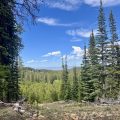
Stand on Casper Mountain’s north slope at dawn and you’ll hear little more than meadowlarks and a magpie’s rasp over Platte Creek. Families draw drinking water from shallow wells, kids and parents alike run dogs along dusty two-track and the mountain’s shoulder reveals first light for the 60,000 people in Casper. That Casper Mountain peace is why thousands of us chose to live and invest here.
Opinion
Now, swap the birds for dozens of gravel trucks grinding up Coates Road six days a week — that is the stated future that Prism Logistics hopes to lock in by reapplying for sand and gravel leases on what Casper calls the “School Section.” School sections are state lands granted throughout the West at statehood to be managed for revenue production that supports schools and other public institutions. The state currently makes money through grazing fees and leasing the lands now at issue at the base of Casper Mountain. On Thursday, the State Board of Land Commissioners will decide whether to trade one of Casper’s signature landscapes for a short burst of road base and a royalty that amounts to less than $2 per student, while risking millions in long-term damage.
The leases were granted in 2023 without even a postcard being sent to adjacent landowners or Natrona County officials. The first word came when residents witnessed test pits being dug. Within weeks, neighbors formed the Casper Mountain Preservation Alliance, gathered more than 20,000 signatures, and requested that county commissioners correct zoning in the area to “Mountain Residential 1—no mining allowed” to once again preserve fragile water resources. The commissioners agreed unanimously. Prism has since sued the county, and unless the state land board acts, the leases are on track to move forward.
But the board now has a second chance to look before it leaps and to prove it answers to the people, not the pit. The choice is not gravel versus nothing; it is gravel versus water security, property values and the mountain that defines Casper’s southern horizon. Trust lands like this sit in every Wyoming county. How Casper Mountain and Wyoming citizens are treated will echo from Sundance to Star Valley.
Why water is the red line
Casper Mountain’s north slope sits atop a fragile perched aquifer — rain and snowmelt seep into gravel above an impermeable shale layer, feeding shallow wells. Strip away that gravel and the water drains off the mountain instead of soaking in. Hydrologists warn that even moderate excavation can lower the water table or cause it to drain downslope faster than it can recharge. Prism’s owner says the company will drill deeper wells “if something goes wrong.” Ask homeowners what that promise is worth: A replacement well, if water can even be found, costs tens of thousands of dollars and erases the security families thought they had bought. Long-term related expenses exceed the promise of drilling a water well.
The money is laughably small
In theory, schools benefit from gravel royalties. Even if production reached Prism’s high-end projection of about 300,000 tons a year, royalties at 60 cents per ton would only top out near $180,000 annually, or $1.95 per Wyoming K-12 student. Wyoming’s school system spends more than $20,000 per pupil annually. One failed well can cost $30,000 to replace; damage to a hundred wells would wipe out decades of royalties in a single summer. Factor in lost property value, dust-control expenses and road repairs, and the ledger flips from black to deep red.
A process failure the board can fix
Secretary of State Chuck Gray and Superintendent Megan Degenfelder have acknowledged that they originally approved the leases without realizing the full scope of the situation. Their openness shows how quickly the original application moved through the system and onto the consent agenda in 2023. The board now has a second chance to do what should have been done the first time: evaluate environmental risk, economic trade-offs, and community input and deny this new round of lease applications.
Things you can do right now
1. Reach out to your elected officials who make up the State Board of Land Commissioners:
- Gov. Mark Gordon, 307-777-7434, governor@wyo.gov
- State Auditor Kristi Racines, 307-777-7831, SAOAdmin@wyo.gov
- Superintendent of Public Instruction Megan Degenfelder, 307-777-7675, askthesuperintendent@wyo.gov
- Secretary of State Chuck Gray, 307-777-7378, SecofState@wyo.gov
- State Treasurer Curt Meier, 307-777-7408, treasurer@wyo.gov
2. Speak up. Email lands@wyo.gov with “Casper Mountain leases — public comment” and/or attend the meeting at 8 a.m. Thursday at the Wyoming Capitol Building in Cheyenne. Casper Mountain points us toward what matters: ample, clean water for our homes and leaders who listen. Make sure the land board hears that message — loud and clear — before they vote Thursday.
This is an excellent overview of what is happening to this area in Casper. This lease threatens both Casper residents and citizens of our state. Thank you for stating this issue so clearly.
Please take a few moments to write the SLIB and tell them Casper Mountain isn’t the appropriate place for a gravel pit mine. The residents are worried about losing water to their homes because of the shallow aquafer. The noise, additional traffic to hwy 220 and air quality (constant dust) are other legitimate concerns for West Casper residents. Please stand up for your neighbors and tell them to find another place to mine.
I am a retired Petroleum Geologist. When the gravel operation first became known publicly I did some research. I was stunned when I found there were hundreds of water wells north of the proposed gravel mine. The aquifer flows from south to north and mining will exhume the aquifer and disturb its natural flow. I selected an area closest to the proposed mine operation and found 320 active water wells. Many of these wells have a total depth of 30 feet or less, averaging 9 feet deep. Trenches dug into the aquifer for gravel assessment were 13 feet deep. How deep will the mine be? As stated in the article, many wells will dry up. Not mentioned is that others will be impacted by pollutants that will be released by the mining activity. Of particular concern is the radioactive materials that have been deposited by erosion of the basement rocks found at the top of Casper Mountain. There is active mining for uranium South of Casper Mountain. There certainly will be some amount of uranium held in the sediments on the north side of the mountain. Gravel mining will mobilize a lot of materials that will move through the parts of the aquifer that do not dry up.
What do you do when your (our) representatives don’t do as we ask? You spank them by voting them out of office. That goes for both state and federal politicians.