

Utah officials are bucking more than a century of legal rulings, and their state’s own constitution, in asking the U.S. Supreme Court to transfer millions of acres of federal lands to state ownership. It’s either a quixotic Hail Mary or a bold move banked on hopes that the court’s majority conservatives will overstep Congress’ authority and grant their wish.
Analysis
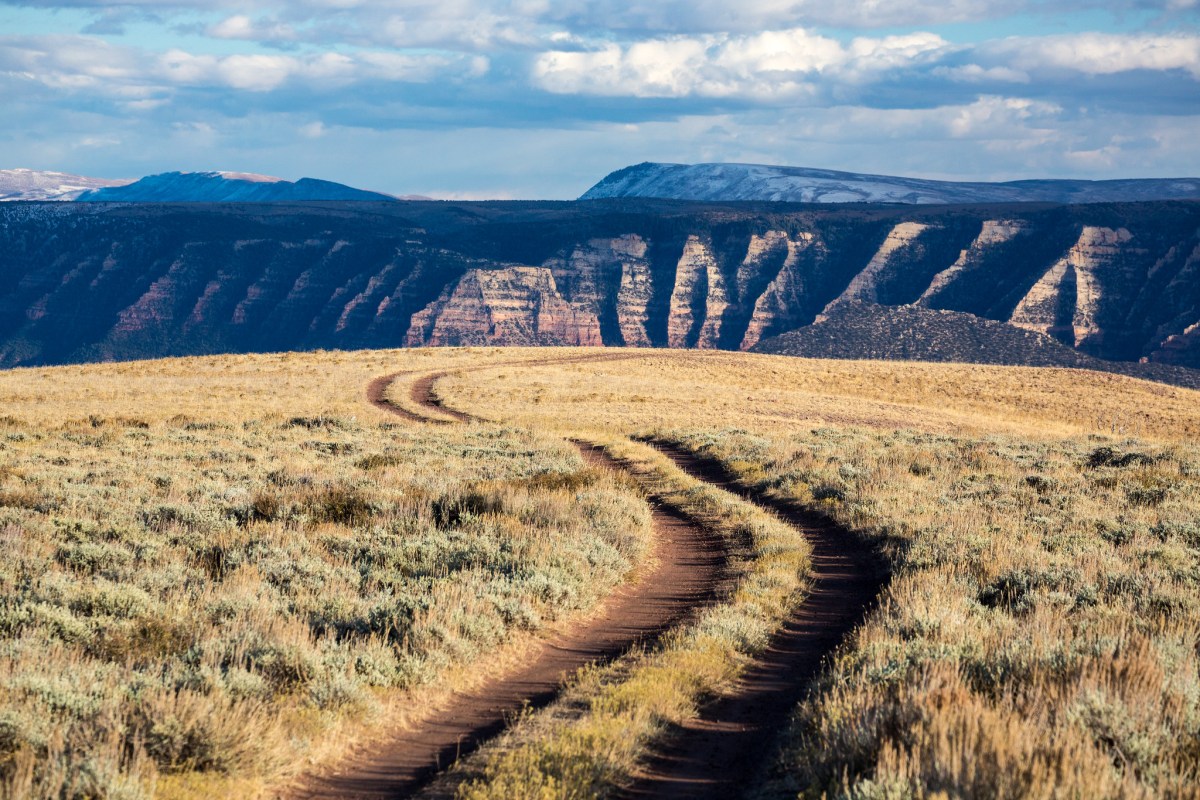
The land at issue accounts for more than two-thirds of Utah, some 18.5 million acres managed by the U.S. Bureau of Land Management on behalf of all Americans. Utah officials contend the federal government is unjustly denying the state the financial remuneration that could be gleaned from converting the land to state-desired uses such as livestock grazing and energy and transportation needs. They accuse the federal government of hanging on to the land “in perpetuity” to ultimately make a profit from it.
If the Supreme Court agrees to take up Utah’s case, its ruling could have vast implications for not just the 18.5 million BLM acres in Utah, but lands owned by other federal agencies, such as the National Park Service and Forest Service, across the nation. But first, Utah has to convince the high court that the state never actually meant to cede any right to the lands in question.
When Utah officials took their request to the Supreme Court in August they maintained that the federal government made “express and implied promises” about future state jurisdiction over the lands when Utah entered the union. But the state’s own constitution specifies that its residents “agree and declare that they forever disclaim all right and title to the unappropriated public lands lying within the boundaries thereof” and that the United States rightly holds title to those lands.
The challenge arises at a time of resurgent states’ rights fervor and distrust of Washington.
“It’s absolutely a Hail Mary,” said Stephen Bloch, the legal director for the Southern Utah Wilderness Alliance. “All of the law says that Utah is wrong, and yet they’re persisting in trying to chart an entirely new path.”
“It’s a weird lawsuit,” is the opinion of John Leshy, the Interior Department’s chief attorney during the Clinton administration and today the Emeritus Harry D. Sunderland and Distinguished Professor at the University of California Hastings College of the Law. “What Utah is claiming here is that they only have a constitutional claim on the ‘unappropriated’ public land that BLM manages. Now, frankly, nobody knows what that means. There’s no general standard definition of ‘appropriated’ or ‘unappropriated.’ Congress hardly ever uses that term. They’re just kind of making it up and they leave it very ill-defined.”
The lawsuit is steeped with the fervor of the “Sagebrush Rebellion” of the 1980s that sought to have federal lands in the West given over to the states. The poster child of the rebellion rose up on July 4, 1980, when several hundred people gathered in Moab, Utah, on the doorstep of both Canyonlands and Arches national parks, to celebrate the nation’s birthday and decry federal land-management policies. From atop a Caterpillar bulldozer, adorned with “Sagebrush Rebel” stickers and spouting a U.S. flag from its smokestack, county officials complained about federal land managers. After firing up the crowd, the politicians fired up the bulldozer and, while following the scant traces of an abandoned mining road, worked to scrape a path into a nearby Wilderness Study Area on BLM lands.
Not a unique attempt
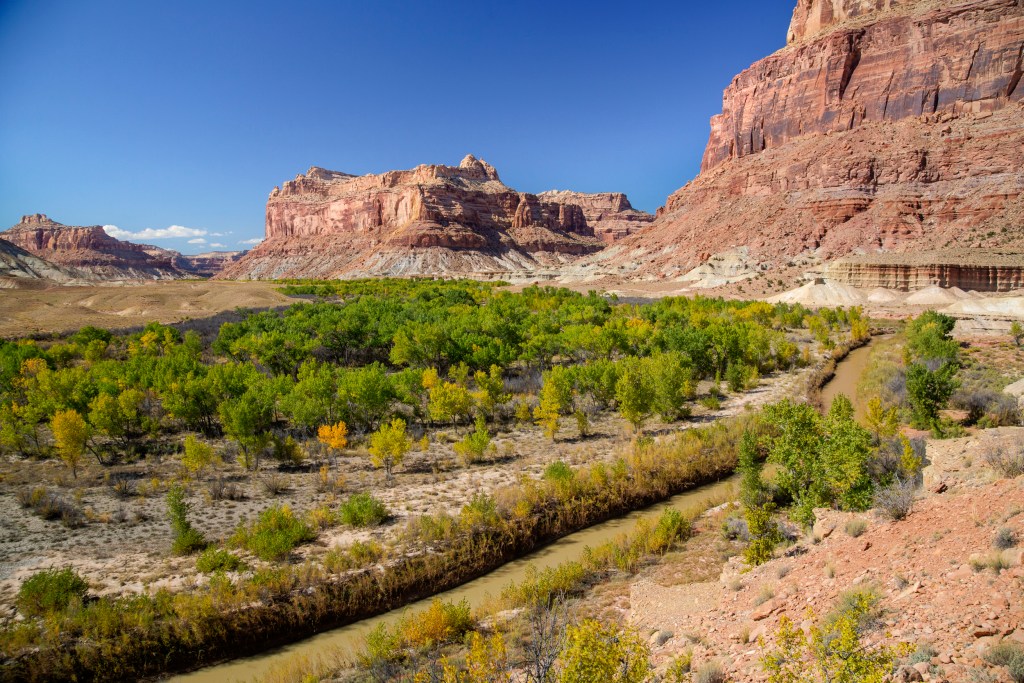
Utah politicians have been striving for decades to take control of BLM lands in their state. They maintain that the state could better manage places such as the San Rafael Swell, an 80-mile by 30-mile bulbous protuberance of rock in south-central Utah. It was ratcheted into place by geologic machinations some 60 million years ago and holds magnificent galleries of ancient rock art. Or like the Valley of the Gods that embraces rock spires and buttes beneath Cedar Mesa in the state’s southeastern corner, or the White Wash Dunes south of the town of Green River with its stands of cottonwoods that sink their roots deep into the dunes to slake their thirst.
The Sagebrush Rebellion faded away after the election of President Ronald Reagan. Now Utah Republicans are resting their hopes with incoming President Trump and the conservative Supreme Court he cemented by appointing justices Neil Gorsuch, Brett Kavanaugh and Amy Coney Barrett during his first term in office. The Utahns were able to convince Trump, during his first term, to shear 2 million acres from the Grand Staircase-Escalante and Bears Ears national monuments so as to open up lands for energy development.
President Biden, of course, reversed Trump’s actions when he came to office.
In its 94-page filing, Utah argues that the federal government’s massive land holdings “are patently unconstitutional.”
“Nothing in the Constitution authorizes the United States to hold vast unreserved swathes of Utah’s territory in perpetuity, over Utah’s express objection, without even so much as a pretense of using those lands in the service of any enumerated power,” the state maintains. Indeed, the western lands the young nation acquired were viewed “by nearly all” as a treasure that could be sold to fund the fledgling country, the filing asserted.
Utah’s current bid, which contends that federal ownership of the land “deprives the Utah Legislature of its full ability to shape policy for the benefit of those closest to the land: the people of the State of Utah,” seems contrary to the will of those very residents. Polling conducted by Colorado College for its 2024 State of the Rockies report found that 84% of the state’s residents “support the creation of new national parks, national monuments, national wildlife refuges, and tribal protected areas.”
Nevertheless, the elected officials — including Utah’s entire congressional delegation — argue that the federal government’s holdings make Utah a lesser state than the other 49.
“That the federal government currently deprives Utah of its full sovereignty cannot be doubted. The United States owns approximately sixty-nine percent of the land in Utah to the complete deprivation of the State,” the congressional delegation argues in a supporting brief. “Nearly half of that land is not being used by the federal government to carry out any enumerated power; instead, the land is simply being held in perpetuity for federal profit. So, in over two-thirds of the land within its state lines, Utah is stripped of its sovereign power to tax, exercise eminent domain, and even regulate.”
“Only by returning to Utah ownership over its lands,” the supporting brief states, “can the United States rectify the State’s loss of control and make it fully equal with the other States.”
Usurping legislative authority
In seeking Supreme Court consideration of their case, Utah officials want the high court to overstep Congress’ authority given by the Property Clause of the U.S. Constitution to “dispose of and make all needful Rules and Regulations respecting the Territory or other Property belonging to the United States.”
Missing in the arguments from the congressional delegation and other supporters is why the Supreme Court should look the other way when it comes to the U.S. Constitution, the state constitution and congressional intent.
“Congress said in 1976 that the BLM should manage all of its land in these ways. Multiple use, sustained yield, and very elaborate and long guidance that Congress gave to the BLM and told them how to manage this land,” said former Interior Department attorney Leshy. “And now you [Utah] tell them, ‘Well, that’s unconstitutional.’ And so, it’s quite a weird, incoherent almost, kind of lawsuit.”
More shocking, Leshy added, is that in tossing the matter to the Supreme Court, “[T]he political process won’t make this determination, the justices will.'”
A supporting brief filed by Wyoming takes the matter even further, opening the door to state takeover of all federal lands — BLM’s, as well as those managed by the National Park Service and the U.S. Forest Service. Utah’s request doesn’t go that far, but it still could send earthquake-like tremors across the West and north into Alaska if the Supreme Court agrees.
“While Utah may not be contemplating broader arguments at this time, they are cracking open a door to much broader claims,” said John Ruple, the Wallace Stegner Center Law & Policy program director at the University of Utah. “The scope of potential claims is staggering if somewhat hard to quantify.”
It could call into question “ownership of almost a quarter-billion acres of land, which is what the BLM currently manages nationwide,” he said. Beyond that, “the United States controls over 655 million acres of land surface, most of which appear to fall within the sweeping claims in Wyoming’s footnote,” which calls for the Supreme Court to consider turning all federal lands over to the states, Ruple added.
The professor, who recently worked as senior counsel for the White House Council on Environmental Quality, pointed out that “the Supreme Court [in past decisions] has made clear that the Property Clause grants Congress an ‘absolute right’ to decide upon the disposition of federal land and ‘[n]o State legislation can interfere with this right or embarrass its exercise.'”
Utah was not even a federal territory — and thus did not exist as a jurisdiction — when the United States acquired the land in question at the end of the Mexican-American War, Ruple noted. Utah didn’t become a U.S. territory for another two years, and a state 44 years after that.
Thus, he concluded, “Utah cannot claim to ‘take back’ land that never belonged to it. Utah also cannot ignore federal law or its own constitutional disclaimer of rights to the land just because that disclaimer no longer suits the state’s wishes.”
Trampling tribal rights?
Filing a motion to intervene against Utah’s request is the Ute Indian Tribe, which maintains that Utah’s bid includes 1.5 million acres of tribal lands on the Uncompahgre Reservation. In 2018 the tribe sued the federal government “asserting that the 1,500,000 acres of land which the United States owns on the Uncompahgre is either tribal trust land or must be returned to tribal trust ownership.”
In that lawsuit, the tribe claims that the federal government in 1880 forced Ute tribal bands living in Colorado to relocate to the reservation in Utah. While that 1880 Act created the 1.8 million-acre reservation, the federal government retained ownership of 1.5 million acres, the filing states. In 1945, however, the Interior Department ordered the federal lands to be turned over to tribal trust ownership, the document adds.
Whether that transfer actually occurred is in question in the tribe’s current case against the federal government. Utah, meanwhile, in its request for the Supreme Court to hear its bid to obtain BLM lands in the state, includes those 1.5 million acres in the 18.5 million acres it is hoping to acquire, the tribe said.
In December, a federal district court is scheduled to hear arguments in the Ute Indian Tribe v. United States on whether the 1.5 million acres are already considered tribal trust land or must formally be turned over to the tribe.
“Utah and the United States are both aligned against the Tribe. Both argue that the 1,500,000 acres of land that the United States owns on the Uncompahgre are federal public lands. Only the Tribe would make the legally correct argument that under the 1880 Act, the lands are not federal public lands,” the tribe’s motion to intervene states.
History matters
History matters, but it also can be interpreted differently.
In its filing, the state of Utah argues that Congress early made a practice of relinquishing lands to newly formed states. Furthermore, the state argues, the federal government never intended to hold onto the land in the Utah Territory that was not initially given to the new state.
“Congress made clear that it was obligated to dispose of the federal lands in Utah, not retain them in perpetuity,” reads the filing. “Congress specifically prohibited the territorial legislature from passing any law ‘interfering with the primary disposal of the soil,’ and instructed that ‘when the lands in the said Territory shall be surveyed … preparatory to bringing the same into market,’ two sections in each township would be reserved for schools. Congress thus plainly understood … the federal government would hold the unappropriated public lands in that territory only on a temporary basis, not as a permanent federal fiefdom.”
In opposing Utah’s filing, the Justice Department in its own filing last week noted the state’s constitution had relinquished any claim to lands the federal government did not convey to it at statehood and that only Congress, not the Judicial Branch, can dispose of federal lands. Beyond that, the state should have brought its case to federal district court, a more appropriate place for jurisdiction and procedural issues that Utah raises, the government said.
“Utah alleges that the United States is ‘simply holding’ ‘18.5 million acres’ of land in Utah without ‘using it to execute any of its enumerated powers,” the Department of Justice responded. ”Before a court could determine whether that assertion is correct and craft appropriate relief, it would need to resolve any factual disputes about how those 18.5 million acres are being used. [The Supreme Court] is poorly suited to perform that task in the first instance. In any event, the benefits of litigation in the lower courts go beyond the district court’s superior capacity to find facts. For example, the lower courts can sort through threshold jurisdictional and procedural issues, such as those raised here.”
The DOJ filing noted that the United States “has owned public lands since its founding,” including claims ceded by original states to land west of the Appalachian Mountains and lands acquired during the nation’s 19th-century westward expansion. “Through the cession of territory by foreign sovereigns — as in the Louisiana Purchase, the Mexican Cession, and the Alaska Purchase — and subsequent negotiations with Indian tribes, the United States acquired not only sovereignty over the region, but also title to the public lands within it,” the department pointed out.
The BLM through its management over the lands in its portfolio can sell some if “it is determined that disposal of a particular parcel will serve the national interest,” as in the historic opening of rail lines, the lawyers pointed out.
The government’s brief also notes that early in the 20th century Congress considered bills to turn over some lands, including those that Utah now wants, to the states. “Utah Governor George H. Dern led the fight against those proposals,” the DOJ writes. “Governor Dern ‘testified that Utah could not adequately manage these lands and that, indeed, the state was not interested in accepting them.”
Going back further in time, the department points out that the Founding Fathers saw value in the government owning land.
“James Madison described the western lands as ‘a mine of vast wealth to the United States,’ and he expressed hope that, under ‘proper management,’ those lands would furnish ‘liberal tributes to the federal treasury,'” the lawyers noted.
Back at the Southern Utah Wilderness Alliance, Bloch pointed out that the Western Governors Association in 2016 asked the attorneys general from their member states to explore the question of whether federal lands could be turned over to the states, and the answer was no.
North Dakota Gov. Doug Burgum, president-elect Trump’s choice to run the Interior Department, hasn’t said where he stands on Utah’s filing, according to his office.
Careful what you wish for
Ruple at the Wallace Stegner Center wonders if Utah residents really would prefer to see their elected officials prevail before the Supreme Court.
“Utah’s remedy lies in the halls of Congress, not with the courts. The problem is not that the United States isn’t complying with the law, but that the law does not give Utah’s elected leaders what they so desperately want,” he said. “The remedy is to change the law to make it align more closely with those values — if Utah can convince a majority in Congress that existing laws are indeed unjust.


“But let’s assume for the moment that I am wrong and that the Supreme Court orders the United States to convey away title to the unappropriated public lands within Utah. Utah has not presented any legal claim to ownership of those lands, and it can’t because it disclaimed those rights as a condition of statehood,” Ruple added. “Utah argues only that the United States can’t keep the land. Presumably, the United States could sell the lands to the highest bidder. Would the people of Utah be better off if the lands were bought by a billionaire who chose to exclude the public? By a hedge fund manager or foreign investor with no long-term stake in Utah or its economy? What would happen if Arizona and California teamed up to buy lands with valuable water rights only to then allow that water to flow downstream to thirsty population centers?
“Those scenarios may not come to pass but we should, at a minimum, think carefully about what may happen if the state ‘wins.'”
This article originally appeared on National Parks Traveler.

Freedumb caucus idiots will follow suit .
MAGAts will be MAGAts. How’s it feel to be swirling in the toilet bowl…like the country has been doing since the 70s?
Do Wyomingites want the famous Freedom Caucus in charge of public lands?
I think the states are forgetting all the things they will acquire along with the land. Not only will they get all the land and minerals and money that can bring in, but they will also get all the problems. For example the always problematic task of managing wild horses. Are states ready and able to fight those battles? I think not
Geez, WyoFile, why can’t you refer to these lands correctly? These areas are NOT “BLM lands,” or “US Forest Service lands,” or “National Park Service lands.” These are PUBLIC lands, i.e. belonging to you and me and other Americans, which are managed by the BLM, USFS and NPS, for the benefit of the public. In your future articles, please use the correct phrases: “BLM managed lands,” “US Forest Service managed lands,” and “National Park Service managed lands,” etc.
These areas are not owned by some faceless bureaucrat in Washington DC but by a veteran in Virginia, a teacher in Minnesota, a student in Louisiana and other people across our great nation. In other words, not just those who live in Wyoming, Utah, and other western states. So WyoFile, STOP using language which emboldens the propaganda of the wacko rebels who want to overturn “government ownership.” I’m the owner, you’re the owner, not some amorphous, supposedly illegitimate agency.
And, as owners, we must be concerned about and involved with what belongs to us. If states obtain control of these lands, we all know these will be the first on the auction block when an economic downturn occurs. Then our heritage will be sold to out of state tech bros or pharmaceutical titans who will cut off public access and sue us to block access. We’ve already seen that scenario play out in Wyoming, haven’t we?
For years, western organizations have pushed the concept of ‘first right of refusal’ for private land owners adjacent to public owned lands. Those who have private lands next to forests and parks are offered the right to buy public lands before the public can place a bid. This attempt at insider trading will come to fruition if the states gain control of our public lands. Wyoming residents can’t wait to watch this come true, but need to take action now by contacting Gov. Gordon, legislators, newspaper editors and posting opposition online to this public lands grab. Or be prepared to explain to your grandchildren how you let this come to be.
So clear – so well stated. Thank you Ms. Moore…
AMEN Jocelyn. Outstanding write-up on who own these lands, and it’s not rich developers planning exclusive resorts.
Well said, Jocelyn. I spend time out on my public lands almost daily, sometimes walking the dog, sometimes just to be out there. I need to be in wild places. It’s who I am. No one is going to take that away from me. No one… ever.
Excellent article by Kurt Repanshek. One thing to clarify though – when Mr. Trump removed the 2 million acres from Bear’s Ears and Grand Staircase – that’s different because it remained BLM land. It wasn’t transferred to become State or private land.
Keep voting for these clowns, low information voters.