

University of Wyoming student Taryn Brooke Bradley interviews Colorado ranchers Penny and Cal Howe. (Adlynn Jamaludin)

No matter their lifestyle or politics, anybody who has spent a decade or more outdoors in the West has seen environmental changes that worry them, University of Wyoming graduate student Taryn Brooke Bradley said. Yet many find it difficult to engage in public conversations about how those changes affect them and what to do about it. 

“The way we talk about environmental change sometimes feeds into polarization — and that does have an effect on people,” Bradley said.

There’s a lack of understanding about how a changing climate impacts local communities, Bradley said. There is also a lack of depth and nuance about how people — from every walk of life — might respond if given the opportunity to learn and discuss it without politics or other divisions getting in the way.

For her communications master’s thesis, Bradley wanted to learn more about how people in the West are reacting to climate change and what can be done to spur conversations about it. Last fall, she began gathering stories from people who are not often part of the public conversation. Now she’s published the result on a website: A Changing Frontier: Voices Across the West. It features several written and video profiles, as well as links to climate and weather resources.

One video features Brian Dimoff, a gunsmith and co-owner of the firearms and outdoors retail shop Gold Spur Outfitters in Laramie. “We need to have everybody basically sit down at a table and hash some stuff out instead of just screaming at each other from across the aisle,” Dimoff says. “I think we need to get to the point that people are trying to understand where everyone else is coming from.”

Wyoming Catholic College professor Tom Zimmer discusses faith and commitment to the environment for the “A Changing Frontier” project. (Taryn Brooke Bradley)

Another video features Rachel Watson, a competitive skier and co-coach of the University of Wyoming Nordic ski team. “Over the many, many years that I’ve been an elite ski racer and coach, one of the biggest changes that we’ve seen is a change and accessibility to skiing,” Watson says. “But what I know is that we will only make positive change if we all come together.”

The website also invites visitors to share their stories about environmental change. The hope is that readers identify with a wide range of perspectives and feel welcome to engage by sharing their stories and ideas about how to begin taking practical steps to improve the situation at the local level, Bradley said. 
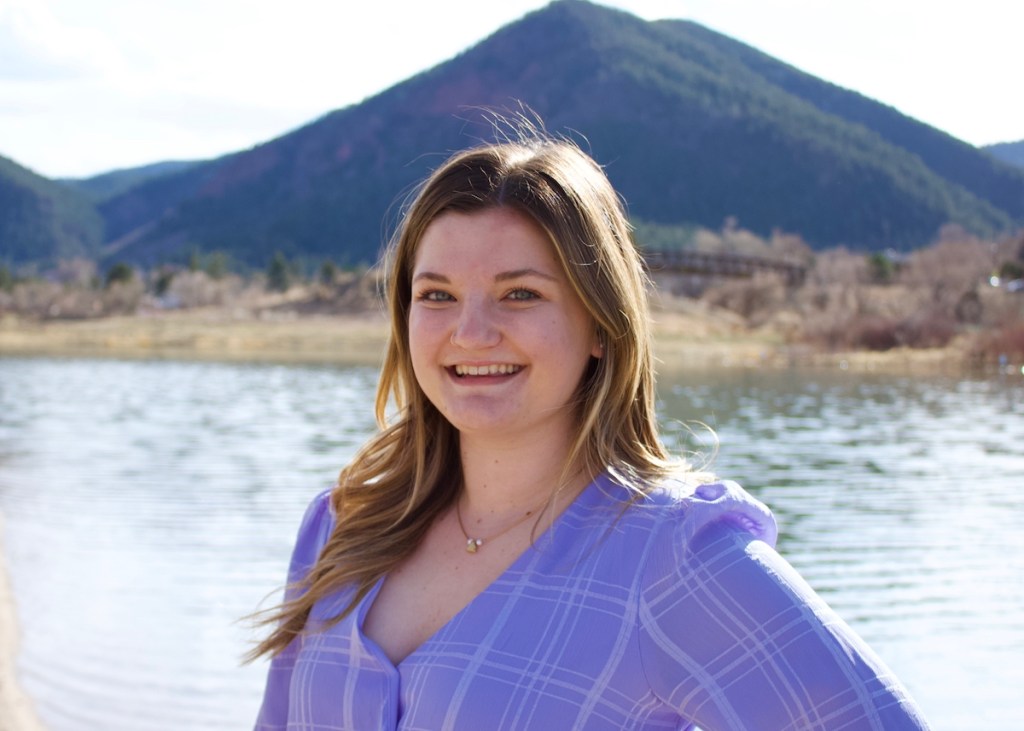
University of Wyoming student Taryn Brooke Bradley at Palmer Lake in Colorado. (Hannah Cossmann)

“One of the things that I was kind of surprised about that came up in a couple of the interviews was kind of a general frustration as it relates to the polarization around environmental change and climate change,” Bradley said. “I think a lot of the frustration I heard comes from how people like them are portrayed in the media and on TV because, you know, they do care about the environment.”

Bradley, who grew up in Colorado, wants to work in the realm of science writing and communication. She intends to add stories to the website and hopes the project will grow and become a resource for others who are trying to elevate conversations about climate and the environment — in Wyoming and beyond.

“A lot of people have expressed a need for something along these lines — people talking about their own personal experiences and encouraging others to begin thinking about it,” Bradley said.

Dustin Bleizeffer covers energy and climate at WyoFile. He has worked as a coal miner, an oilfield mechanic, and for more than 25 years as a statewide reporter and editor primarily covering the energy...

Leave a comment

WyoFile's goal is to provide readers with information and ideas that foster constructive conversations about the issues and opportunities our communities face. One small piece of how we do that is by offering a space below each story for readers to share perspectives, experiences and insights. For this to work, we need your help.

What we're looking for: 

  • Your real name — first and last. 
  • Direct responses to the article. Tell us how your experience relates to the story.
  • The truth. Share factual information that adds context to the reporting.
  • Thoughtful answers to questions raised by the reporting or other commenters.
  • Tips that could advance our reporting on the topic.
  • No more than three comments per story, including replies. 

What we block from our comments section, when we see it:

  • Pseudonyms. WyoFile stands behind everything we publish, and we expect commenters to do the same by using their real name.
  • Comments that are not directly relevant to the article. 
  • Demonstrably false claims, what-about-isms, references to debunked lines of rhetoric, professional political talking points or links to sites trafficking in misinformation.
  • Personal attacks, profanity, discriminatory language or threats.
  • Arguments with other commenters.

Other important things to know: 

  • Appearing in WyoFile’s comments section is a privilege, not a right or entitlement. 
  • We’re a small team and our first priority is reporting. Depending on what’s going on, comments may be moderated 24 to 48 hours from when they’re submitted — or even later. If you comment in the evening or on the weekend, please be patient. We’ll get to it when we’re back in the office.
  • We’re not interested in managing squeaky wheels, and even if we wanted to, we don't have time to address every single commenter’s grievance. 
  • Try as we might, we will make mistakes. We’ll fail to catch aliases, mistakenly allow folks to exceed the comment limit and occasionally miss false statements. If that’s going to upset you, it’s probably best to just stick with our journalism and avoid the comments section.
  • We don’t mediate disputes between commenters. If you have concerns about another commenter, please don’t bring them to us.

The bottom line:

If you repeatedly push the boundaries, make unreasonable demands, get caught lying or generally cause trouble, we will stop approving your comments — maybe forever. Such moderation decisions are not negotiable or subject to explanation. If civil and constructive conversation is not your goal, then our comments section is not for you. 

Your email address will not be published. Required fields are marked *