

The University of Wyoming’s board of trustees voted Wednesday to no longer require masks in classrooms. The decision, which goes into effect Monday, follows a recent survey of UW students in which 63% of the roughly 1,800 respondents supported dropping a mask requirement.
Even if professors want to continue requiring masks in their classrooms, they won’t have that power, UW General Counsel Tara Evans said during the trustees’ Wednesday meeting.
Plans are in place to provide “necessary accommodations” for severely immunocompromised people who might be threatened by the removal of masks in classrooms, she said.
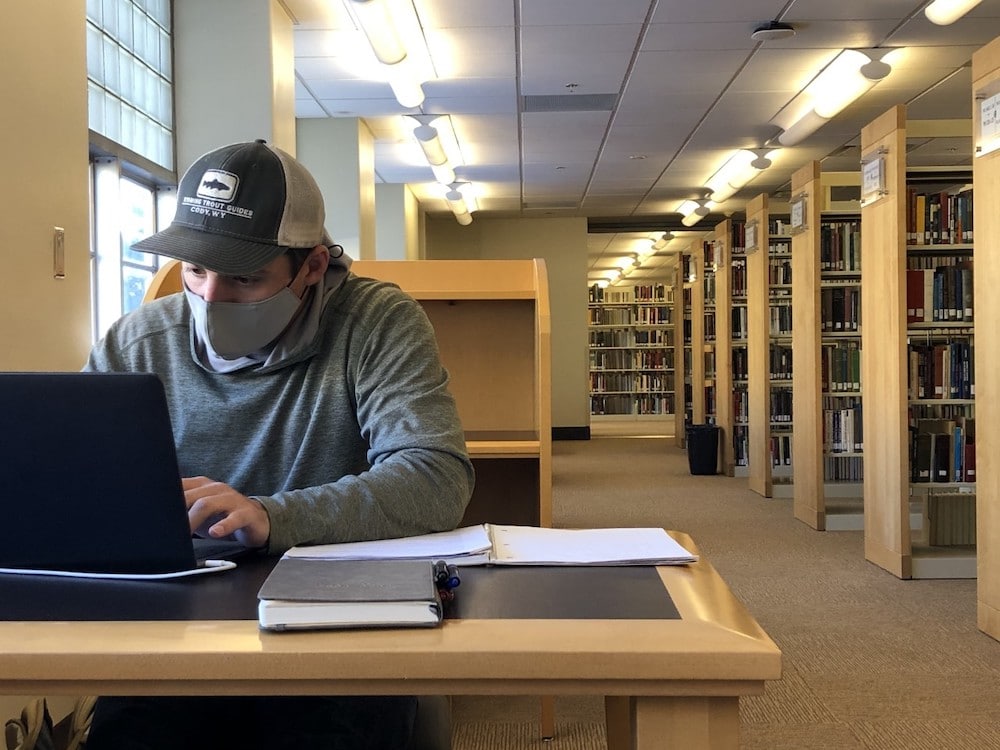
The trustees’ vote also drops masking requirements for most other locations on campus, like the Wyoming Union and Coe Library.
Masks will still be required in campus offices when requested by an occupant. They’re also still required in the university’s medical units and for employees at the Early Care and Education Center.
Because of federal regulations, masks are also still required on buses.
Trustees stressed that UW will support employees and students who continue wearing masks.
“I just want to make it clear — there is no excuse for denigrating someone who chooses to wear a mask,” said Trustee Kermit Brown, adding that the board should take action if there are reports of such behavior.
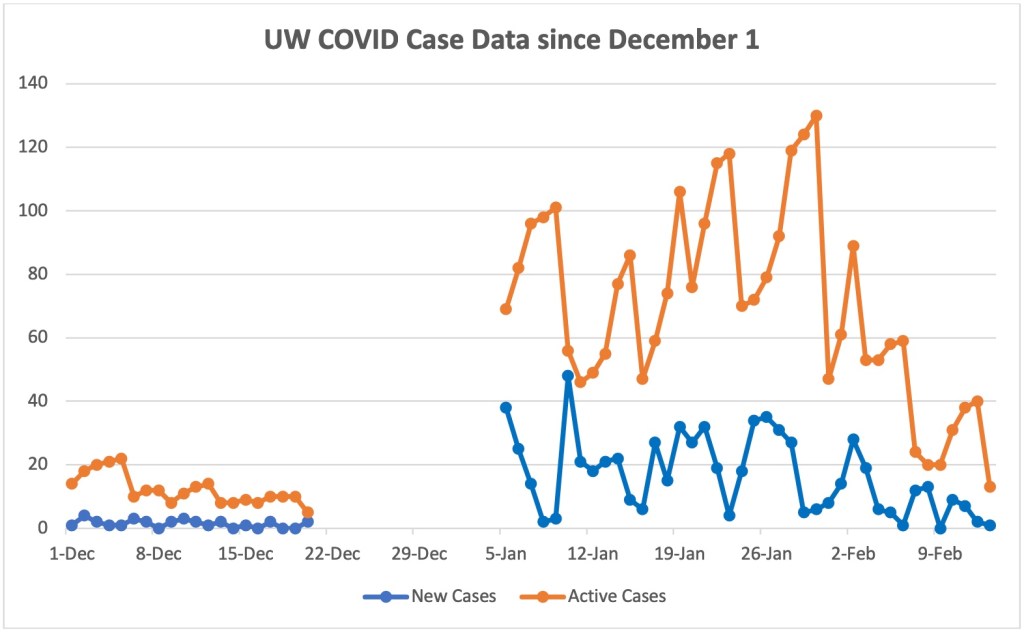
COVID-19 cases have dropped significantly on campus since January. As of Monday, there were 13 confirmed active cases among the campus community, President Ed Seidel told the trustees.
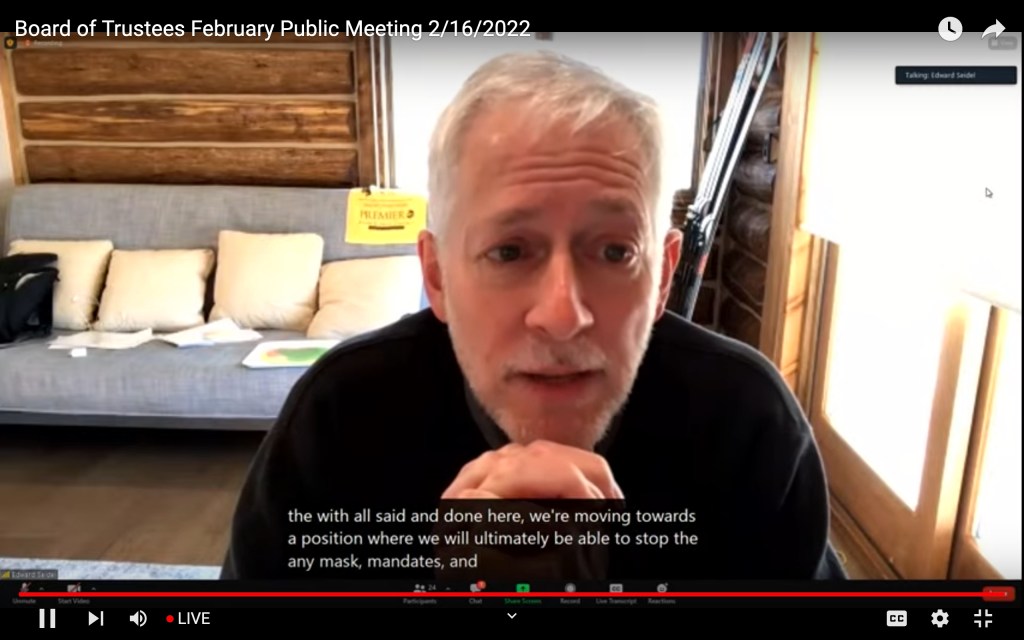
Seidel is currently infected with the virus, which he said he suspects he contracted during a recent UW basketball game.
“I’ve been running through boxes of Kleenex, but am otherwise not too bad,” he said via Zoom from isolation in his basement.
Declining trends
The trustees overrode the plan preferred by Seidel, which would have kept mask requirements in place for at least another month for classrooms that don’t allow for social distancing.
Seidel had supported the idea of dropping the masking requirement for non-classroom areas on campus, with a goal of ending the classroom mandate in March, assuming the wave of cases caused by the Omicron variant continues to subside.
Hospitalization rates in Wyoming are no longer as concerning a factor to Seidel as they once were, he said.
As of Wednesday, 82 patients with the virus were hospitalized in Wyoming, according to the Wyoming Department of Health. The Cheyenne Regional Medical Center and Casper’s Wyoming Medical Center accounted for about half that total.
Many universities across the country are dropping their mask requirements this month, Seidel said. He noted that UW vaccination rates are much lower than on most campuses.
Some 67% of employees and 44% of students have been confirmed vaccinated via immunization records, though as many as two-thirds of students have said in surveys they’re vaccinated.
Seidel’s recommendation to continue the masking requirement was based on a report from a campus advisory group that acknowledged numerous concerns about the current masking policy, including “reduced adherence” and the fact that there is “no enforcement of the current policy, and no individual or unit is eager to enforce the policy.”
Continuing divisiveness
The decision to drop nearly all masking requirements was more contentious than the final 9-2 vote indicated. Trustees David Fall and Dave True were the only “nays.”
Before the final vote, Fall unsuccessfully moved to adopt Seidel’s recommendation to maintain the classroom masking requirement for at least another month.
Echoing administrators’ sentiments, Trustee John McKinley supported Seidel’s recommendation, saying it strikes a balance that “protects the most vulnerable in those mandatory settings.”
Faculty Senate Chair Adrienne Freng also supported the plan to keep masks for another month.
“There are (faculty) that have wanted to get rid of the masks and still do, but I don’t hear from them nearly as much as those who feel like the classroom is just a different space” needing additional protections, Freng said.
Hunter Swilling, UW’s student body president, also urged the continuation of the mask requirement for another month.
However, Fall’s original motion died on 5-6 vote, with trustees Laura Schmid-Pizzato, Macey Moore, Carol Linton, Brad LaCroix, Elizabeth Greenwood and Jeff Marsh voting in opposition.
Trustee Michelle Sullivan was not present for the meeting.
Noting that all K-12 school districts in Wyoming have dropped mask requirements, Moore said UW’s mandate “continues to be divisive.”
For the entirety of this academic year, masks have not been required at voluntary public events, including sporting events, theater performances and other social events. Individuals have also been allowed to remove their masks in buildings where social distancing is possible.
Critics of the masking policy have called it confusing.
“I just find it kind of contradictory that we don’t have the policy in the gymnasium where the games are. If you’re going to spread something, that’s the place where people are screaming and yelling and jumping up and down right next to each other,” Greenwood said.
College of Health Sciences Dean David Jones, who advocated to continue the mask requirement, stressed that classrooms should be treated differently because students and professors are required to be there.
“The exposure risk is also greatest there because of the duration,” he said. “Students are sitting in class from 50 minutes to an hour-and-a-half, and that’s where there are faculty and students on campus who are still concerned.”

The trustees’ decision came as the Wyoming Department of Health’s official tally of active COVID-19 cases dropped below 1,000 this week — for the first time since August.
As of Wednesday, Albany County had 40 confirmed COVID-19 cases.

Comments referencing actual science not posting…. Wonder why.