

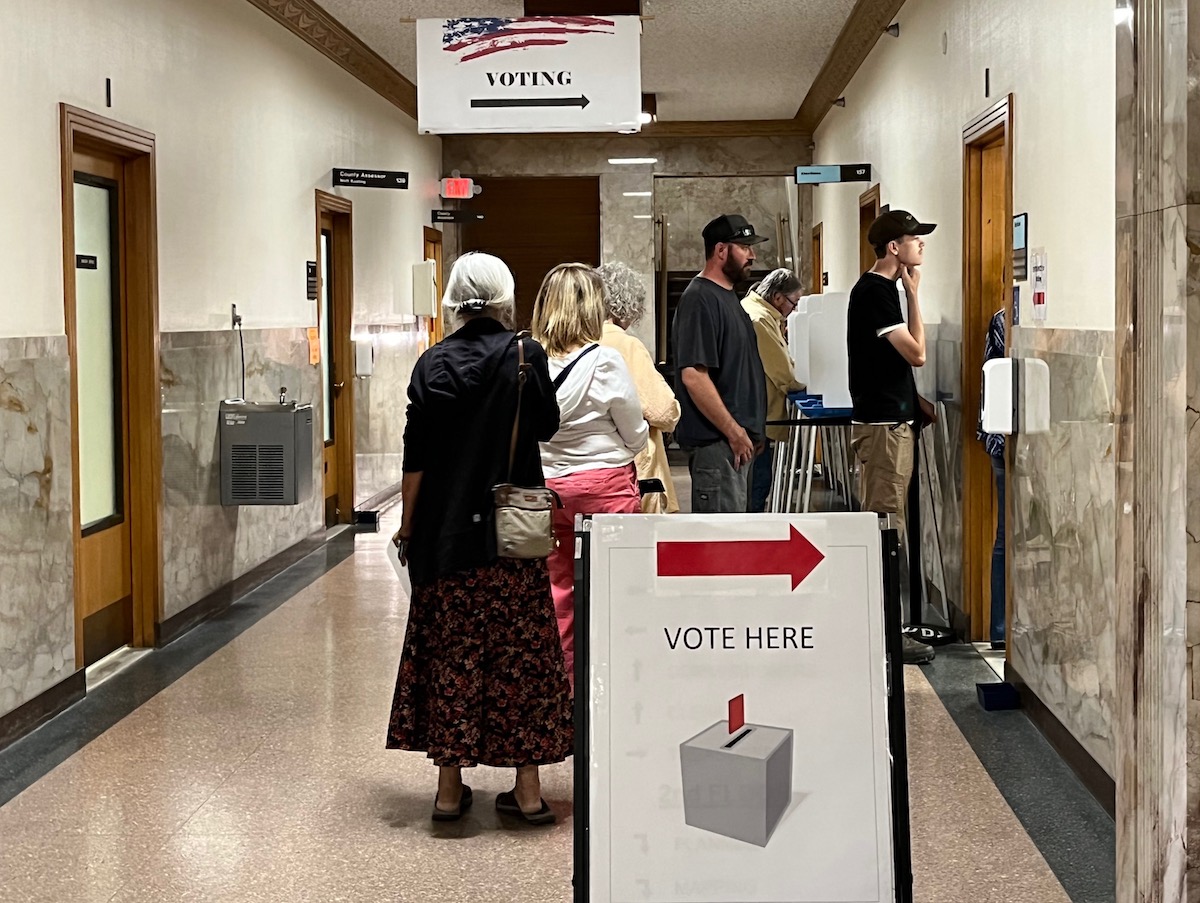
Voting is something that we Americans sometimes take for granted. Most of us have never thought about whether we would be allowed to vote or how barriers might impact us. In Wyoming, especially, voting has always been easy. Our state has Election Day voter registration, which means that unregistered voters can show up at the polls, register and cast a ballot that same day. Given the relative ease with which we can register and vote, it is perhaps understandable that voting may seem trivial. Nothing could be further from the truth.
Opinion
Voting is how we make choices about how our world works. Whether it be national, state or local, our government is led by those whom we voted for, and those votes matter. It is telling that some of the bitterest battles of our nation’s history have been over who is entitled to vote. Whether it be extending the vote to African Americans after the Civil War, to women during the early 20th century, or in breaking down practical barriers associated with Jim Crow laws, the right to vote is inextricably linked to the type of world we live in. Allowing different people to vote means that different issues or perspectives may be the deciding factor on who wins. Who votes impacts what issues are impacted by those votes.
In Wyoming, there is one significant change to our voting system that we should be aware of. Until recently, Wyoming’s Election Day registration meant that voters could change their registration at the polls, regardless of whether they were registered or unregistered before showing up to vote. If a voter felt they no longer aligned with the Republican Party, they could switch to the Democratic Party and vice versa. But no longer. Now, voters who are registered before the election cannot change their party affiliation between the beginning of candidate filing and the end of the primary.
For most of us, this is no major change. I have been a registered Republican since I was 18 years old. I do not intend to change that. The change in the law has no impact on me. However, for some, it might. For those who are unfamiliar with our rules, who do not vote consistently, or who have decided that a particular political affiliation does or does not fit them, this change may impact their ability to participate in our political process. This is especially true of voters who typically only vote in presidential election years. Many of these voters cast only a general election ballot and may not be registered with any party. If they want to participate in a party’s primary this year, they must ensure that their registration is updated ahead of the deadline.
For those voters, awareness is key. With that in mind, here are the specifics: A voter can change their party affiliation until the close of business on May 13. To do this, you must go to your county clerk’s office and fill out a simple form to register with a new party. If you are unsure of your registration, call and check. It is better to take the time to be sure now than to be excluded from the process later. If you do go to change your registration, also remember to bring your identification.
In bringing this awareness, it is also important to point out that Election Day registration is still the law in Wyoming. If you are unregistered, you can still show up to vote on Election Day — even in the primary — and register, declare a party and vote in that party’s primary. This change in the law only applies to those who want to change their affiliation, not to those who are registering for the first time.
Lastly, some may feel uneasy about registering with a party because they feel that they do not fit neatly within the perceived mold of a particular party. Do not let that discourage you. Political parties are made up of all their members, not just the loudest voices. All our major parties have always had different viewpoints within them. That is still true today and will be tomorrow. Political parties are not monoliths. There is no such thing as a RINO or DINO. Parties evolve based on the voices within them, so by choosing a party, you are just as entitled to a say in what that party stands for as the person insisting on their version of ideological purity. The main difference is that the party with more voices is more likely to succeed. To be a part of that, above all else, you must vote.

Voting is the First Amendment right of every legal citizen to promote their values for our country. The majority wins. It’s always been that way and I pray it never changes Don’t complain if you don’t vote!
Ellie, I have heard “if you dont vote you cant complain.” I fail to see the logic in that when the election/2 party system in the USA is completely broken and corrupted.
Those that no longer consent to be governed by a broken system have the ultimate reason to air their discontent, it is essentially what this nation was founded on.
For voters, dont complain if you vote and your team doesnt win. You lost and have no say until the next election. Isn’t “Democracy” great?
“Voting is the key to our future”
LOL, it’s working out great for this entire nation.
The system is BROKEN in all but the smallest locales, pal.
Voting is an act of denial of what is actually happening in this country.
People keep voting and the decline never changes course.
Thank you so much for information for the citizens who need to know in order to cast their vote!