

Politics does indeed make strange bedfellows. The latest example in Wyoming is the shared opposition to carbon-capture initiatives by level-headed environmentalists and the Legislature’s anti-science brigade.
Opinion
To describe these groups as polar opposites would be an understatement. At times it’s hard to reconcile that they occupy the same planet, much less live in the same state.
Yet, during the budget session, both opposed Senate File 42 – Low-carbon reliable energy standards-amendments, albeit for far different reasons. But alas, they couldn’t drum up enough like-minded (or additional different-minded?) partners to keep it from passing.
The bill amended a measure Gov. Mark Gordon promoted and signed into law in 2020 that required regulated utilities to meet federal pollution regulations by retrofitting their coal-fired power plants with carbon capture technology instead of simply closing the facilities — unless they could prove it would be uneconomic or technically not feasible to do so. The goal was to extend the operational life spans of Wyoming coal-fired power units, and with them, an important customer for Powder River Basin coal.
Both measures are part of Gordon’s costly, never-ending campaign to save the state’s coal industry, which has experienced a steady decline in demand and production peaking in 2008. This inherently anti-free enterprise effort mandates what utilities must do with their properties, at the expense of their customers who foot the bills.
It’s concern over the latter that primarily united the Powder River Basin Resource Council, a Sheridan-based landowner advocacy group, and climate change deniers in the Legislature, including all five members of the Senate Agriculture Committee.
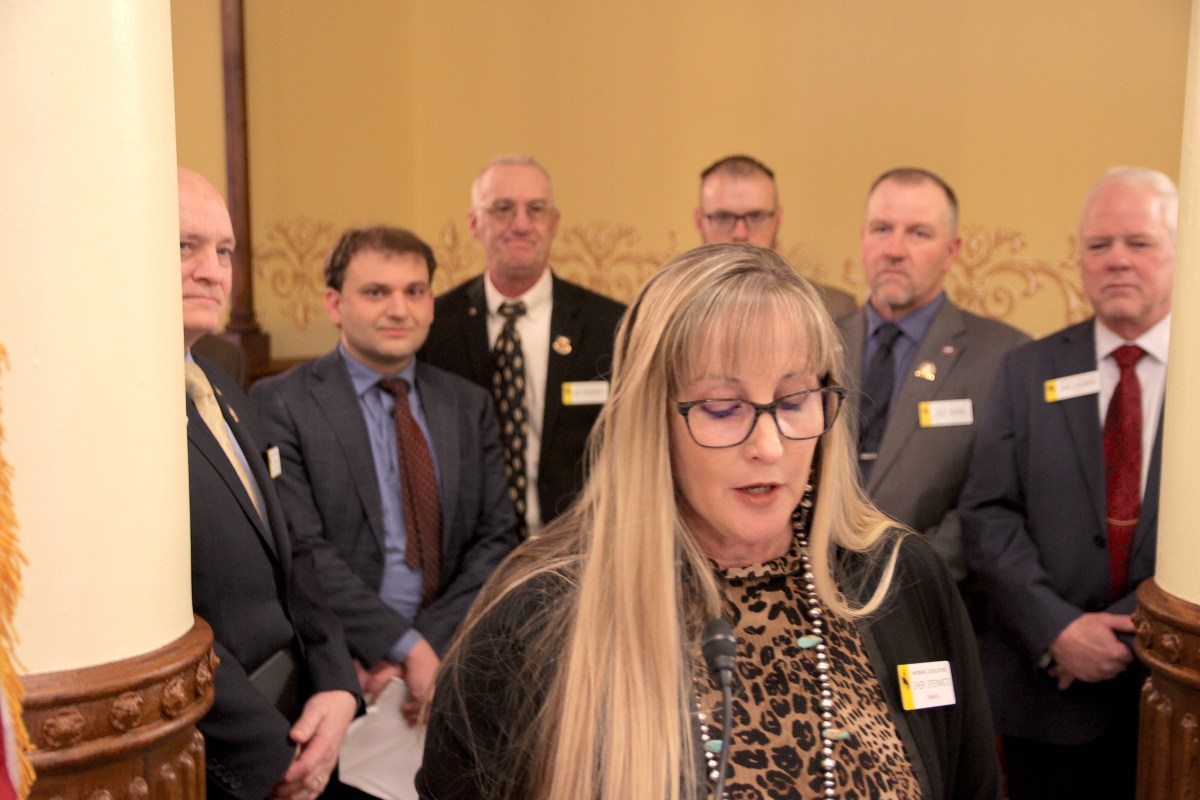
The panel held a hearing on carbon capture in February that was over-the-top crazy, featuring the CO2 Coalition, a traveling band of “scientists” with dubious credentials. Sen. Cheri Steinmetz (R-Lingle), chair of the committee, ruled at the outset that no one with opposing views would be allowed to speak.
Members of the coalition compared people who believe carbon dioxide and other greenhouse gasses are threatening the survival of humans and other species, to “brainwashed” members of a cult.
“I do not support using taxpayer funds [for carbon capture],” Steinmetz told Inside Climate News. She added that unless such legislation is repealed, “Wyoming ratepayers will pay for these policies.”
“We are extremely concerned about the impact to ratepayers,” resource council organizer Claire Deuter told the House Minerals, Business and Economic Development Committee during its SF 42 hearing.
While utilities may recoup expenses for carbon capture construction, operation, analysis and engineering projects, Deuter explained the unproven technology “makes it likely all of this will result in the lack of a viable project, and Wyomingites will have paid millions into something that is never put into use. We just see this as a lost cause.”
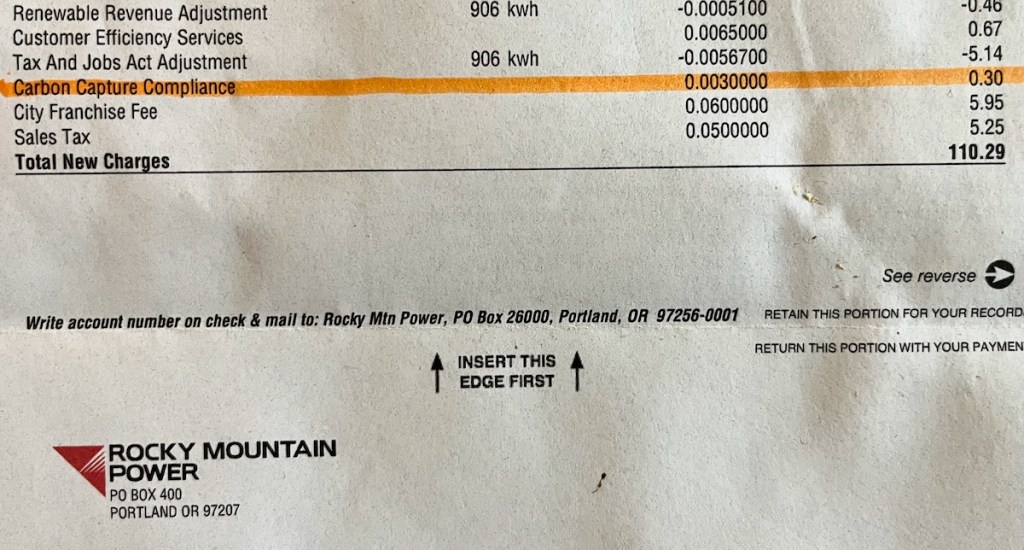
Two electric utility companies — Rocky Mountain Power and Black Hills Energy — will advance engineering studies and analysis to potentially retrofit four coal-burning units with carbon capture technology by 2033. But the companies’ recent filings with state regulators suggest significant cost and technical challenges remain.
Combined, Wyoming ratepayers are now spending more than $3 million per year for the initial study phases, and that total will soon increase to between $10 million and $20 million.
A year ago, Rocky Mountain Power estimated a cost of $1 billion per coal unit for a carbon capture retrofit, and that figure is unchanged. Meanwhile, Black Hills Energy recently told regulators the cost of retrofitting its Wygen II power plant east of Gillette is between $500 million and $668 million.
“It’s just fascinating because [the cost of] carbon capture retrofits are still so much higher than renewable energy — even solar with storage and other options,” said resource council attorney Shannon Anderson. She added there does not appear to be an economically justifiable path forward for carbon capture retrofits.
The resource council worries that if Wyoming forces utilities to invest in carbon capture, it will reduce money available for renewable energy projects. Legislative opponents, though, harbor no such fears. They simply don’t believe the technology is necessary, because “beneficial” carbon dioxide emissions shouldn’t be captured and stored.
“As a farmer, I need a lot of CO2 to grow my crops,” Sen. Tim French (R-Powell) said at a news conference the day after the CO2 Coalition brought its carnival sideshow to the Capitol. “There’s a lot of hype out there from different individuals, but in my world, my business, I really need it.”
French and other GOP Wyoming lawmakers who are climate change deniers are totally at odds with the global Intergovernmental Panel on Climate Change, whose research shows the window of opportunity for action is “brief and rapidly closing.”

An IPCC report in 2023 concluded climate change has already stressed agriculture, forestry, fisheries and aquaculture, and will increase the number of people at risk of hunger by 2050.
There are several problems with Wyoming’s carbon capture strategy, beginning with the fact there still isn’t a commercial-scale carbon capture and storage project operating in the U.S., despite industry, state and federal governments having poured billions of dollars into technology research.
The Biden administration still sees carbon capture as a chief option to keep certain coal and gas plants throughout the nation online past 2040. That makes the Democratic president and the Wyoming Republican governor another pair of strange political bedfellows, since the state’s leaders have long complained about the federal government’s so-called “war on coal” and the necessary transition to renewable energy resources.
Gordon, in an amazing display of self-congratulatory rhetoric, patted himself and the Legislature on the back for passing SF 42. He called Rocky Mountain Power’s very tentative plan to retrofit two units at the Jim Bridger coal-fired power plant with carbon capture “a remarkable change of direction.”
Of course, there’s nothing remarkable about it at all. The state of Wyoming ordered utilities to stop planning to close coal-fired power plants, and mandated increasingly expensive studies of technology that will be implemented unless the company can categorically prove it’s not economical.
Surprise! Does the governor really expect us to believe any part of that decision was made because utilities might do it on their own? The Resource Management Plans the companies submitted to the state concluded it was much more economical — and beneficial to Wyoming ratepayers — to convert most of their respective power plants to wind, solar or natural gas.
Gordon is banking on federal tax credits and the opportunity for utilities to sell captured carbon dioxide for enhanced oil recovery to help bring down costs. It may just be wishful thinking.
Instead of dreaming up ways to extend the state’s dependence on coal for jobs and tax revenue, I wish Wyoming would listen to knowledgeable educators like Naomi Oreskes, professor of the history of science at Harvard University.
In a recent Scientific American column, Oreskes noted the IPCC says the world only has until 2030 to stop irreversible climate damage. It’s urgent for us to quit listening to climate change deniers and find solutions that can be immediately implemented.
Oreskes said the process could be jump-started by expanding carbon capture sites, but nearly all such projects in the U.S. are designed for enhanced oil recovery that keeps oil and gas flowing. It’s counter-productive, because every new barrel of oil and cubic foot of gas sold and burned puts more carbon dioxide into the atmosphere.
“So not only do these kinds of projects not help, but they perpetuate our use of fossil fuels at a critical moment in history when we need to do the opposite,” Oreskes opined.
By focusing on propping up coal at all costs, it’s increasingly looking like Wyoming may not learn that lesson until it’s too late.

I can’t understand why our representatives fund education they don’t trust the science that comes from our universities. They are more content with superstitions and misinformation coming from their cult leader.
1. Plants to need CO2 but they have survived on what existed for a few million years and recent studies have shown that excess CO2 can harm the plants and take out vital nutrients.
2. Does Tim French know exactly how much CO2 they need . I am guessing not. Scientist don’t know how much plant need so am guessing he does not. Hopefully they don’t let him handle pesticides. That could be scary.
3. Any one that does not believe that man and his pollution is changing the environment is an uneducated fool or as we call them in Wyoming the freedom caucus.
4. Mr. Drake offers us some great insight into this problem. The problem he doesn’t address is all the people that waste energy daily. Slow your cars down. Turn the lights in your house off when you are not using them. Stop wasting water. Turn your house temperature down a little. Mother Nature is going to get even with us.
It is not nice to piss Mother Nature off
“As a farmer, I need a lot of CO2 to grow my crops,” Sen. Tim French (R-Powell) said at a news conference the day after the CO2 Coalition brought its carnival sideshow to the Capitol. “There’s a lot of hype out there from different individuals, but in my world, my business, I really need it.”
I find Tim French disingenuous at best or just a plain terrible farmer? He claims to grow barley and hay which in order to get a good yield requires proper moisture and and nitrogen mix. In all the literature I have read there is no discussion of the proper amount of CO2? So is Tim French adding CO2 and if so how much? Is he adding nitrogen in the form of fertilizer or not? If Tim has found a new way to grow crops by adding CO2 and no fertilizer then that should be front page news!
Wyoming loves spending federal dollars to prop up fossil fuels. The fact that it costs the citizens of the state in increased costs doesn’t enter into the conversation. I’m not surprised with this coalition – the group that hates spending to go green, and the people who know that there is, after decades of trying, no way to extract the CO2 when burning coal.