


This column is produced in partnership with WyoHistory.org, the online encyclopedia of Wyoming history.
A Casper man walking home from work one evening in 1923 was stopped by his neighbor, who held up a whistle. “If I was to blow this whistle once right now,” the neighbor said, “I would have fifty members here within two minutes.” The man believed him. “Klansmen were everywhere,” he later recalled.
The neighbor was a Ku Klux Klan recruiter. The man he was trying to recruit was Bob David, whose unpublished memoir — now in the Casper College archives — offers one of the most vivid firsthand accounts of the Klan’s Wyoming years. His story is part of a larger history the state has long underestimated about itself.
The second Ku Klux Klan of the 1920s was not a Southern phenomenon. It was a national one, because the Klan had reinvented itself. Where the first Klan had targeted Black Americans in the post-Civil War South, the second broadened its enemies list to include Catholics, Jews, immigrants and anyone deemed insufficiently “American.” It used intimidation and the ever-present threat of violence in an attempt to bend communities to its vision of America. Wyoming was not immune to it.
The stage was set
Wyoming offered the Klan exactly what it needed: a population anxious about rapid change, and a Prohibition law that officials lacked the will or means to enforce. Catholics — many of them Irish and southern European immigrants — had grown to about 10%of the state’s population; foreign-born white people made up 13% of residents overall. The state had already passed laws restricting immigrants’ employment and barring them from owning firearms.
Prohibition was in effect, but enforcement was uneven and widely flouted — Casper’s oil boom had made it, by one account, a “vice capital” of the Rockies. The Klan seized on those anxieties, positioning itself as the guardian of Protestant values and American order that elected officials had failed to uphold. It was a recruitment pitch, but it was also a warning: We are watching, and we will act where the law will not.
A Klan in every town
Wyoming’s leading 20th-century historian, T.A. Larson, downplayed the influence of the Klan, writing that the Klan organized “a few units in the Big Horn Basin and Cheyenne.” Newspaper records and archival research tell a much fuller story. The Klan’s own national newspaper boasted in May 1923 that Wyoming had “a Klan in every town of more than 1,000 population.” Major Klan hubs were in Casper and Cheyenne, and documented chapters also existed in Buffalo, Cody, Douglas, Evanston, Green River, Greybull, Laramie, Lingle, Pinedale, Riverton, Rock Springs, Sheridan, Torrington and elsewhere.
The members were not, by and large, the poor or the fringe. They were doctors, attorneys, bankers, businessmen, Protestant ministers — the people who controlled credit, employment and community standing. That was the point. Wyoming’s Grand Dragon, Dr. L.D. Johnson, had previously taught surgery at what is now Loyola University’s medical school. The Klan cultivated respectability as cover, donating to churches, showing up in robes at funerals to honor “brother Klansmen” and staging public spectacles — in Riverton, 150 people joined the order in a single torchlit outdoor ceremony, a show of confidence rather than concealment.
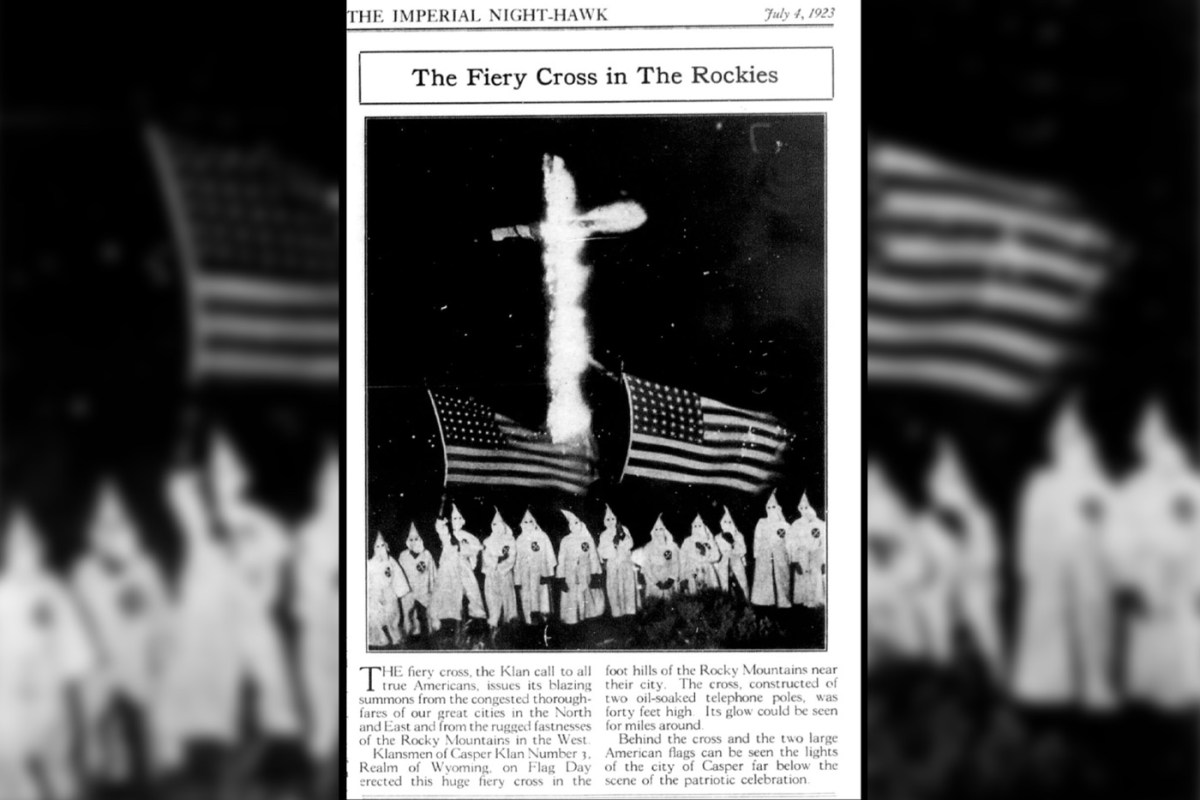
Beneath that respectability, the klaverns made their presence felt. In Sheridan, members sent threatening notes to business owners. In Buffalo, residents were jolted awake on Christmas night 1925 by a dynamite blast and the sight of a 40-foot cross burning on a hill. In Evanston, the Klan summoned the county sheriff and prosecutor to a meeting and had a robed spokesman deliver a direct warning: “Klansmen’s eyes and Klansmen’s ears are upon you and every county and city official, silent and unknown.” In Casper, Klansmen confronted the Irish Catholic community outside St. Anthony’s Church. In late summer 1921, two roadhouses in Casper’s Sandbar district burned to the ground. Local suspicion fell on the Klan. Nobody was charged.
The locked door
It was into this climate that Bob David and a friend eventually accepted an invitation from his local butcher to attend a Klan lecture at Casper’s Odd Fellows Hall. A county deputy locked the door behind them. Unmasked Klansmen filled the seats at the back, watching and being watched. When the national speaker launched into a racist tirade, David stood to leave and found the deputy blocking his way. The law itself was in the room and it was not there to protect him. He sat back down. Only when the Grand Dragon finished speaking did David and his friend manage to push past and leave.
The next day, the butcher explained: Catholics had been watching from across the street, recording names. The Klan had cleared two blocks before dismissing the crowd, he said, “for your own protection.”
Surveillance presented as kindness. Intimidation framed as concern. Vigilantism masked as law and order. That was how the Klan operated — through intimidation and the constant reminder that it was everywhere, that it knew who you were, and that the men with power — over your business, your church, your community — might be among its members.
Fighting fire with fire
Alongside fiery crosses, residents in Cody and Greybull also saw flaming circles on their hillsides. These circles belonged to the militant anti-Klan group, the Knights of the Flaming Circle. Organized in 1923, the group opened membership to anyone who was a target of the second Klan. The Knights used the Klan’s own tactics against them: They held outdoor rallies, wore white or red robes, and lit circles on fire instead of crosses. While the Klan and the Knights had violent clashes across the country, activities in Wyoming appear to be limited to competing displays of crosses and circles.
Greybull bookstore owner Lizabeth Wiley did not feel the need to hide in the ranks of another secret organization to fight the Klan. She made herself a known enemy of the Klan by publicly opposing them, and in 1924, she ran for mayor to prevent the Klan from taking over. While the men of Greybull were afraid that the Klan might win, Wiley’s decision to run was marked by her characteristic confidence; she wrote, “There has never been a time when I doubted the klan could be beaten.”
She ran on a law-and-order platform promising “equal rights to all and special privileges to none” — a direct rebuke of the Klan. Her campaign slogan was, “It can be done!” Wiley won her first race with 444 votes to her opponent’s 278 and went on to serve three terms. When the Klan announced it would attend her first council meeting wearing masks, she sent word that no masked persons would be allowed inside. No Klansmen came. She swiftly put an end to both the cross and circle burnings after her election.
In Casper, a group of Catholic men fought back by unmasking the Klan. They hired investigator Patrick O’Donnell of the American Unity League — a prominent Chicago-based organization founded in 1922 to publicly expose the Klan — to infiltrate the local chapter and obtain its membership rolls. The names were published in “Tolerance,” the League’s newspaper. Copies sold out in Casper the day they arrived. Grand Dragon Johnson resigned from Klan leadership shortly after his own name appeared in print.
Fading, not finished
By the early 1930s, the Klan had largely faded in Wyoming — done in by national scandals, internal corruption and the exposure of its leaders. Many members simply moved on, some later speaking of their Klan years with pride, insisting they had never thought of it as a hate group. The violence, the arson, the locked doors — none of that, in their telling, had really happened, or had not really been what it was.
But Wyoming did not suddenly become a different place when the Klan faded. State law still banned interracial marriage. Black residents in some towns navigated unwritten rules about when they could appear on Main Street. Native Americans on the Wind River Indian Reservation continued to fight for treaty rights the federal government had spent decades eroding. The Klan had not created those conditions. It had exploited them, organized around them, and given them a hood and a torch. When the hood came off, the conditions remained.
Read more at WyoHistory.org:
Reborn in Robes: The Second Ku Klux Klan in Wyoming, 1921-1930
It Can Be Done: Mayor Lizabeth Wiley and the KKK
Available at Your Local Library: The Novel that Welcomed the Ku Klux Klan to Wyoming


For a more complete 20’s Klan history, read ” A Fever in the Heartland” by Timothy Egan. It’s happening again but not with White hoods, this time with Red hats.
Years ago, I did the local curation in Sheridan for a traveling exhibit on Anne Frank. We added a panel about the KKK as a way to illustrate that racial intolerance exists in Wyoming. The way I heard about the KKK in Wyoming was from my husband’s great aunt who, as a child, was chased home from school by adult men hurling abuses. She also remembers a cross burning on the hillside above the mining town of Monarch. Fun times.
Sadly, I believe that many of the same attitudes and positions touted by the Klan back then are still very much alive in many people across the country, and only the hoods and burning crosses are seldom seen.
I wish to add this book to your reading list.
A FEVER IN THE HEARTLAND BY TIMOTHY EGAN. Note that they attempted to attack the University of Notre Dame. Rumor has it that the school’s students defeated the attempt and got the nickname “The Fightin’ Irish.”
Thanks for the fascinating article.
I was going to point out that fact too. Indiana was the most populated state with Klan membership. The Notre Dame students, there were about 1,000 attending at that time, were far outnumbered by the Klansmen who came from all parts of Indiana to abolish the university.
I’m pretty sure the hooded robes are still hanging in grandpa’s closet up here in Cody…
Thanks for a fascinating article on Wyoming’s darker past ladies.
What an informative, interesting and well researched article. Thank you
Very interesting piece of Wyoming history I knew little about. Great article!
Wow! This article was shocking to me. I never imagined the KKK was active in Wyoming. Thank you for a well-researched, well-written essay on this aspect of Wyoming’s history. It was a good reminder of where hate can lead us.
WOW, dig up century old history for exactly what reason?
Continually stoking racial strife.
The SPLC was just exposed for paying MILLIONS to “white extremists” to essentially boost donations. Culminating with their greatest windfall event “Unite the Right Charlottesville”, nearly tripling their assets from 51 million to 133 in one year.
This horse is simply a pile of ancient, sun bleached bone frag being still being beaten.
George Santayana: “Those who cannot remember the past are condemned to repeat it,” (“The Life of Reason: Reason in Common Sense”). The quote’s popularity may be attributed to William Shirer using it in his “The Rise and Fall of the Third Reich”.
How funny. You’re the guy that continually spouts gloom and doom because someone said or did something a long time ago.
Chad, you have expressed a surprisingly strong reaction to a historical piece of writing.
The 100 years that have passed make this a good time to look back.
Why are you so bothered by these ladies digging up century old history, as you phrased it? On a larger scale, why are MAGA types in general so opposed to their fellow citizens being reminded of the full spectrum of our collective national history? Is it because there are shameful aspects of our history that are eerily similar to much of the agenda that Trumpigula’s administration is so aggressively pushing?
As clarification, I’ve never been a fan of the SPLC, but they have been accused of the stuff you mischaracterized as being exposed for doing, in non-MAGA ‘Murika accusations are NOT in any way equal to findings of guilt.
I’m not MAGA, van.
Race baiting divisive garbage and profiting from it, is big business in an America that has an infinitesimal fraction of the actual racist problems it once had.
Divide and conquer is being used everyday in this country to tear it down. Race is just one of the avenues. I haven’t mischaracterized a thing about what the SPLC is accused of doing.
They essentially created the alleged extremism they supposedly expose. Paying millions to insiders, essentially funding a fictitious boogeyman that they can hold up and say “send us money, so we can fight this”.
It is much the same as the FBI cultivating “muslim terrorists” to foil on a 6 week news cycle basis for years.
Consistently dredging up history that is absolutely not repeating itself is an effort to keep the psychological divide intact.