

WyoFile’s local news initiative partnered with Oil City News to produce this story.
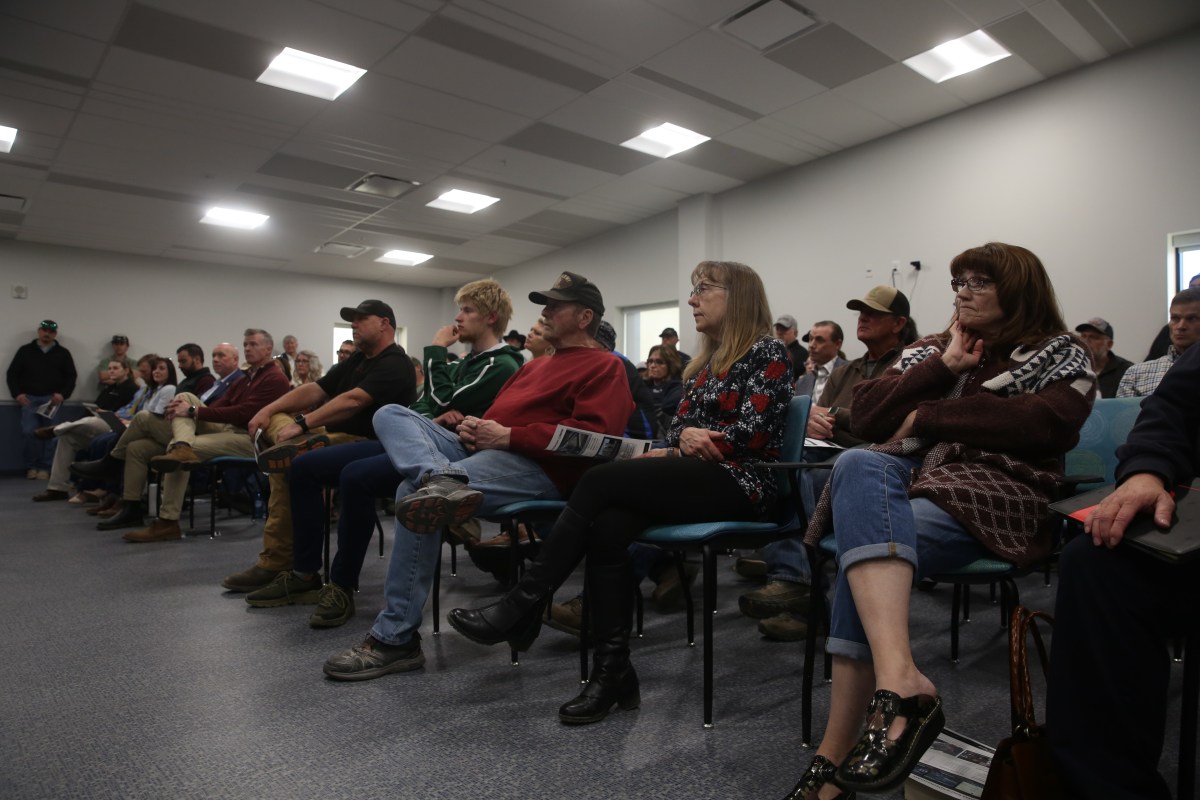
BAR NUNN—A crowd, both uneasy and excited, packed the town of Bar Nunn’s community center Tuesday night to learn about a company’s plans to build portable nuclear microreactors in Natrona County.
Bar Nunn City Councilman Tim Ficken called the project a good opportunity for the area, which has long been economically reliant on the fossil fuel industry. He represents a community of roughly 3,000 people that sits just north of Casper.
“It’s a different type of manufacturing for our county,” he said.
Likewise, Natrona County resident Chastidy Cockrum offered enthusiastic support.
“I think we should be thanking them for considering us,” Cockrum said. “For them to choose this state blows my mind. What they’re going to bring into this community is more than a lot of people understand.”
But others were more cautious. A question many posed was why the California-based company Radiant chose to relocate to the Equality State.
“How many states turned you down?” Natrona County resident Judy Jones asked during the Q&A.

According to Radiant Director of Operations Matt Wilson, the company identified the small Natrona County community as its ideal location for the commercial factory roughly six months ago. The clean energy startup plans on purchasing roughly 130 acres and developing a roughly 350,000-square-foot, campus-style facility.
“It’s more jobs, more capital, and you really get to be the future of advanced nuclear and reshape what that means for the United States,” Wilson told attendees.
One of the main draws, he said, is the existing workforce with experience in the energy field.
“A lot of the types of jobs that we’ll need to fill, we see the skills already in the local market,” he said. “The only gaps we really see are on the nuclear engineering side, and that’ll be fairly easy to fill.”
“We had dozens of criteria that we looked at, and the simplest way to put it is you scored the highest,” Wilson said. “This is our preferred site.”
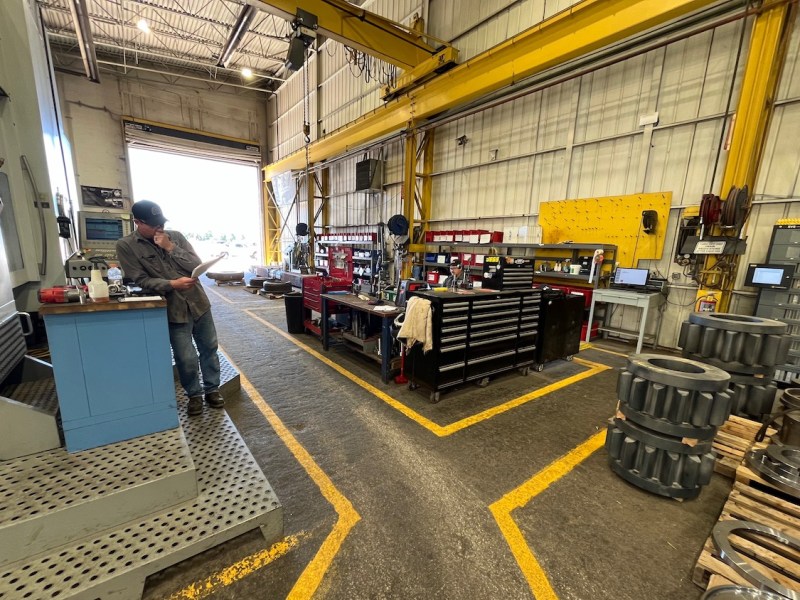
The company, which is based just outside of Los Angeles, expects the plant to have 70 to 80 employees immediately upon opening, eventually growing to approximately 230 jobs.
“At least half of those are going to be technician-oriented,” Wilson said. “So that could be assemblers, welders… and then the other half I’d say would be business operations, such as finance, accounting [and] a lot of the logistics around moving these.”
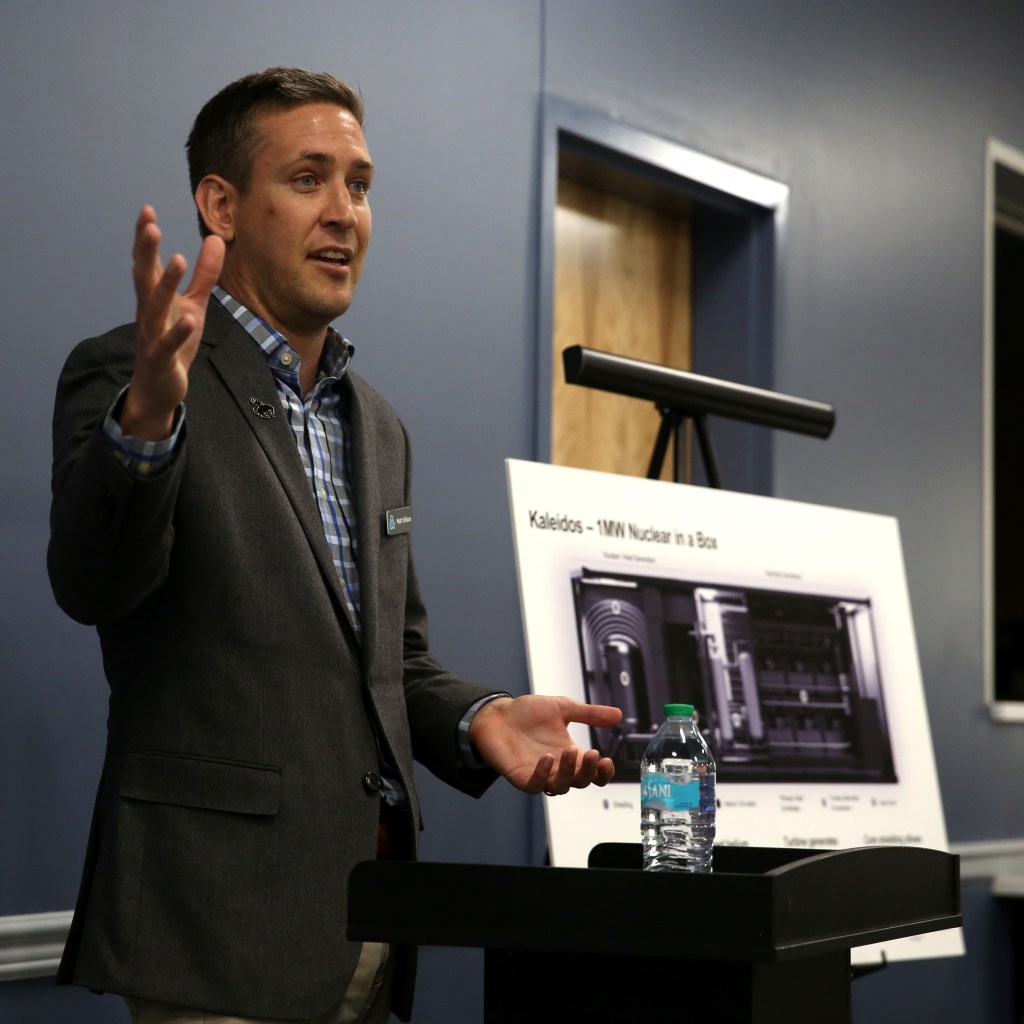
Radiant’s facility will build container units with a reactor and all of the equipment needed to convert heat into electricity, Wilson said. The units will have a life expectancy of 20 years, though they will need to be refueled every five years.
“We’ll build the units here, and we’ll ship them to our customer locations,” he said. “The entire nuclear life cycle will be managed at the Bar Nunn facility. When we refuel them, we’ll ship the units back to our facility, we’ll take out the used core, put in a new core and ship it back out to either the same customer or a different customer.”
The used cores, referred to as spent fuel, will be put in a dry cask once fully expended.
“It’s a similar process to what the other nuclear reactors around the U.S. use today, but the biggest difference I’d say is one of scale,” Wilson said. “We’re one megawatt worth of power, where they’re at 1,000. It’s a very small amount of fuel that we’ll have to store over time.”
According to the U.S. Department of Energy, a single megawatt of electricity can power approximately 1,000 households. A standard nuclear power plant generates a gigawatt of electricity.
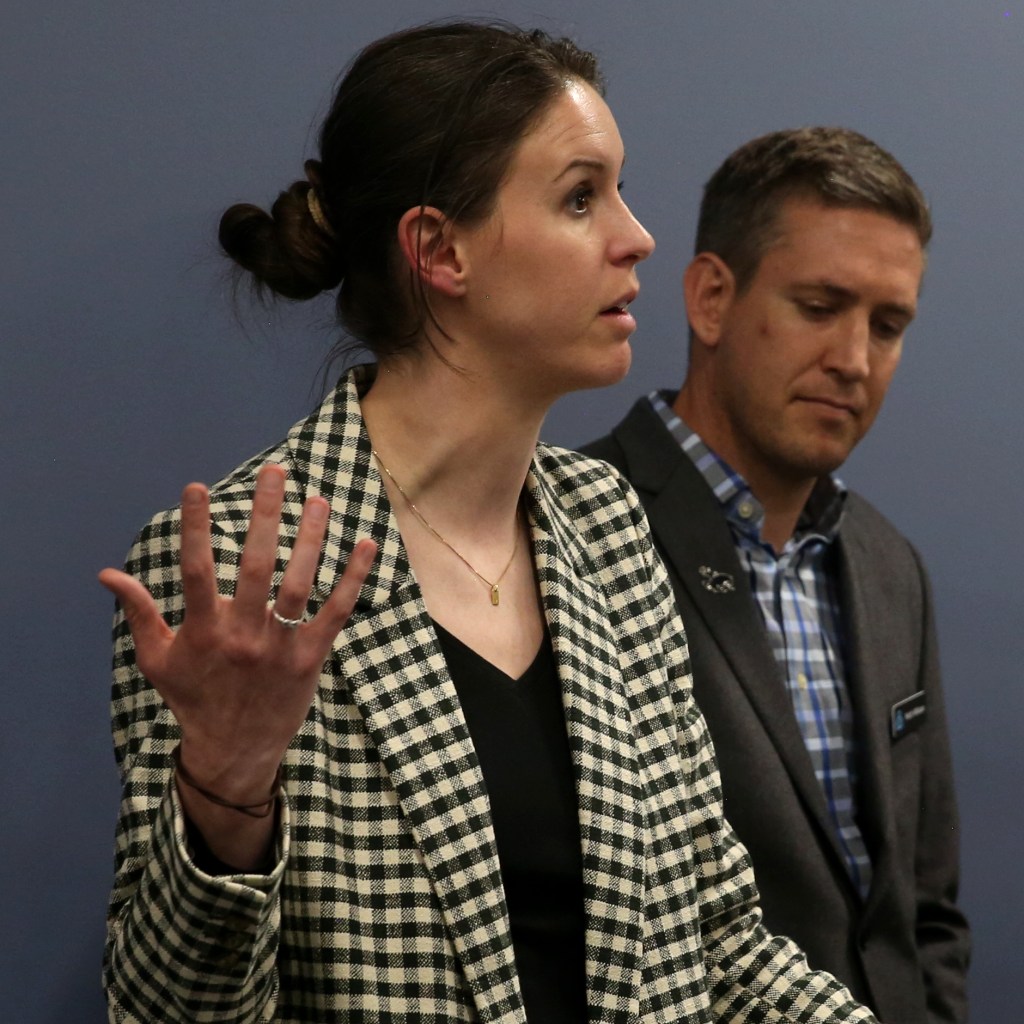
Many residents raised concerns about storing spent fuel. Radiant Chief Operating Officer Tori Shivanandan said the process would be conducted under strict control and in negative pressure. When asked to provide a percentage for how safe the process would be, Shivanandan replied, “99.99%, because that’s how sure you need to be to receive the permits you need.”
Natrona County Commission Chair Dave North said he thinks the company did a good job alleviating people’s fears surrounding nuclear power.
“People hear the word ‘nuclear,’ they think of Chernobyl; they think of Hiroshima,” North said. “They don’t realize how many places in this country have nuclear power. They have one in California in the middle of a big city, and they have one in Boston at MIT.”
Some weren’t swayed. “I’m still neutral on it, but if this is as safe as they claim, that’s big,” said attendee Michael Newquist. “Of course, we’ve heard that before.”
Another common concern was the potential tax burden manufacturing microreactors could place on the community.
“No taxpayer dollars go to Radiant, or for cleanup,” Shivanandan assured. “The investment here is made in utilities for the community. Say our prototype doesn’t work and the project doesn’t happen. I’m having a very bad day, but you guys will keep the investment on the utilities which, again, are things that help improve and help you guys.”
Among those not ready to take a stance was Rep. Tony Locke, a Natrona County Republican. “This is not my forte, and so I’m learning,” he said with a chuckle. “My main goal was to get some information that I can bring back to my constituents, and I think [the company] did a good job of doing that.”
Several attendees said they’re still not convinced, though many added that Radiant’s answers helped put them more at ease.
“I could see it being good for our community, but I want to do some more research first,” area resident Kimberly Zahara said.
Attendee Mike Schoolcraft called Radiant’s answers “informative” and “well presented.”
“I think the community got enlightened,” Schoolcraft said. “I think a lot of them are more receptive to the idea than when they got here.”
Despite Radiant’s optimism and a partially receptive crowd, the project still has legislative hurdles to clear.
House Bill 16, “Used nuclear fuel storage-amendments,” died during this year’s legislative session in the House Minerals, Business and Economic Development Committee.
The bill was drafted in response to multiple companies, including Radiant, that expressed interest in setting up nuclear microreactor manufacturing in Wyoming.
Reacting to several claims that the storage of radioactive nuclear fuel waste poses no human health or environmental risks, Rep. Scott Heiner of Green River previously listed a litany of reported leaks from the same type of “dry cask” containers in other states that would come to Wyoming. Other legislators voiced concerns regarding the federal government’s ability to build and maintain a permanent repository.

At the time, Wilson assured lawmakers that the U.S. Nuclear Regulatory Commission would be the primary authority over the factory, and that the federal agency had deemed it to be safe. However, such a facility does not yet exist in the U.S.
Similarly, Senate File 186, “Advanced nuclear reactor manufacturers-fuel storage, failed. The bill was crafted in response to recent interest from a handful of companies, including Radiant and BWXT Advanced Technologies.
“The issue is one of verbiage,” Wilson said prior to the start of Tuesday’s meeting.
The company remains optimistic the legislative issues will be resolved, and is moving forward undeterred, Wilson said.
Radiant would like to start building its factory in Natrona County in late 2026 or early 2027 and be operational by 2028. Currently, the project is still in the pre-application stages, and Wilson said it is a multi-year process for the company to get the OK to build its units.

I’m a bar nunn home owner. I’m concerned about this nuclear facility lowering home values. Before the facility is placed here. The community needs to know what it’s options are as far as removing the nuclear facility if we decide it’s not for us. I would like to know what removing it would take and how much of that would be the communities responsibility? It’s one thing also for this to help our community. We don’t need to be a hub for storing any nuclear wast of any kind though without legal assurance to the community that we are covered 100% from that 0.01% chance something does happen. I am not one to take unnecessary risks with my family, home or community.
Wyo. Has always been a experimental state, in 1959 Laramie and Provo Utah was selected to be the first universities to have a Nuclear Reactor years later they revealed that if there was an accident only the two small cities would be wiped out. This new experimental sand nuclear facility in Wyo. Was selected for the same reason. Fire in Yellowstone was another experiment. There has been many experiments the public has not been aware of.
Be 20-25 years before the plants generate enough juice to lite a lite bulb. Russia makes the fuel rods.
It is not clear from the article if the spent radioactive fuel would be stored in Wyoming or shipped back to the state where it was used. Would Wyoming be the dumping ground for the nation’s nuclear waste?
Valid concerns Mark. The more facts we understand the better, both good and bad. I’d assume the spent fuel would be stored at the manufacturing facility, and then we work to see if this is acceptable.
I found this clip on the TRISO fuel to see what it is and how it’s made. The good news is that the actual radioactive components are essentially cemented into a ceramic material, so it’s locked up and not in some ‘powder’ form blowing around.
https://www.youtube.com/watch?v=uR7VDqUbaCg
Also, here’s a clip on the ‘Kaleiods’ process used to generate electrical power. I like the idea there’s no water, steam or other media that can become radioactive that’s used to transfer heat from the nuclear core to the turbines generating electricity. Also no risk of a ‘melt down’. The primary loop off the reactor is helium with the secondary loop(s) being CO2 in a ‘super critical’ state running the generators.
https://www.youtube.com/watch?v=9cc1j-MbVVA
This could be a real game changer, not only for Wyo but all kinds of folks across the planet. Imagine a decentralized power grid reducing the use of transmission lines draped all over everywhere that have massive power losses when generating power in Wyoming and shipping it to some other State, maybe ~30% of the power lost just pushing it down the transmission lines. Miles and miles of wind mills or solar panels goes away. Just little boxes pumping out electricity only where it’s needed. Pretty neat.
DONT DO IT!!!!
Not one kilowatt from these new reactors will go towards lowering energy costs for human beings.
Nationwide “AI” data centers are going to require 2-3 times what our nation currently uses.
“”Data centers powering artificial intelligence could use more electricity than entire cities””
https://www.cnbc.com/2024/11/23/data-centers-powering-ai-could-use-more-electricity-than-entire-cities.html
“The only gaps we really see are on the nuclear engineering side, and that’ll be fairly easy to fill.” – that was worth a good belly laugh. Nuke engineers are a dime a dozen these days, certainly. Those with odd sounding last names and dark skin are especially eager to move to central WY and integrate into the communities.
Right on the heels of the Kemmer dead-coal layoffs, Natrona county has an opportunity at an economic future and is balking. Local residents with a Marlboro hanging out of their mouth, breathing in toxic fumes from the local coal fired plant, drinking the pesticide and herbicide runoff dumped into our water by local farms, are worried about potential health issues associated with a microreactor? Radiant can offer free horse dewormer to anyone negatively affected. Please team orange, get out of our way. Do not say something cannot be done to the people who are doing it.
Coy, the “new” reactors are not for the benefit of anyone but Big Tech.
Wyofile is deciding to censor comments exposing the admitted fact that AI datacenters nationwide will require 3 times the energy our country currently consumes.
Balking at this “opportunity” is a victory for the human beings inhabiting this nation. AI datacenters are no a bright spot on America’s horizon, quite the opposite.
I fully agree with you Jack on the crypto-mining farms. We are burning up what remains of our environment to power a criminal ponzi scheme. My point is those crypto farms are going up either way – they are going to get prioritized over main street. We need to build the necessary clean capacity or look out of our dark huts at the pretty lights down the road where the global mafia is conducting illicit business.