

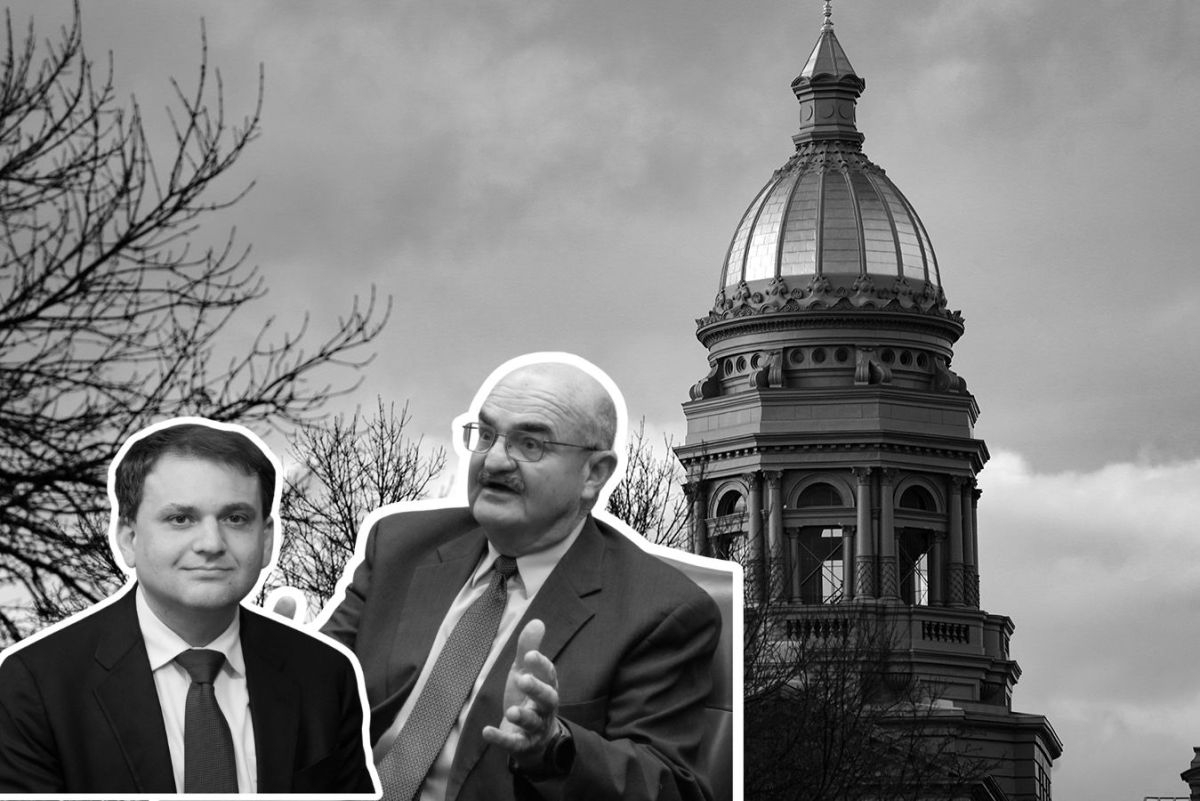
Wyoming Attorney General Keith Kautz made an astonishing state Supreme Court filing last week that raised a big red flag about conflict of interest.
Opinion
Kautz is the state’s chief attorney and, therefore, represents Secretary of State Chuck Gray. So then why did Kautz think it was a good idea to personally appoint two “special prosecutors” to evaluate whether Gray — his own client — should be charged with a crime?
The only way for Kautz to guarantee an impartial determination would have been to ask a judge to select the attorneys, but he didn’t. Par for the course in a controversy that began last August, when Gray, the state’s chief elections officer, admittedly handed over confidential Wyoming voter data to the U.S. Department of Justice. Gray said he went to the attorney general to seek advice about how to handle the federal request.
Gray was the first official in 16 states to comply with the DOJ’s request. To date, eight federal courts have found the requests unlawful.
Before we get into the details of the Wyoming case, it’s important to remember that every bit of illogical political spin Kautz and Gray have used to claim that justice has been served occurred in the wake of an April 2025 executive order by President Donald Trump that aimed to illegally overhaul and take control of major parts of the nation’s election system.
Last October, a federal court permanently blocked Trump’s executive order. But his administration has doubled down on other threats to the security of this year’s midterm elections, serving as the backdrop that makes many Wyoming voters and officials fear that Gray’s potentially illegal release of voter data — and Kautz’s legal advice to provide it — must continue to be fought in the courts.
Under Wyoming law, it’s a misdemeanor to release confidential voter information. For an election official, it rises to a felony for violating the state’s election code.
In January, the Wyoming League of Women Voters sounded the alarm over Gray, a staunch Trump ally, turning over sensitive voter information to the federal government, including birth dates, addresses, drivers’ license numbers and partial Social Security numbers. That data belongs to the state.
The group asked Gov. Mark Gordon to order Kautz to examine the secretary of state’s authority, by statute, rule and regulation, and issue an opinion on Gray’s actions.
That’s when Gray first said Wyoming’s AG approved his data release after collaborating on a “routine voter list maintenance effort.” Kautz cited their attorney-client privilege and did not disclose their discussions.
Meanwhile, Fremont County Clerk Julie Freese publicly said she was “perturbed” at Gray for releasing the information.
“I think the problem was [Gray] never even told the clerks, and they are very, very angry in our state,” Freese told a meeting of the U.S. Election Commission in Chicago in April. “And I don’t blame them.”
The same month, George Powers, a retired Cheyenne attorney, filed an official complaint with the AG’s Office alleging that Gray had violated state elections laws. Since Kautz had reportedly counseled the secretary of state, Powers suggested that he have a judge appoint an independent prosecutor.
Kautz replied on March 4 that Powers’ complaint would be handled in accordance with the AG office’s policies, the law and state professional conduct rules for attorneys.
The record indicates Powers wrote back several hours later, thanking Kautz for acknowledging the complaint and asking him what the office’s policies are and where he could find them.
This is where things get undeniably weird.
Kautz wrote back a half-hour later to tell Powers “there are no written policies” and “no response will be forthcoming.” To Powers’ next attempts to get answers to his questions, the AG said investigations and charging decisions are “not conducted in the public square.”
Thus began the attorney general’s effort to stonewall, which continues to this day. Kautz argued Powers wasn’t injured by Gray’s actions, so his complaint has no standing, even though he’s a voter, and like all voters in the state, his personal information was given to the DOJ despite specific state statutes prohibiting such releases.
At this point, Kautz called the case “moot.” It is decidedly not, because of what then transpired.
Four weeks passed with no apparent action by the AG. On June 2, Powers filed a petition with the Wyoming Supreme Court — where Kautz once served as a justice — to appoint a special prosecutor because the attorney general had neglected his clear duty to do so.
Last Tuesday, Kautz made the surprise announcement: he did appoint two independent prosecutors to decide if Gray should be charged with a crime before Powers asked the Supreme Court to intervene. Lo and behold, neither one did!
Kautz refused to name the prosecutors who declined to file charges against Gray, because he claimed he didn’t have to. He said there was an investigation conducted by his own office, protected by a so-called “Chinese wall,” an internal information barrier.
The second investigation was turned over to a private Wyoming law firm, in conjunction with a Wyoming county prosecutor. Kautz has not disclosed the names of any parties that conducted the probe, but the public has the right to know.
Kautz said Powers had no reason to think he was doing nothing about the request for a special prosecutor, because he had no obligation to disclose how he was addressing the complaint. Kautz asserted he was following the DOJ’s guidelines to keep an ongoing investigation quiet to avoid infringing on the rights of the accused. The accused, of course, is Kautz’s client.
Essentially, Kautz said he did everything he had to under the law to answer the complaint — he just didn’t reveal his special prosecutors’ findings before Powers filed a petition asking the Supreme Court to recuse the AG from the case.
Anyone who has seen Gray respond to all criticism during his days as an elected official can easily guess how he handled this controversy from the beginning.
Gray blasted Powers’ complaints as “nothing more than lawfare and weaponization of the legal system by leftists and the insider media.” It’s the only gambit Gray knows, and it’s way past stale.
In an email to Cowboy State Daily, Gray wrote, “I have and will continue to stand for the truth, and I will continue to comply with the law and advance election integrity and voter list maintenance.”
Fortunately, Powers isn’t backing down. The public should join him in demanding to see the names of the private lawyers and prosecutors Kautz appointed, and the full results of both investigations.
Powers’ attorneys — Ryan Semerad and Rob Shively — explained in a statement why it is essential to hold Gray accountable for his actions.
“Justice requires a truly independent review — by someone the attorney general did not choose,” the lawyers wrote. “Elected officials are not above the law, and they deserve no special treatment when they are accused of misusing the power the people gave them.”
Semerad and Shively noted that by Kautz’s own admission, he had a decision not to charge Gray in hand before their client filed a petition with the Supreme Court, “and said nothing.”
They rightfully contend that the attorney general cannot keep a citizen in the dark, force him to sue, and then call the lawsuit unnecessary.
And the investigations conducted by Kautz’s own office, and the private lawyers he selected and deputized, are not proof of justice served, but a demonstration of why our government must have checks and balances.
As James Madison wrote in Federalist No. 10, “No one can be permitted to judge his own cause, because his interest would certainly bias his own judgment, and, not improbably, corrupt his integrity.”

I love an support Wyofile. But when I see words like “bombshell” I equate that to mass media garbage news outlets. I wont even read an article that has words like “Breaking!”, “This just in!”, or bombshell. In the currnet chaos and bullshit that we are swimming in, informed readers want a measured approach to news and events. When looking at the big picture shit storm we are facing, very little in Wyoming can elicit such a title.
With the way things work now not only will this be swept under the rug, they will also be rewarded for doing so.
AG Kautz saying he can’t divulge conversations between himself and SoS Gray because of the lawyer/client relationship sounds mighty self serving. I would assert that the AG is the lawyer for the citizens of the great state of Wyoming and implying SoS Gray is anything but a fellow state employee is simply a deflection to cover his ass. Both work for us and need to be given the same treatment Gray gave Becky Hadlock (Weston County clerk).
Every citizen of the state has an interest in this—it is their information surrendered to the most corrupt régime in American history. The executive branch has no right to this information. Kautz and Gray’s conflict of interest is blatantly self-evident as Kerry so eloquently explained. And thanks are due to Sheryl Yates for her further elucidation. I only hope that the citizens of my birth state understand the danger of caving into False Messiah’s unconstitutional demands represent to our democratic republic. James Madison in Federalist No.10 was absolutely correct.
Quoting the James Madison statement from The Federalist Papers is a most pertinent citation that seems to be ignored by many in our Federal government, from the top down! Thank you, Kerry Drake for highlighting this blatant conflict of interest.
Thank you, Mr. Drake, for explaining this so thoroughly.
It’s disappointing that voters can’t get justice for Gray’s misconduct.
I’m afraid that in this case, as is so frequently the case, the bad guys have the game rigged and will gloatingly win again. The only consolation we can take if and when that happens is that Mr. Kautz is Mr. Kautz, and no longer Justice Kautz. Him in robes again is a very scary thought.
Not one person I know believes Gray had any right to comply with an illegal order to submit voter information to trump. Voting is 100% the responsibility of the states.
U.S. election laws date back to Article 1 of the Constitution. This gave states the responsibility of overseeing federal elections. Many constitutional amendments and federal laws protecting voting rights have been passed since then.
Here’s how you know
USAGov Logo
Español
Menu
HomeVoting and elections Voting and election lawsVoting rights laws
Voting rights laws and constitutional amendments
Federal laws govern voting rights. Learn about the laws and how they protect your rights and make it easier for you to vote.
U.S. election laws date back to Article 1 of the Constitution. This gave states the responsibility of overseeing federal elections.
Constitutional amendments affecting voting rights
The 15th Amendment gave African American men the right to vote in 1870. But many weren’t able to exercise this right. Some states used literacy tests and other barriers to make it harder to vote.
The 19th Amendment, ratified in 1920, gave American women the right to vote.
The 24th Amendment, ratified in 1964, eliminated poll taxes. The tax had been used in some states to keep African Americans from voting in federal elections.
The 26th Amendment, ratified in 1971, lowered the voting age for all elections to 18.
Congress, not any president enacted these changes to increase voter participation for all Americans.
Trump’s attempts to control voters roles will fail. And you should agree as there is not any significant issues with fraud or illegals voting. The states do a great job of maintaining voter roles. This over reach is unprecidented. Gray is wrong and broke the law. He should be prosecuted.
Nice article Kerry. You spelled out this whole sordid mess in plain English so anyone reading this could truly understand what’s been going on and hopefully, draw their own conclusions without all of the noise and distractions coming from Gray and Kautz.
So Kautz is saying that he followed “policy”, but when asked for said “policy”, he says there is no “policy”???? I’d personally like to see the justification of not filing charges as Wyoming law seems pretty clear.
Also – the hypocrisy of Gray saying anything that puts him and the truth is astounding! This is the person who campaigned by showing a movie (2,000 Mules) that was nothing but lies and has been widely debunked!
In a case like this, appearances do matter. A transparent and independent investigation is needed. Stonewalling makes it look like Gray and Kautz know they are on shaky ground. The law sets the minimum standards. Sometimes you need to do more than the law requires.
This whole issue stinks to high heaven, and Kautz and Gray are the dunderheads causing it. Why Governor Gordon has not intervened is beyond me.
I agree there is a role for Gov. Gordon to protect the voters of this state and to insist on accountability/transparency to the public, especially by the people he appoints.
Wyoming voters deserve the level of daylight that Kerry Drake offered today in his opinion piece about Secretary of State Chuck Gray giving away our private voter information to the federal government and Attorney General Keith Kautz refusing to allow a judge to appoint a special prosecutor to look into the legality of Gray’s actions but instead acting as if he can investigate and make decisions on the case without publicly sharing any of the findings.
Birds of a feather seem to flock together: Kautz and Gray.
This proves Grey has no concern about the privacy of Wyoming citizens when it comes to voting only his loyalty to the most corrupt president ever to hold office . Voting integrity BS