


A wildfire burning in the Wyoming Range due west of Pinedale grew to more than 1,300 acres as of Wednesday afternoon, five days after a lightning strike ignited it.
Though the fire is sizable for the time of year, a U.S. Forest Service spokesperson and the Wyoming State Forester told WyoFile the blaze wasn’t an early indicator of a difficult fire season. Instead, they attributed the fire’s growth to a bounty of dead and downed trees in that part of the Wyoming Range, and to the area’s high elevation — where conifer trees and other plants have not loaded up as heavily with moisture for a spring “green up” as they have in Wyoming’s valleys and plains.
Dubbed the Horse Fire, the conflagration has not shown extreme fire behavior or made any big, dramatic runs that can quickly increase a fire’s size, Bridger-Teton National Forest spokesperson Mary Cernicek said. The fire has forced the closure of portions of several forest service roads in the area, including Horse Creek Road, both for public safety and because they’re seeing heavy use from firefighters and equipment.

Firefighters also wrapped a historic fire lookout post on Prospect Peak with a layer of the material used in fire shelters — a mix of aluminum and other materials that firefighters will cover themselves in as a last resort when trapped by the flames. Other than the lookout, there does not appear to be any significant threat to structures.
The fire is burning in an area of conifer forests and meadows, at an elevation where there are still a few patches of snow on the ground, Cernicek said. But the flames have grown in intensity most afternoons alongside the winds, she added. The area is currently listed as at moderate fire danger, but on June 13, the day the fire ignited, that segment of the national forest was listed as in low fire danger.
But that doesn’t mean fires won’t start and grow. “The misconception is if it’s low fire danger, there’s no chance of fire,” Cernicek said, but “it started in just perfect conditions,” for a fire, even if the danger for rapid spread was low overall.
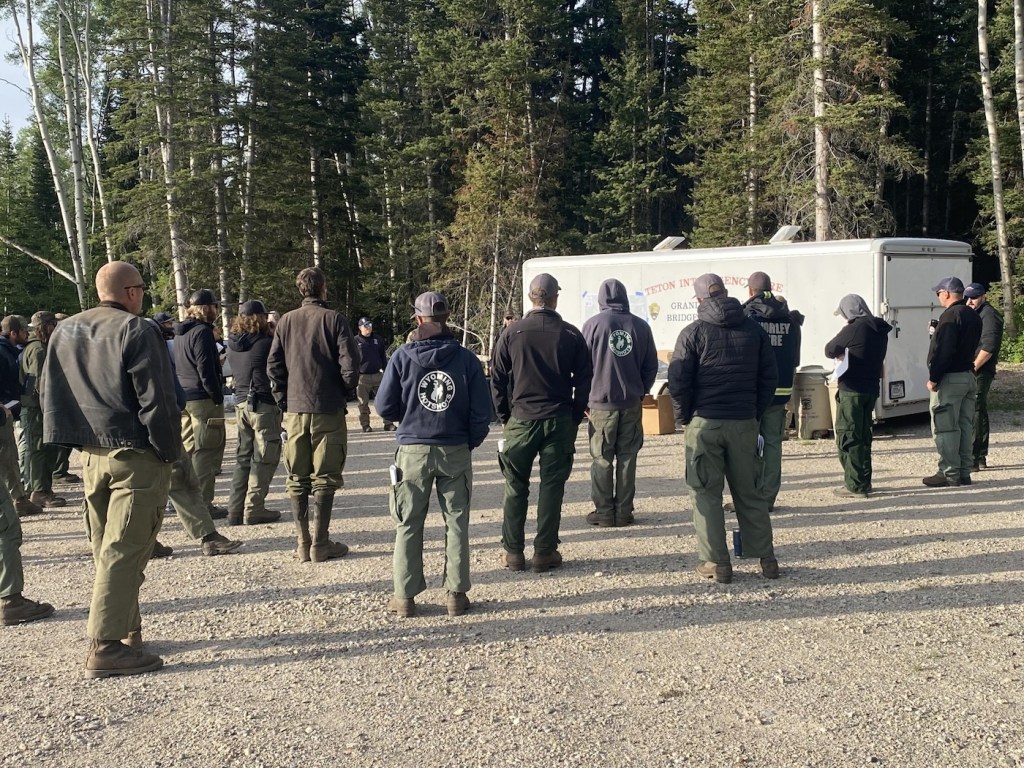
There are 208 people working on the fire, including hot shot crews, helicopters and fire engines, according to the Horse Fire Inciweb page – Inciweb is a government website where fire updates are posted throughout the year. The approach is “full suppression,” Cernicek said, “and it has been since the beginning.” Tough terrain and thick downed trees have made firefighters’ job challenging and led to a strategic suppression strategy, she said. As of 5 p.m. Wednesday, Inciweb only listed 6% of the fire’s perimeter as contained.
Because it’s early season and the West isn’t confronting large or dangerous wildfires yet, plenty of personnel and resources are available, Cernicek said.
Early spring and fall fires are common in the mountains of western Wyoming, State Forester Kelly Norris told WyoFile. Worse fires come in the fall, when spring’s new growth dries out and becomes combustible. A June wildfire “is typical and is going to continue to be typical in that area just because of the amount of dead trees we have in those forests,” Norris said.
She expected an aggressive response to the Horse Fire. “It’s not the easiest place to go full suppression … but our expectation is for firefighters to make a point to put that out,” she said.
So far, weather and fuel modeling at this point in the year suggest an average wildfire season for Wyoming, Norris said. But as Wyomingites know, high winds and drying weather can change a fire season’s projection in an instant.
“We were to have an average fire season last year too, and that didn’t turn out as expected,” Norris said.
Wyoming had a record-breaking, and state bank account-draining, fire season in 2024. Wildfires burned across 840,000 acres in grasslands and mountains across the state, a season surpassed only by the famous 1988 fires in Yellowstone National Park. About half of last year’s acreage burned in four big fires in the northeastern part of the state in late August.
Once again this year, the northeastern corner of the state, stretching into the Bighorns, is predicted to have a higher-than-normal fire risk come August and September, Norris said. Modeling predicts high temperatures and reduced precipitation later in summer, despite a rainy May and June across the grasslands. Spring grass fires are also not unusual, she noted, but Wyoming has not seen any that required a major incident response so far this year.
“We know the [precipitation] faucet is turning off sooner rather than later,” Norris said. “It does not take much in Wyoming, with the amount of wind and a lack of moisture, for fire danger to increase quickly.”
CORRECTION: This story has been updated to note that Wyoming has not had any grass fires this year that have required a major incident response. -Ed.

Could you report on the incident early in the fire with the drone? I understand aerial suppression activities were stopped because someone was flying a drone. Were any legal actions taken against the person flying the drone?