

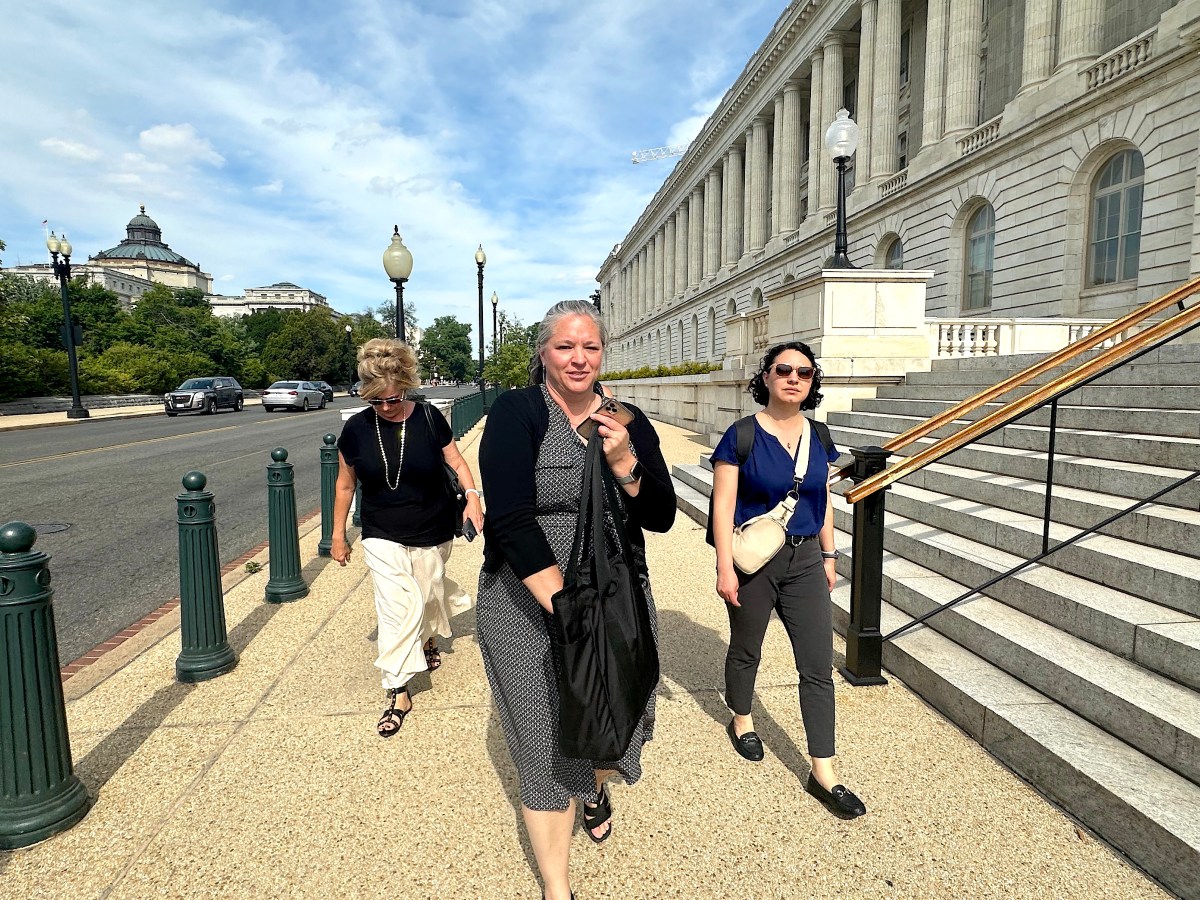
WASHINGTON, D.C.—Flanked by three fellow activists, Kristin Combs was tired, hungry and catching up on messages after hours of trying to convince congressional staffers that legislation was needed following the most infamous animal welfare case in recent Wyoming history.
The all-women activist crew, who traveled from around the country, had met with the offices of several congressional Endangered Species Act Caucus members: U.S. Reps. Debbie Dingell (D-Michigan), Don Beyer (D-Virginia), Raúl Grijalva (D-Arizona) and Jim McGovern (D-Massachusetts) just that morning. They’d given the congressional staffers an earful about the now infamous torment of a wounded wolf that played out in a Sublette County drinking hole in February — and implored them to do something about it. The case sparked international outrage, especially after it was revealed the man accused of tormenting the wolf received only a $250 fine for wildlife possession.
Combs, who leads Wyoming Wildlife Advocates, was requesting legislation that would prohibit the vehicular pursuit and killing of wildlife on federal lands. The Victor, Idaho resident and her counterparts were also asking lawmakers to consider a broader bill that’s similar to the Animal Welfare Act, but for wildlife.
“Basically we’re just asking for something that would prohibit what happened in Daniel,” Combs said on a recent Tuesday afternoon from the Library of Congress’ Madison cafeteria.
Ideally, she said, what happened would be a felony under federal law in the future.

Those ideas were brought to “13 to 15” congressional offices by the time Combs left the nation’s capital.
At Combs’ side also espousing calls for reform: Paula Ficara of the Los Angeles-based Apex Protection Project, Betsy Klein of Plan B to Save Wolves, a Sedona, Arizona outfit; and Jewel Tomasula, an Endangered Species Coalition policy advisor who lives in the D.C. area.
Ficara explained what motivated her to travel across the country.
“It was so horrifying to such a huge number of people, it was just devastating,” she said. “It’s just time for all of us to act. We all have a responsibility to use our voices as best as we can.”
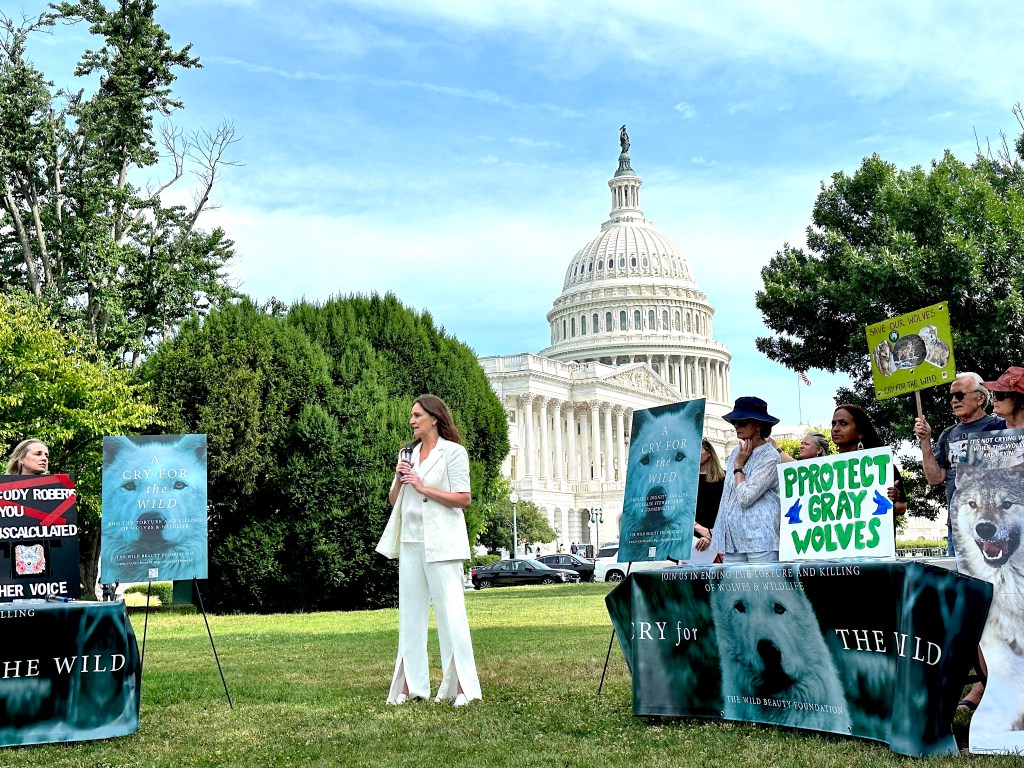
The Ficara, Klein, Combs and Tomasula quartet wasn’t the only coalition of wolf-advocating activists convened in Washington, D.C. last week. Filmmaker Ashley Avis organized a Capitol Hill rally, dubbed “A cry for the wild,” which attracted other groups with a presence in the Equality State, including Western Watersheds Project and Wyoming Untrapped. Those groups independently met with separate congressional staffers to push for policy reform on the federal level. And that’s not the end of the disparate lobbying efforts that have come about as a direct result of a Sublette County man’s decision to take a wounded wolf into a bar after running over it with a snowmobile.
Even though he lives in nearby Chevy Chase, Maryland, Wayne Pacelle, a former CEO of the Humane Society of the United States, didn’t convene with the other activists for the rally. But he’s made progress working with one lawmaker in particular on a response bill: Rep. Troy Nehls (R-Texas).
“Troy is from Wisconsin, he’s a big snowmobile guy and he’s a big gun rights guy and hunting advocate,” said Pacelle, who now works for a group called Animal Wellness Action. “I thought that he fit all the criteria.”
According to Mountain Journal writer Ted Williams, who acquired a draft of Nehls’ bill, the legislation would make it a felony to use “a motor vehicle to intentionally drive, chase, run over, kill, or take a wild animal on federal land.” Introduction of the bill was delayed after it was vetted with “well-known hunting groups and Second Amendment defenders,” the Montana outlet reported.
But Pacelle expects its introduction in the U.S. House soon. (WyoFile was unable to reach the Texas congressman’s legislative director to confirm.)
“When the Nehls’ bill gets dropped — hopefully next week — my guess is we’ll get hundreds of groups behind that bill,” Pacelle said.
In the meantime, nongovernmental organizations pushing for reform are operating with a degree of independence and in cliques. Combs attributed the fracturing of the activism element to competition for fundraising dollars.
“I would say that it all comes down to money probably,” she said from the Capitol Hill cafeteria. “Wolves raise money, bottom line.”
That’s been the case after word spread of the yearling female Wyoming wolf kept alive while suffering. In May, Texas dog trainer and social media influencer Jonas Black put on a motorcycle ride fundraising benefit he dubbed Hogs for Hope, and the ride ended in the tiny town of Daniel — where the incident occurred. The ride was a benefit for Wyoming Wildlife Advocates and Wolves of the Rockies, and it brought in about $130,000, Wyoming Public Media reported.
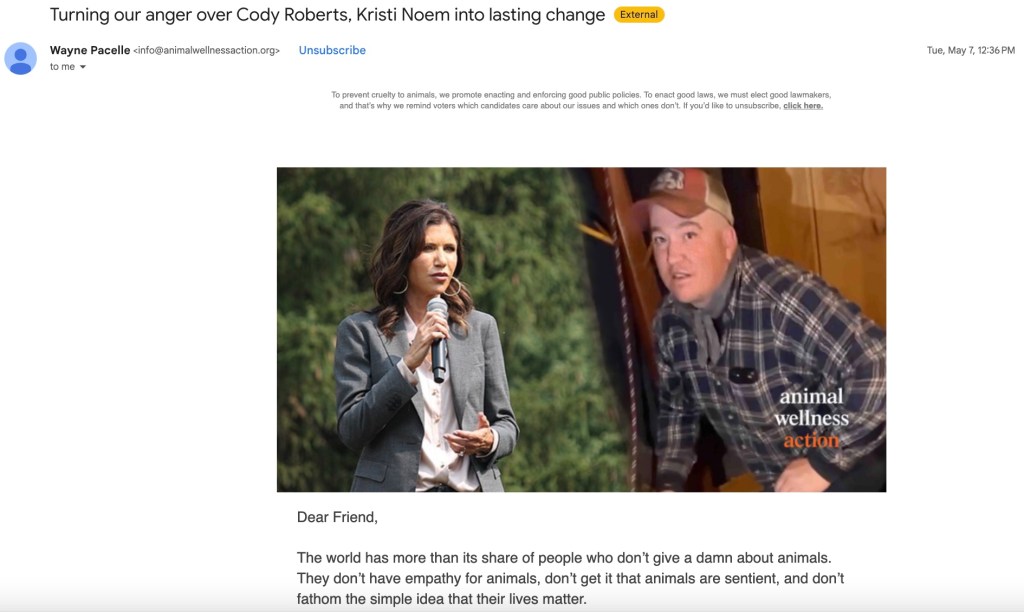
Pacelle’s group, Animal Wellness Action, has also played up the Wyoming incident in its emailed fundraising appeals, though he told WyoFile that he doesn’t agree that wolves are a moneymaker.
“I never viewed [wolves] as a great fundraising issue,” Pacelle said. “In fact, when we sued in the Upper Great Lakes, we couldn’t get any of the national groups to even join the lawsuit.”
That 2014 Humane Society lawsuit resulted in Minnesota, Wisconsin and Michigan losing jurisdiction over their wolves, which were designated as “threatened” under the Endangered Species Act.
A decade later, Pacelle pointed toward the Sublette County incident as his motivation for joining another lawsuit that challenges whether Wyoming, Montana and Idaho should have jurisdiction over their wolves.
Meantime, there’s also legislation that would ensure the states retain control. U.S. Rep. Lauren Boebert’s (R-Colorado) “Trust the Science Act,” which would delist wolves across their range in the Lower 48, narrowly passed the House, though it’s unlikely to succeed in the Senate. Several of the groups WyoFile interviewed were lobbying against it.
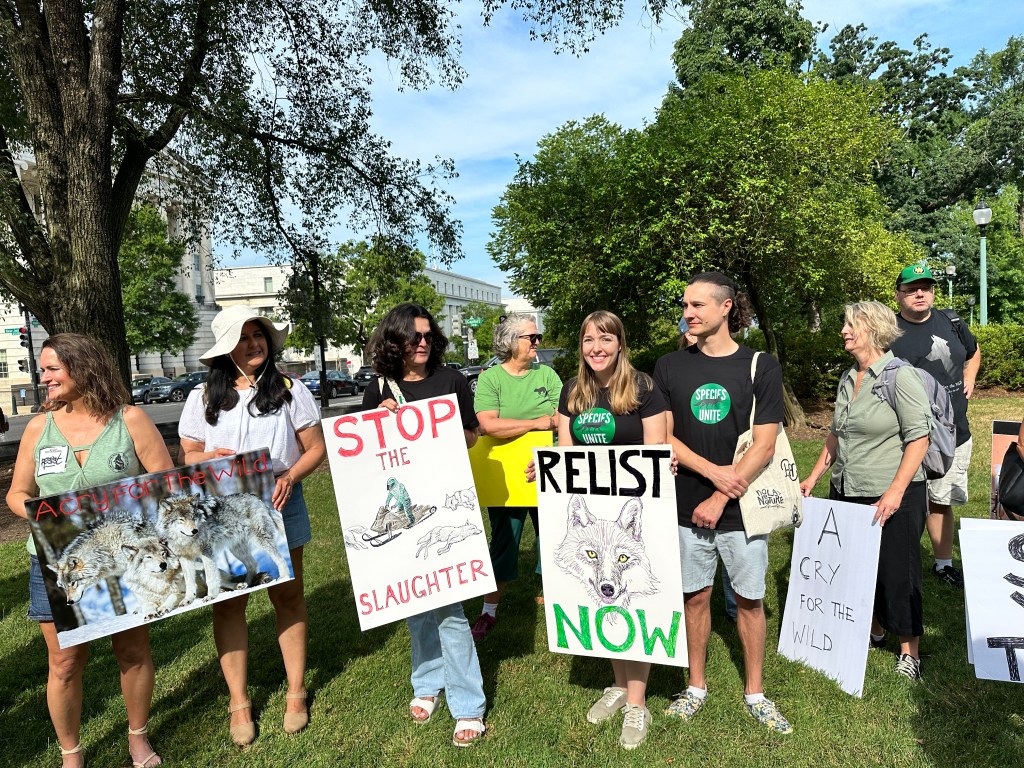
Dagny Signorelli, the Wyoming representative for Western Watersheds Project, traveled to D.C. last week and took time to meet with congressional staffers. She did so separately from Ficara, Klein, Combs and Tomasula, and pointed out there are differences in the groups’ approaches to advocacy.
“While Wyoming Wildlife Advocates and the Wolves of the Rockies are taking on a collaborative approach, that isn’t the space that WWP holds,” Signorelli said of her employer, known for its hard-line tactics.
Signorelli was also one of about 150 people who attended the rally last week. All were passionate, she said, and many of the attendees had a direct life connection to wolves.
“There’s a lot of people whose livelihoods depend on wolves being present,” Signorelli said. “Seeing all these people come together reinforces my belief in the power of collective action.”
Jackson resident Lisa Robertson, who founded Wyoming Untrapped, was among the outraged activists gathered in D.C. It was her first trip to the nation’s capital, and like other Wyoming residents, she spoke to congressional staffers, attended the rally, and demonstrated near the U.S. Capitol building.
“I was just taken by the whole spirit of it all, being there,” Robertson told WyoFile. “It was maybe the first time we’ve been [in D.C.] to speak for wolves in Wyoming, and it felt good.”


This was a stupid act by a person who hates wolves that shouldn’t have been allowed in Wyoming in the first place! Interesting that some people give more attention to a wild animal than to unborn babies! We spend more money on feral horses than we do Veterans in some cases!
A scenario that comes to my mind is when a driver accidentally hits a small animal, say a raccoon or fox, but the animal isn’t dead and is suffering, and the driver doesn’t have a weapon to finish it off. Sometimes using your vehicle to intentionally and quickly put it out of it’s misery is the only realistic option. Should that be a felony?
The operative word used is accidental. There was absolutely nothing accidental in the actions of Mr. Roberts.
So glad to see this effort on a federal level. The State obviously will not do much. The “Select Committee” appointed to examine this issue will not touch the “sport” of killing predators by purposely pursuing them with snowmobiles and other motorized vehicles and running them down. This is cruel, unethical, and should not be tolerated.
No, all politicians involved were adamant about protecting their favorite family activity of Chasin’ Fur or “Yote Whackin”.
Rob Wallace, who oversaw the U.S. Fish and Wildlife Service and the National Park Service as the Assistant Secretary for the Interior under the Trump administration, said he was “sickened” by the photo, which Cowboy State Daily shared with him Saturday morning.
“This is awful,” Wallace said from his Teton County home. “Wyoming represents the best in wildlife stewardship and this is a sad and disgusting outlier.”
“In no way do I believe this represents who we are as a state,” he added.
Problem identified, simple fix,eh?
It’s taking a bit of a liberty to focus on fundraising to protect wolves implying it’s about money. The last time I checked, you needed funds to lobby for wolves, spend the time protecting wolves, paying ranchers for any losses due to wolves, and on and on because on this planet, everything we do takes money. The gun lobby for instance fundraises and uses plenty of money to get what they want so why imply these groups are in it for the money? Wolves should be protected by the Endangered Species Act so we wouldn’t have to spend so much time and money stopping deranged psychopaths from killing them wantonly.
A scenario that came to mind was this: Let’s say that you are in a truck or some other conveyance (snowmobile, etc.) and just ahead you see a bear or wolf about to attack your child or someone else’s child or a fellow adult citizen. If you have no other weapon at your disposal, then running the bear or wolf over with your vehicle might be the only way to prevent the attack and save human lives.
Animal cruelty is certainly wrong and even a five year-old human knows this. Given that the objection seems primarily to be the low fine given for the obvious act of cruelty committed against the wolf in this case, it seems more logical for these out-of-state activists to push for stronger fines rather than to make such acts a felony.
One major issue that this case raises that I think we should all take notice of are the lobbying activities of the myriad 501(c)3 non-profit groups. I would support a law that says that our Senators and our Congressmen/women cannot meet with lobbyists of any kind but instead shall devote their time to listening to the citizens of their respective districts and state. Most organizations that hide under the guise of charitable groups are just political lobbyists. We could do a great deal of good for ourselves and our Republic by restricting the political lobbying of such groups and reforming the qualification for 501(c)3 status to those true charities who directly provide food, clothing, shelter and medical care (not counseling) to the indigent population.
Many people have gone to too much trouble to restore Wolves to Yellowstone and it has cost alot of money to bring them back into that environment. Something MUST be done to protect them and keep the Yellowstone Wolf project moving.
Wolves belong!! They are a native species. CATTLE ARE NOT!!! It’s time to turn the tables against welfare ranchers free grazing on OUR public lands!!! BTW: TEXAS is the MAIN beef producer of the USA. Leave our wild mustangs alone & stop the torture of ALL our wildlife for CATTLE!!
Are the Feds now wanting to claiming sovereignty of all States wildlife on federal land?
Wildlife on public lands are considered public domain. By law it belongs to all American citizens, not the state.
Meanwhile, the folks at the Green River Bar are still yukkin’ it up. Pretty cheap laughs for a measly $250 fine.
These activists aren’t thinking strategically. There’s no way this proposed bill will make it through the GOP/Trump controlled House. On top of that, it doesn’t solve the problem (see below). And quite frankly, even if it were passed, it’s unenforceable. Finally, thanks to SCOTUS overturning Chevron, our ability to call on federal law to solve our local and regional conservation and environmental problems is rapidly declining.
I’ve argued time and time again to various activists that the problem with wolves in Wyoming is the political control that the livestock industry has over wildlife management. The key log to dislodge is figuring out how to break that control. That’s why I think things need to start with getting rid of the predator zone, probably with a state public trust lawsuit, and build from there.
A possible felony for hitting a rabbit or ground squirrel darting across the highway?
We know what the problem is. We are working on it.
Heartbreaking assessment on the state of Western culture that we need a Federal law making it illegal to run down wildlife on a motor vehicle. Seems an implied part of life as a human being.
This gets more idiotic by the day. If you want to get rid of stupid actions, start with taking alchohol off the market. The idea that the food (meat) producers have to pay the price of having a lot of wolves to entertain those who have no cost at all, but all of the say, is really dumb.
Alcohol is not the problem.
Plenty of people who choose to be cruel don’t drink it.
That control by Cattleman is not limited to wyoming, they have control of the whole West which is why they must be stopped.
The American people have been paying for the preservation and upkeep of public lands in every Western States for decades, and yet we don’t have a say anymore.
It’s the saddest thing to me the American people don’t realize their blindness is destroying our country and world. Species go extinct everyday in all parts of thr world right under our noses.
Indeed!
Marion, while I appreciate you voicing your opinion, once again I respectfully disagree with your statements. Everyone has a stake in this. Cody Roberts was not a rancher protecting his domestic livestock. Every federal taxpayer subsidizes grazing allotments on federal land. Therefore they too need to be considered stakeholders. Do I think that a rancher has the right to protect their investment in domestic livestock, absolutely…..does that include being able to run down predators, no. Personally I don’t believe that Wyoming needs a “predator zone” Ranchers will deal with livestock depredations, either thru SSS or thru county, state or federal programs. There is no vaccine against stupidity, and unfortunately there is a healthy dose of people who could use some. Brains, that is!