

Losing a job in journalism can be soul-crushing. I know because I’ve lost a couple.
Opinion
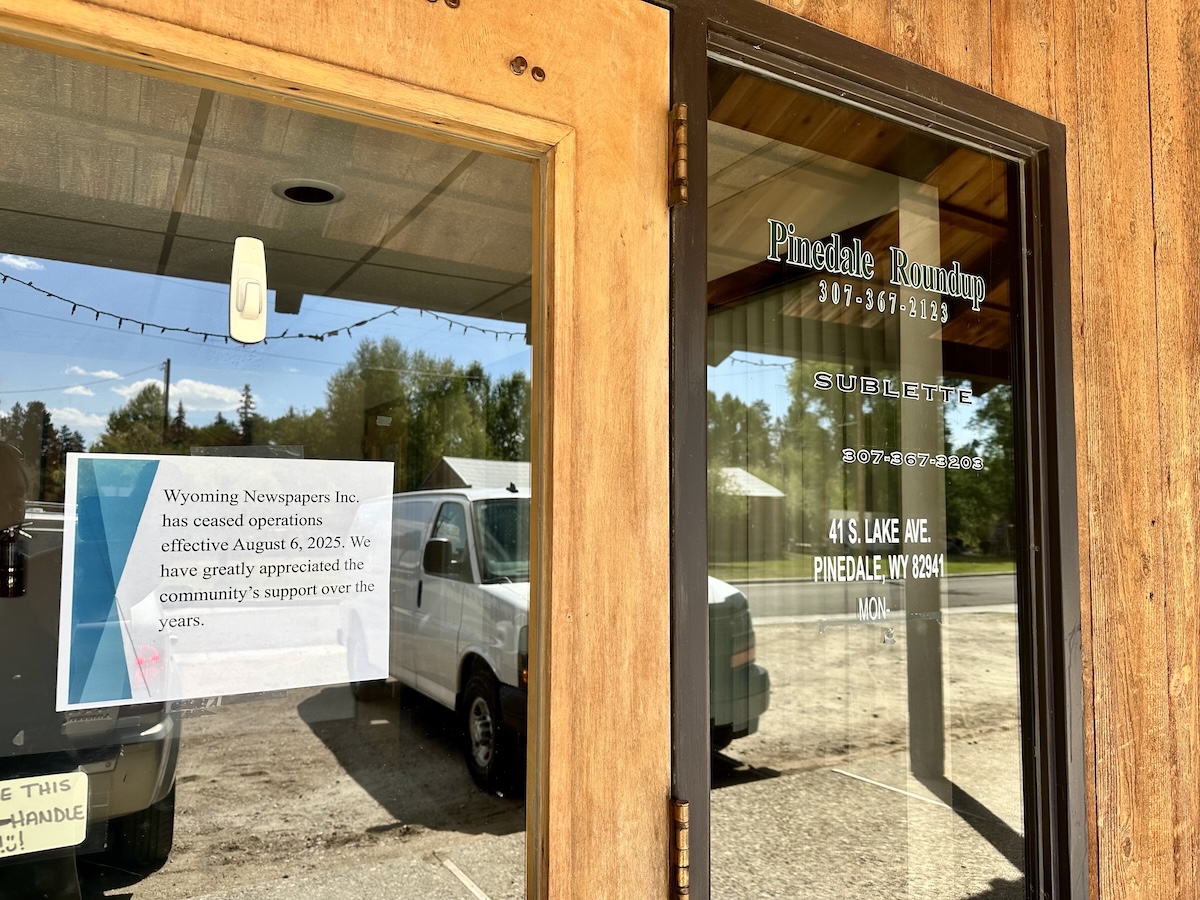
When I read that eight local newspapers in Wyoming closed without warning last Wednesday, my thoughts immediately turned to the well-being of reporters and editors who saw their world spin out of control through no fault of their own.
It’s telling that when other journalists sought their reaction, these professionals suddenly experiencing the loss of paychecks and health insurance focused on how their layoffs will impact their readers and communities.
Evanston, Guernsey, Kemmerer, Lusk, Lyman, Pinedale, Torrington and Wheatland experienced a dramatic decrease in local news when the Illinois-based News Media Corporation — now there’s a generic name! — shut down its papers here and in four other states. Some journalists learned of their fate right before they were to print their weekly edition, so presses didn’t roll.
Cali O’Hare was managing editor of the Pinedale Roundup, which started publishing 120 years ago. “We’re going to see what we can do to fill the gap here in Sublette County to ensure that our community still has access to factual, reliable news, because we just can’t stomach the idea of just being OK with the news desert here,” she told the Wyoming Tribune Eagle.
There may be help coming that could allow some of the newspapers to reopen, but nothing was certain as of Sunday. O’Hare said a potential Roundup buyer has been found, and another group is reportedly interested in reopening the Platte County Record-Times, Torrington Telegram and Lusk Herald. But News Media Corporation has, according to sources involved in the situation, yet to respond to any offers.
“Most of us are concerned about the community,” Marie Hamilton, a reporter for the Record-Times and the Guernsey Gazette, told Cowboy State Daily. “These are our people. This is our home. It’s an honor of a lifetime to work in a rural community.”
What will readers do without their local paper? “Without us being the watchdog on a couple of boards here, what’s going to happen?” Hamilton replied. “How many more secret meetings are going to happen because the papers are down?”
More than one-third of the nation’s local newspapers have closed since 2005, typically shrinking newsrooms to a few employees and cutting costs to the bone before finally shutting the doors.

There is a whole body of research aimed at finding out how the issue is affecting residents and institutions like local governments. I like how comedian John Oliver once framed the issue on his “Last Week Tonight” TV show: “Not having reporters at government meetings is like a teacher leaving her room of 7th-graders to supervise themselves.”
“When police brutality spikes, when welfare offices deny claims, when local officials divert funds — these are the moments when communities need their journalists the most,” writes Abby Youran Qin in the Milwaukee Independent.
Without journalistic scrutiny, Qin adds, “scholars find that mismanagement flourishes, corruption costs balloon, and the communities most vulnerable to abuse receive the least accountability. This is how news deserts exacerbate inequality.”
Newspapers are critical for informing the public about political candidates and their beliefs.. Without that information, voters may stay home on election day — or go to the polls unprepared.
Newspapers are also essential for keeping residents informed about the policies mulled by their local governments. Without them, people may not know about a controversy until it’s already been decided. Without a paper’s opinion section, there are no letters to the editor, commentaries or forums, and the public becomes less empowered and less able to influence public policy.
Way back in 2011, the Federal Communications Commission had a bleak forecast in the wake of then-unprecedented newspaper closures: “More government waste, more local corruption, less effective schools, and other serious community problems.” It’s all happened.
Researchers at the University of Notre Dame and the University of Illinois at Chicago examined the impact of local newspaper closures on public finance. “Local newspapers hold their governments accountable, keeping municipal borrowing costs low and ultimately saving local taxpayers money,” the study found.
Here’s a non-economic cost: Who will continue the legacy of reporting the history of towns like Lusk, where the Herald has been published since 1886, four years before Wyoming Territory was granted statehood?
It’s a job done by fewer people since small local newsrooms began cutting employees to keep afloat. The Pinedale Roundup absorbed the Sublette Examiner, then O’Hare became the only employee when the owner laid off two reporters.
In a Wyoming Public Radio broadcast last October, Melodie Edwards profiled O’Hare and her difficulties covering a story that made international headlines. A man brought a muzzled, injured wolf he’d run over with a snowmobile and paraded it through a Sublette County bar before killing it.
While out-of-state reporters were parachuting in to capture the local flavor and quickly departing, O’Hare’s job was infinitely harder. Other journalists didn’t have to deal with county officials, who are also her neighbors, pressuring her to stop reporting the story, which she related to Edwards.
O’Hare’s reporting helped shape local and state opinion, including legislative discussions that culminated in a new offense for torturing, tormenting, mutilating or causing undue suffering to wildlife — including predatory animals and birds — that have been taken into possession.
Edwards ended her story with this observation: “While lots of other papers publish more and more press releases and national stories, [O’Hare] planned to keep writing original, locally-focused stories. That means the Pinedale Roundup won’t become a ghost paper anytime soon.”
But that’s precisely what happened less than a year later in eight Wyoming towns.
Local governments will be far less accountable. Fewer people will vote, and the newspapers that gave the public a voice have been silenced. Corporate journalism is beholden to out-of-state owners like News Media Corporation, not people who worked for them — and certainly not the public.
These are tense times for all American newspapers trying to hold on, particularly small operations in rural areas. I hope new offers will be accepted by the Illinois owner and presses can roll again. But until that happens, the best contribution Wyomingites can make is supporting local papers across the state any way they can.

Here in Laramie, the purchase of the Laramie Daily Boomerang by an out-of-state private equity firm has destroyed government accountability. The paper’s one half time reporter misses important stories and cozies up to city officials, never critiquing what they do. Sad to see this happening elsewhere.
Just as I begin reading your column, my phone received a message from WyoFile that somebody is going to buy the newspapers and start them again. The Magic of the internet. It’s really great.
As I sit here dictating to my phone, as opposed to using the tiny keyboard to
Type a response , I realized what an important item local news is, and it would be a tragedy for it to be shut down.
Truthfully, I really haven’t read a newspaper since you left the tribune eagle in CHEYENNE. I had a subscription to it until you left and really enjoyed looking through it.. but your article pointed out a lot of important things that the newspaper does that I had forgotten about.
Also, I really enjoyed reading the comic strips and the Sunday comics.
With all the nasty politics going on in Wyoming, the US and the world we still good need honest reporting.
I don’t read much on the Internet, mainly because of all the biases. Truthful and unbiased reporting is the thing of the past on the Internet and hopefully the reopening of these papers will help keep honesty and integrity number one
Speaking of honest and integrity, I’m not sure WyoFile know this, but if I open WyoFile on my phone, I can’t respond to the articles or your opinions without hitting the donate button. I don’t have a computer so I have no idea if it’s just the app or if it’s something else. Which knows it might be my phone
Hopefully somebody can explain this to me, if not, I can still go WyoFile Drake
And find your opinions.
well, P.O.L. is alive and well, but this demonstrates if you are a small business, be darn careful with who you cuddle up . ie: .parable of frog and scorpion
Great job, Kerry! As you noted, these closures are happening all across the country. I’ve heard Portland OR no longer has a local newspaper. I’ve heard The Times Picayune in New Orléans shuttered. Most towns and cities used to have both morning and evening papers and even Extra editions when news broke—watch almost any movie from the 1930s–1950s (cf. Casper’s Morning Star and Natrona Tribune becoming the Casper Star-Tribune). With the growth of the Internet and social media, many papers began losing readership. When regional and national holding companies began buying up local papers, the cut investigative journalists who covered local news. Instead they ran national pieces from Reuters, AP, etc. Then came the closures. Local news disappeared. With the press being the only non-government profession named in the U.S. Constitution, this does not bode well for an informed citizenry. Remember, all politics is local!
Unfortunately in my post above I left out the tyranny of the algorithm that will lead the seeker into a clickbait rabbit hole of somebody who feeds dis/misinformation that some evil clown uses to sell the seeker some cheap crap that s/he doesn’t really need, or even want (but they’re seduced into it). A local newspaper usually prints information (as opposed to dis/mis-) and local advertising allows the seeker to support local businesses owned by their neighbors.
When he heard this news, a retired Wyoming newspaper publisher said by his reckoning the residents of five counties in Wyoming no longer have all-important Legal Notices published by a newspaper of record.
That’s ominous.
Thank you for posting this essay. Factual, concise and easy to read.