

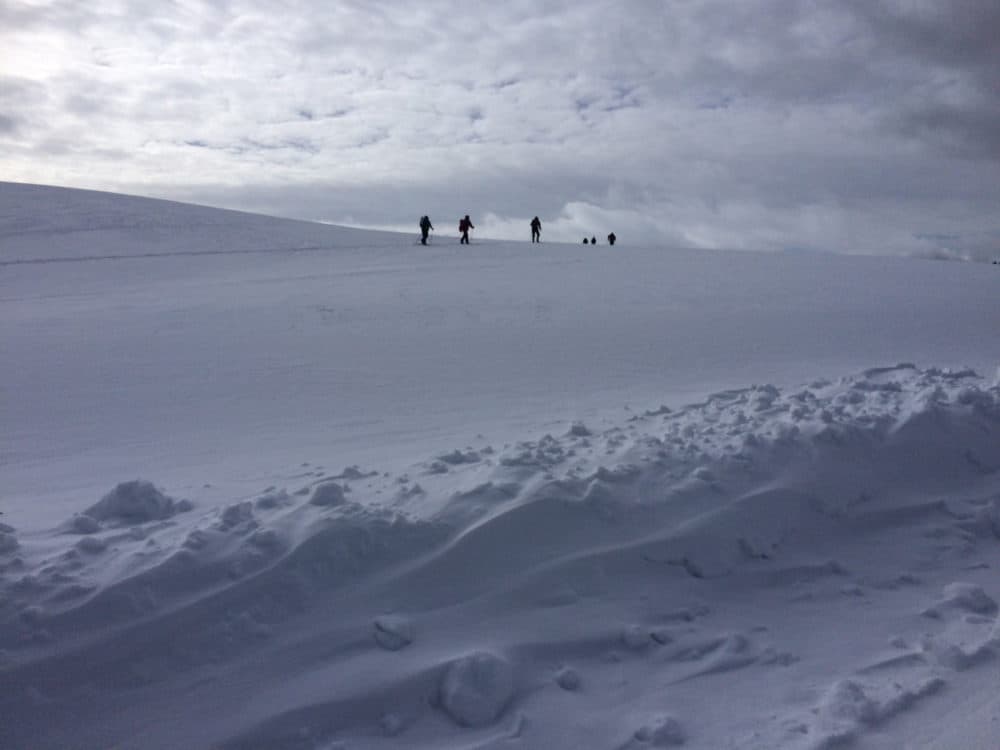
Winter is getting shorter in Yellowstone National Park.
In 30 years, snow will retreat from West Yellowstone, Montana, by mid-April — up to three weeks earlier than it lasts in the area today, scientists say. The road between the town and Old Faithful will be able to support snowmobiles and snowcoaches only 40 percent of the current winter-seasons days, according to predictions.
The changes could transform the park’s landscape.
To understand what scientists are seeing in Yellowstone, it’s important to note the difference between climate and weather, said Ann Rodman, a GIS specialist with Yellowstone National Park and one of the scientists analyzing weather data to understand the park’s climate.
Weather is variable. A cold snowy winter one year may precede opposite conditions the next year. But over 30 years or more — the timeframes that Rodman and other park scientists consider — such year-to-year volatility evens-out and patterns emerge. These long-term conditions describe an area’s climate.
The data show that in the last 30 years the park has been getting less snow, it has been falling and accumulating later in the year and melting earlier.
Despite a strong snowpack this year — in many places it’s well above average — the long-term trend is toward a decrease across the ecosystem, Rodman said. The snowpack also is melting faster with warmer spring temperatures. In years where there is a lot of snow in the mountains, the warm temperatures can cause flooding earlier than people expect.
The number of days snow covers the landscape varies each year, but overall, that also is decreasing. The northeast entrance of the park has snow on the ground about 35 fewer days, on average, than it did 45 years ago.
The relative lack of snow affects the drainages fed by Yellowstone snowmelt.
“That affects a whole lot more than just the ecology in the park,” Rodman said.
If water enters the system as rain, or the snowpack melts rapidly, late season droughts can occur, even if there is a lot of water early in the year.
The park also is experiencing fewer extreme cold snaps where temperatures drop far below zero for a week or more. In mid- and high-elevation areas, temperatures often drop to freezing on summer nights; but those occurrences, too, are less frequent.

Fewer days between the first and last frosts is leading to a longer growing season in the park. In some places the window is 30 days longer than it used to be, Rodman said.
Such conditions are a boon to invasive species, like cheatgrass, which is notorious for taking advantage of early season moisture to propagate, Rodman said.
“Early season invasives are doing better and better and in many cases are able to outcompete our native plants,” Rodman said.
Invasive plants, including cheatgrass, already are found in Gardiner, Montana, just outside the north entrance of the park.
“If [cheatgrass] got into the Lamar Valley, you could lose that battle pretty quickly,” Rodman said.
Park staff is working to keep invasive species out. They’re emphasizing reclamation after construction in the park and stockpiling native plant seeds.
“We can’t just assume [native species] will come back on their own [after a project] and we’ve taken an active role to manage it,” Rodman said.
It’s hard to know what impact the changes in Yellowstone will have on wildlife and the landscape.
Early season floods could wash away bird nests near waterways. Warming temperatures could cause problems for coldwater fish. Earlier snowmelt means an earlier spring green-up and ungulates could be left without enough forage later in the summer. A dry landscape late in the summer is primed for forest fires, which introduces a whole new set of ecological impacts, Rodman said.
Never miss a Peaks to Plains. Subscribe to our free weekly newsletter.
“How individual plants and animals are going to react — we just don’t know,” she said. Comparable climate shifts in the Earth’s history took place over thousands of years, not 100.
“Nobody really knows how things are going to react in that short time frame with those changes,” Rodman said.
The changes mimic other climate data from across the West.
“When we first started looking at this data, I was amazed and pretty shocked,” Rodman said. “Usually when you are graphing data, you don’t see an almost straight line in one direction. But after spending a few years looking at it and talking to other people, this is just what’s happening everywhere. Everybody is basically finding the same thing.”

I grew up in Idaho Falls in the 1950s and ’60s. I remember those long winters. Global heating, climate change, whatever you want to call it is changing the Rockies. I don’t like the big wind farms but they’re preferable to this.