

I outlined my Wyoming adventure goals for 2017 in the first Peaks to Plains column of the year. Like most people, I am terrible at New Year’s resolutions. But I had a sense that 2017 would be different. Unlike my typical collection of annual to-dos — difficult tasks that are no fun to tackle — my outdoor resolution list was an attempt at whittling down the long list of “I shoulds” and “I’ve always wanted tos.”
It included exploring the Red Desert, largest unfenced area in the Lower 48; backpacking the famous Teton Crest Trail, known for its never-ending views; climbing Bomber Mountain with its remnants of a crashed B-17 and scaling Cloud Peak, the tallest peak in the Bighorn Mountains.
Turns out these are the types of resolutions I can keep.
In June two friends and I set out on bikes across the Northern Red Desert. We took in the landscape’s most famous sites, such as the Oregon and Honeycomb buttes, before ending at Boar’s Tusk.
I spent four days in August on the Teton Crest Trail. It lived up to the hype. A new jaw-dropping view appeared around every bend.
That same month, I hiked into the Bighorns. While I didn’t climb the two peaks I’d come to summit, I arrived home thinking of the trip as a success.
It was a year of adventure, and not just for me. People in Wyoming know how to get after it and Peaks to Plains came along for the ride.
Devin Butler attempted to measure the mysterious Blackwater Natural Bridge, and in the process introduced many of us to a little-known natural wonder that has thwarted many explorers.
A record fell in the Tetons when Jake Urban, Meredith June Edwards and Jason Schlarb made what is believed to be the first double car-to-car ascent of the Grand Teton in a single day on July 21. A couple of weeks later Ryan Burke ran up and down the 13,775-foot peak three times in a day.

People in Wyoming have always taken their recreation seriously, but recently its importance has gained notice beyond who climbed what the fastest and whose fish was biggest. The state’s recreation economy received fresh attention in 2017. One study showed recreation accounted for 50,000 jobs in the state. Another, commissioned by the Pew Charitable Trusts, looked specifically at quiet recreation, and said hikers, bikers and others participating in non-motorized recreation spent more than $27 million in southwest Wyoming in 2015. In yet another study, the Center for American Progress gave Wyoming a ‘D’ on its outdoor recreation report card.
A recreation task force created by Gov. Matt Mead acknowledged the importance of recreation to the state’s economy and looked for ways to help foster it.
People’s passion for outdoor recreation showed as they commented on separate proposals to charge mountain bikers fees, allow bikes in wilderness, and updated management plans, such as the recently proposed Shoshone National Forest travel plan.
2017 was also a year in which Wyoming’s outdoors received national attention on some issues, such as the report documenting sexual harassment of Yellowstone National Park employees and the park’s plan created in response.
Never miss a Peaks to Plains. Subscribe to our free weekly newsletter.
Wildlife and wildlife management made headlines as well.
The death of two dogs by cyanide bombs spurred efforts to ban the controversial predator-control devices.
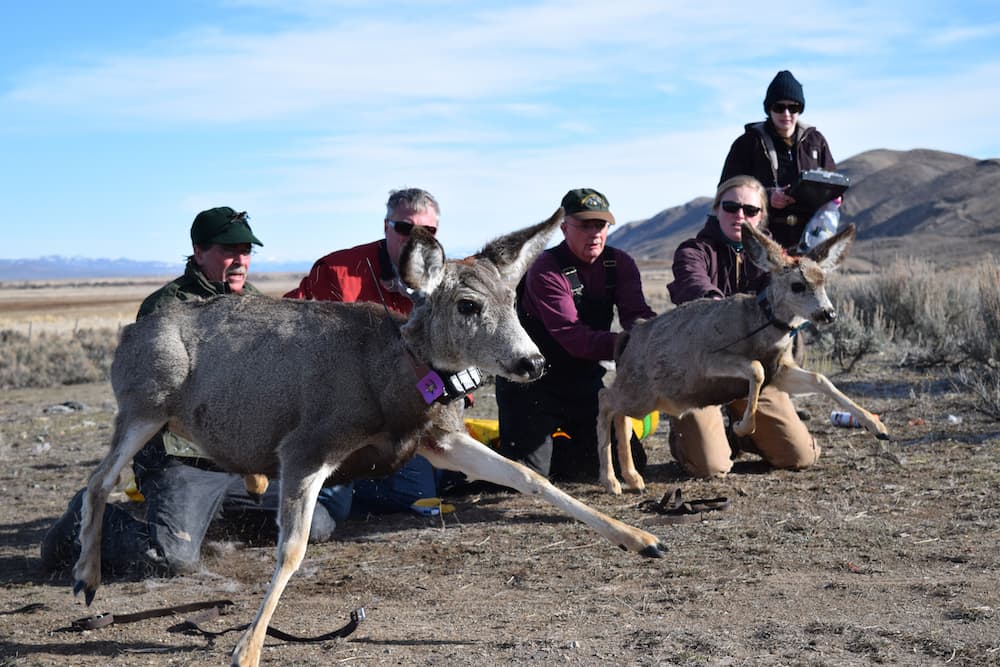
Frigid temperatures and deep snow killed an unusual number of wildlife in early 2017. Researchers, who had collared mule deer in the Wyoming Range for an ongoing study, turned the mass winter-kill into an unprecedented opportunity to study how a herd recovers from such devastation.
It was a year of wildlife studies, around the state. Researchers tracked wolverines and measured the problem-solving abilities of raccoons. Scientists tracked long-billed curlews from Wyoming to Mexico, adding to data that will eventually map the entire species’ migration paths.

On the heels of the federal government removing grizzly bears from the endangered species list, researchers used modeling to identify which paths bears from the Yellowstone and Glacier national park populations might one day use to mingle.
Research wasn’t confined to the living. Archaeologists unearthed information about ice-age plants and animals from Natural Trap Cave in the last year of planned excavation work at the site. Microfauna remains will help scientist discover how environmental changes impacted animals that lived near the cave thousands of years ago. Studying pollen preserved in the cave allowed Thomas Minckley, with the University of Wyoming, to reconstruct thousands of years of plant life.
I’ve written Peaks to Plains weekly for five-and-a-half years and I’m still amazed at the new things people discover and the new physical feats people accomplish in Wyoming. Just when it seems like everything’s been climbed, conquered and documented, someone finds a new route, goes a little faster or a little farther, or unlocks a puzzle that deepens our understanding of the landscape, wildlife and people who call Wyoming home.
I can’t wait to see what 2018 brings.

helicopter skiing for ms. Dayton?